Maharashtra State Narcotics Control And Drug Free Policy Target
Source:deccanchronicle ↗
Why It Matters
Important for MPSC aspirants tracking major policy decisions, governance targets, and state-level social welfare missions of the Maharashtra government.
Summary
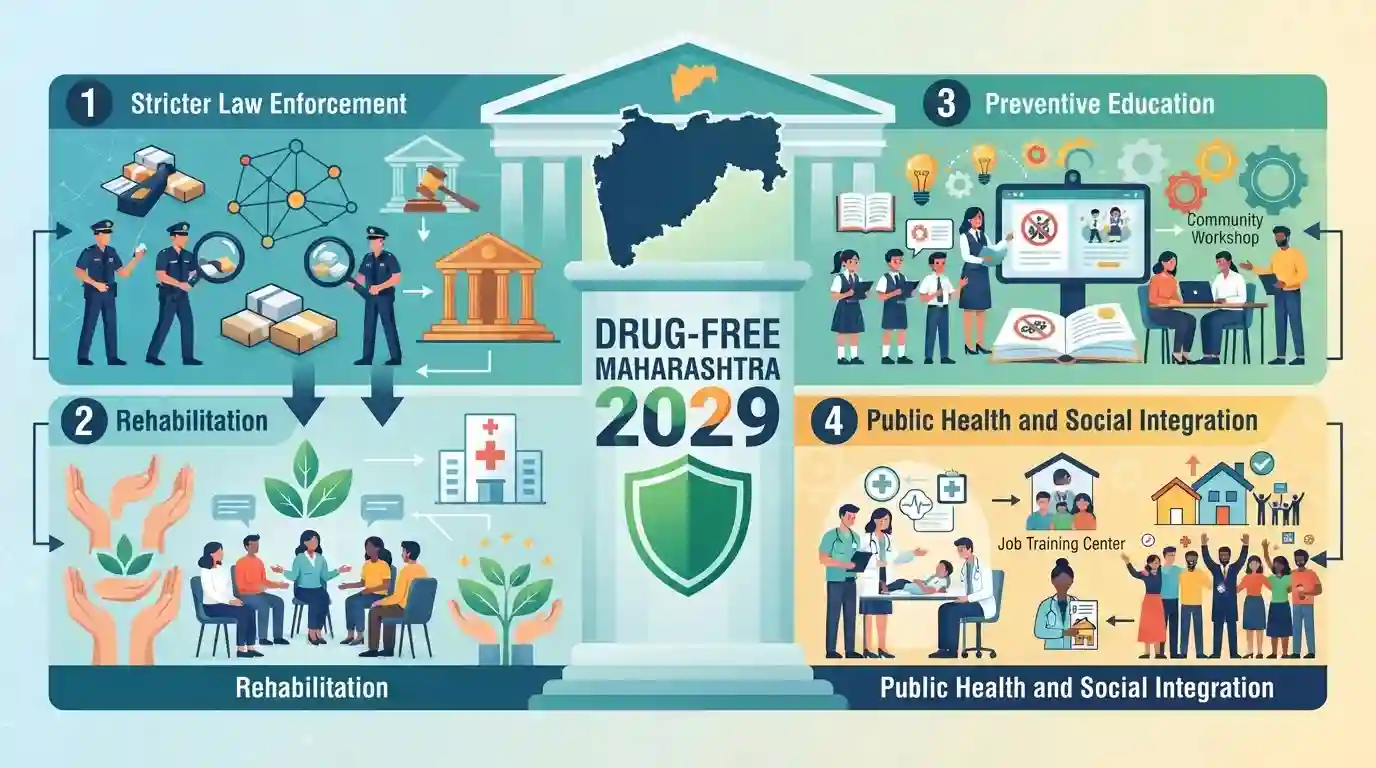
The Maharashtra Cabinet approved a comprehensive action plan targeting a drug-free state by 2029, emphasizing stricter law enforcement, rehabilitation, and preventive education across public health and social sectors.
Key Points
- The Maharashtra Cabinet has approved a strategic roadmap aiming to make the state drug-free by the year 2029.
- The initiative involves multi-departmental coordination focusing on supply reduction, demand reduction, harm reduction, and strict enforcement of anti-narcotics laws.
- Emphasis is laid on community awareness, rehabilitation centers, and specialized police tracking networks to curb substance abuse.
Important Terms
Maharashtra Cabinet

The highest executive decision-making body of the state government, headed by the Chief Minister, responsible for formulating state policies, administrative actions, and legislative agendas.
UPSC context
Important for MPSC Polity and Governance (State Executive), testing understanding of executive powers, cabinet decisions, and policy formulation in Maharashtra.
Government of Maharashtra
The executive branch of the state government of Maharashtra, consisting of various departments functioning under the constitutional framework to govern the state and implement laws and welfare schemes.
UPSC context
Relevant for MPSC governance, administration, and current affairs relating to state-level policy execution and public initiatives.
Prelims Trap
Maharashtra's 2029 drug-free target is solely a central government mandate without state-level institutional mechanisms.
Aspirants often confuse central nodal initiatives like Nasha Mukt Bharat Abhiyan with state-specific policy timelines and implementation frameworks like Maharashtra's 2029 roadmap.
Static Concepts Connected
What are the key legal provisions and institutional frameworks tackling drug abuse in India?
- NDPS Act, 1985: Enacted in 1985, it prohibits the production, manufacture, possession, sale, purchase, transport, and use of narcotic drugs and psychotropic substances.
- Nasha Mukt Bharat: Launched in 2020 by the Ministry of Social Justice and Empowerment to tackle substance abuse through mass awareness and rehabilitation in vulnerable districts.
- NCB Mandate: Apex agency under the Ministry of Home Affairs responsible for combating drug trafficking and enforcing the provisions of the NDPS Act.
Cross-Topic Patterns
NDPS Act + State Public Health Policy
Anti-narcotics enforcement requires concurrent action under central and state statutes, notably the Narcotic Drugs and Psychotropic Substances (NDPS) Act, 1985 and state-specific public health mandates.
Whole-of-Government Approach in State Administration
The multi-departmental coordination model mirrors strategies used in holistic state missions like Maharashtra's nutrition or skill development frameworks.

Maharashtra's 2029 drug-free roadmap and ANTF coordination mechanisms are prime targets for MPSC governance & social justice statements.
Linked PYQs · 3
Linked PYQs · 3
- 2022MPSC_PRELIMSGS1
Government of Maharashtra has adopted gender budgeting from the year ________.
- 2018MPSC_PRELIMSGS1
Government of Maharashtra's Sumatibai Sukalikar Udyogini Mahila Sakshamikaran Yojana is related to
- 2026MPSC_PRELIMSGS1
Consider the following statements regarding the Public Distribution System (PDS) in Maharashtra. (a) By December 2025, there were 270.48 lakh ration card holders in the state. (b) As of 31 October 2025, 51,636 Fair price shops were functioning in the state. (c) By October 2025, about 1.55 crore families received food grains through Aadhaar - based biometric authentication. Which of the statements given above is/are correct ?
