Maharashtra Drug-Free State Strategy and Public Health Framework
Source:deccanchronicle ↗
Why It Matters
Important for understanding state-level governance policies, public health initiatives, and drug control frameworks in Maharashtra for MPSC aspirants.
Summary
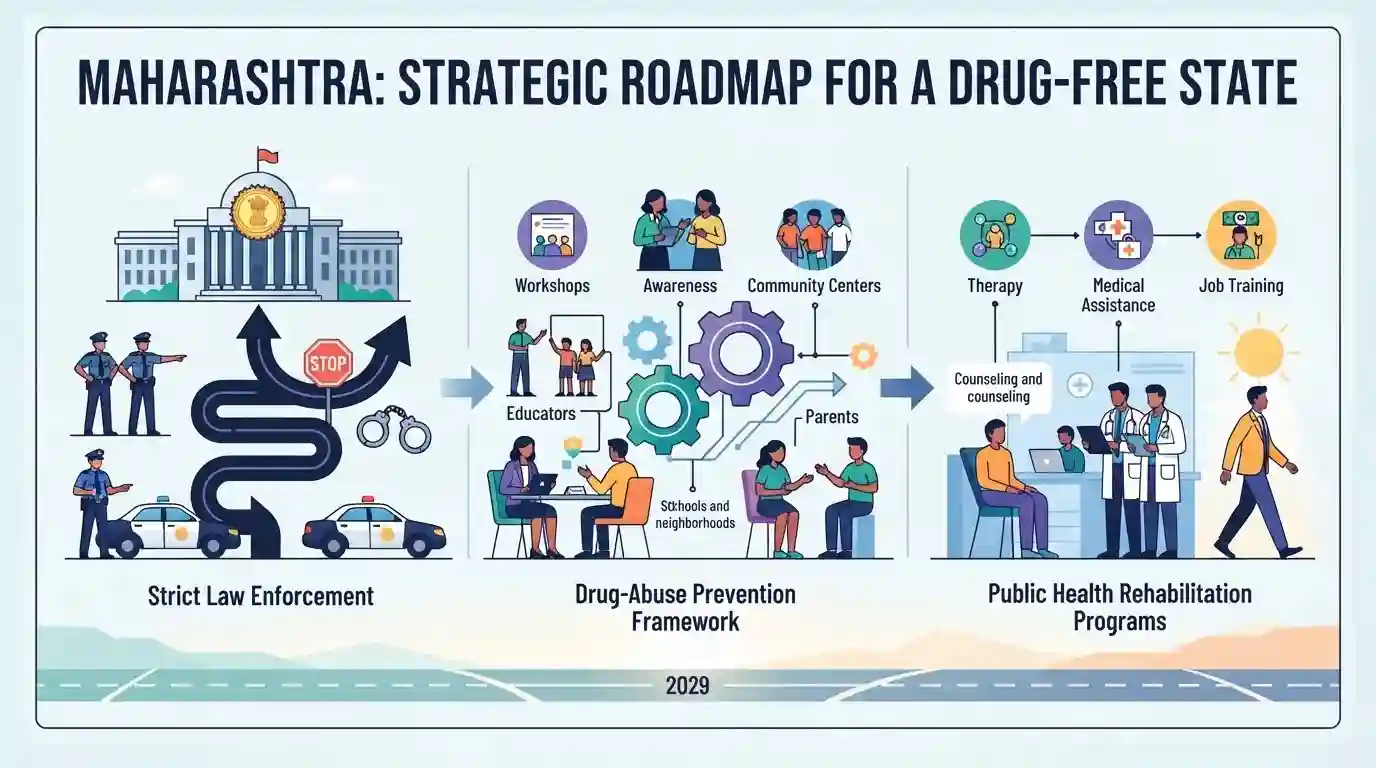
The Maharashtra Cabinet has approved a strategic roadmap targeting a drug-free state by 2029, combining strict law enforcement, drug-abuse prevention frameworks, and public health rehabilitation programs.
Key Points
- The Maharashtra Cabinet approved a comprehensive strategic plan aimed at making the state completely drug-free by the year 2029.
- The initiative focuses on strict enforcement against drug trafficking, rehabilitation of victims, and robust public awareness campaigns across educational institutions and local communities.
- It highlights the state government's policy measures toward public health safety and social welfare governance.
Important Terms
Plan for Drug-Free State by 2029

A comprehensive policy approved by the state government adopting a whole-of-government approach to completely eradicate drug production, trafficking, and consumption by 2029 in alignment with the national Nasha Mukt Bharat Abhiyan.
UPSC context
Important for MPSC Paper II (Governance and Social Sector Schemes), testing state-level policy interventions, public health strategies, and drug-control governance.
Maharashtra Cabinet
The highest executive decision-making body of the state government, headed by the Chief Minister, responsible for formulating major administrative policies, such as the multi-departmental anti-narcotics roadmap.
UPSC context
Relevant for MPSC Paper II (State Administration and Executive Machinery), focusing on executive authority and policy implementation in Maharashtra.
Prelims Trap
The 2029 drug-free roadmap is solely a central law enforcement initiative implemented without state-level department convergence.
Aspirants often assume central schemes like Nasha Mukt Bharat Abhiyan are implemented solely by the Ministry of Social Justice and Empowerment without state-level multi-departmental nodal officers.
Static Concepts Connected
What are the key statutory provisions and institutional frameworks dealing with narcotics and psychotropic substances in India?
- NDPS Act 1985: NDPS Act 1985 prohibits production, manufacture, possession, sale, purchase, transport, and use of narcotic drugs and psychotropic substances.
- NCB Mandate: NCB is the apex law enforcement and intelligence agency under the Ministry of Home Affairs responsible for combating drug trafficking.
- Constitutional DPSP: Article 47 of the DPSP directs the State to bring about prohibition of intoxicating drinks and drugs injurious to health.
Cross-Topic Patterns
Public Health Interventions meets Internal Security
Maharashtra's multi-departmental anti-narcotics roadmap links public health policy (GS-2) with internal security challenges of narco-terrorism and organized crime syndicates (GS-3).

Expect a statement-based MPSC question on the 2029 drug-free roadmap, its four pillars, and Nasha Mukt Bharat Abhiyan convergence.
Linked PYQs · 2
Linked PYQs · 2
- 2018MPSC_PRELIMSGS1
Government of Maharashtra's Sumatibai Sukalikar Udyogini Mahila Sakshamikaran Yojana is related to
- 2024MPSC_PRELIMSGS1
Match the following pairs : | List-I | List-II | |---|---| | (a) Dr. Nitin Karmalkar Committee | (i) For implementation of National Education Policy - 2020 in Maharashtra | | (b) Nitin Karir Committee | (ii) To enquire the incident which happened during the distribution of Maharashtra Bhushan Award | | (c) Sunil Pawar Committee | (iii) To study why the rates of onion collapse. | | (d) Dr. K. Kasturirangan Committee | (iv) To make the syllabus for pre-primary to degree according to National Education Policy - 2020 | Code: (a) (b) (c) (d)
