Maharashtra Budget Fiscal Indicators and Sectoral Allocations
Source:prsindia ↗
Why It Matters
Crucial for understanding Maharashtra's financial health, resource allocation priorities, debt management, and economic policy directions for the fiscal year 2026-27.
Summary
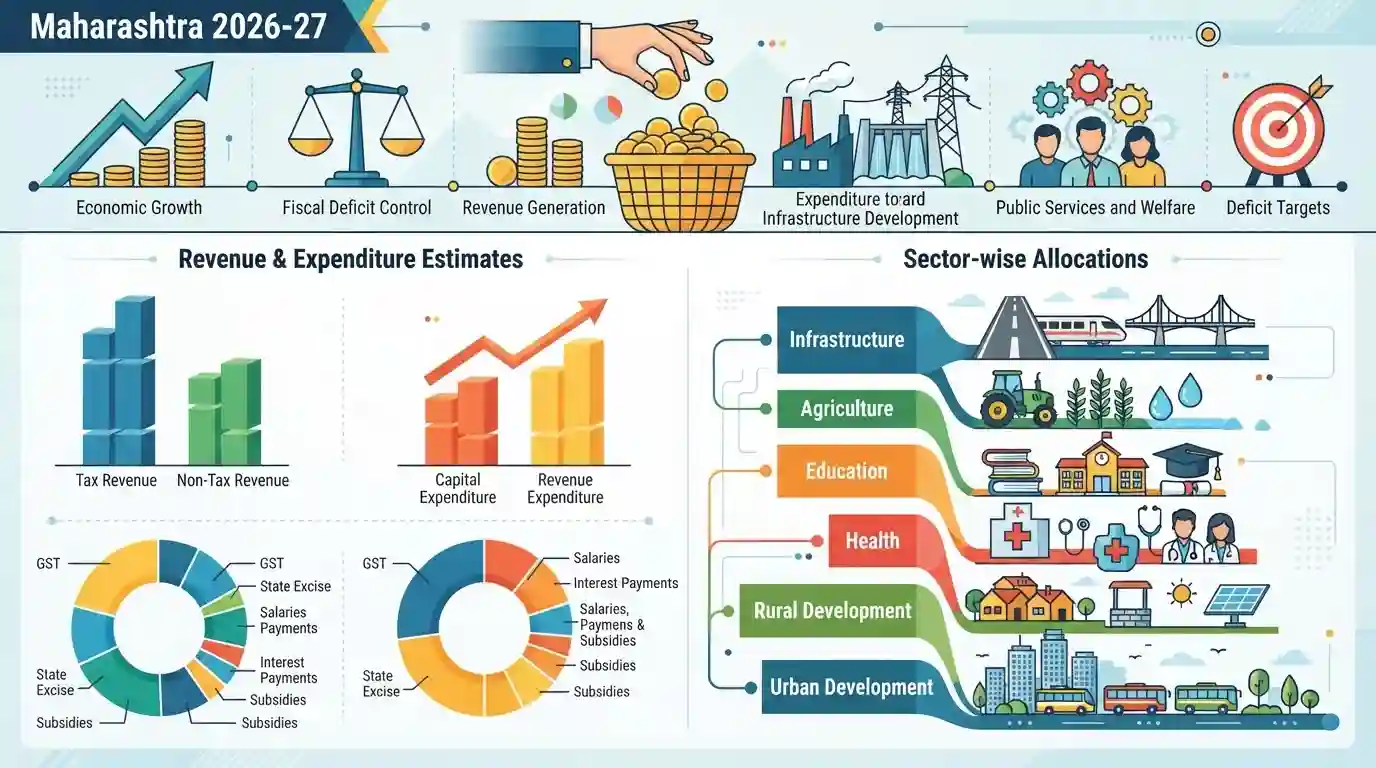
An analysis of the Maharashtra Budget for 2026-27 by PRS Legislative Research, detailing key fiscal indicators, revenue and expenditure estimates, deficit targets, and sector-wise allocations relevant to the state's economy.
Key Points
- The Maharashtra Budget Analysis for 2026-27 provides an overview of the state's fiscal indicators, including total expenditure, revenue receipts, fiscal deficit, and sectoral allocations.
- Evaluates key fiscal parameters such as the ratio of fiscal deficit to Gross State Domestic Product (GSDP) against norms set by fiscal responsibility legislation.
- Highlights allocations towards key sectors like infrastructure, social welfare, agriculture, and administrative services.
- Analyzes tax and non-tax revenue performance alongside capital outlay trends.
Important Terms
PRS Legislative Research

An independent, non-partisan research organization in India that provides data, analysis, and legislative briefs on bills, budgets, and policies to parliamentarians and state legislators.
UPSC context
MPSC Paper II & III / Polity & Governance: Tests knowledge of institutional research bodies supporting legislative accountability and public policy analysis in India.
Government of Maharashtra
The apex executive body of the state of Maharashtra, responsible for governance, formulating public policies, tabling annual state budgets, and steering economic planning.
UPSC context
MPSC Paper II & III / State Administration & Public Finance: Tests understanding of state-level executive functions, fiscal governance, and budgetary allocations.
Prelims Trap
Maharashtra's revenue deficit is targeted to stay within the 3% GSDP ceiling set by the Finance Commission.
Aspirants often confuse Revenue Deficit with Fiscal Deficit limits; under the 16th Finance Commission framework, the fiscal deficit ceiling is 3% of GSDP, not revenue deficit.
Static Concepts Connected
What are the key fiscal indicators and deficit parameters mandated under state fiscal responsibility frameworks?
- Fiscal Deficit: Fiscal Deficit: Excess of total expenditure over total receipts excluding borrowings; capped typically at 3% of GSDP under FRBM norms.
- Revenue Deficit: Revenue Deficit: Excess of revenue expenditure over revenue receipts; indicates borrowing for consumption rather than asset creation.
- Debt-to-GSDP Ratio: Outstanding Liabilities: Total debt burden of the state government projected as a percentage of GSDP.
Cross-Topic Patterns
State Budget + Decentralized Planning (MPSC Polity)
Maharashtra's state budget allocations for irrigation and drought-prone regions intersect directly with the Maharashtra Agriculture Pump Grid and district planning committee decentralization under Article 243ZD.
Finance Commission Devolution + State Fiscal Responsibility
The 16th Finance Commission's 3% fiscal deficit cap for states links public finance management directly with vertical and horizontal devolution criteria.

Maharashtra budget fiscal deficit targets vs FRBM norms will appear as a multi-statement assertion question in Prelims.
Linked PYQs · 2
Linked PYQs · 2
- 2022MPSC_PRELIMSGS1
Government of Maharashtra has adopted gender budgeting from the year ________.
- 2026MPSC_PRELIMSGS1
Consider the following statements regarding the Public Distribution System (PDS) in Maharashtra. (a) By December 2025, there were 270.48 lakh ration card holders in the state. (b) As of 31 October 2025, 51,636 Fair price shops were functioning in the state. (c) By October 2025, about 1.55 crore families received food grains through Aadhaar - based biometric authentication. Which of the statements given above is/are correct ?
