Maharashtra state budget fiscal indicators and public finance analysis
Source:prsindia ↗
Why It Matters
State budgets are crucial for understanding fiscal federalism, resource allocation, and economic performance trends in Maharashtra, making it an essential topic for MPSC Combined Prelims economy questions.
Summary
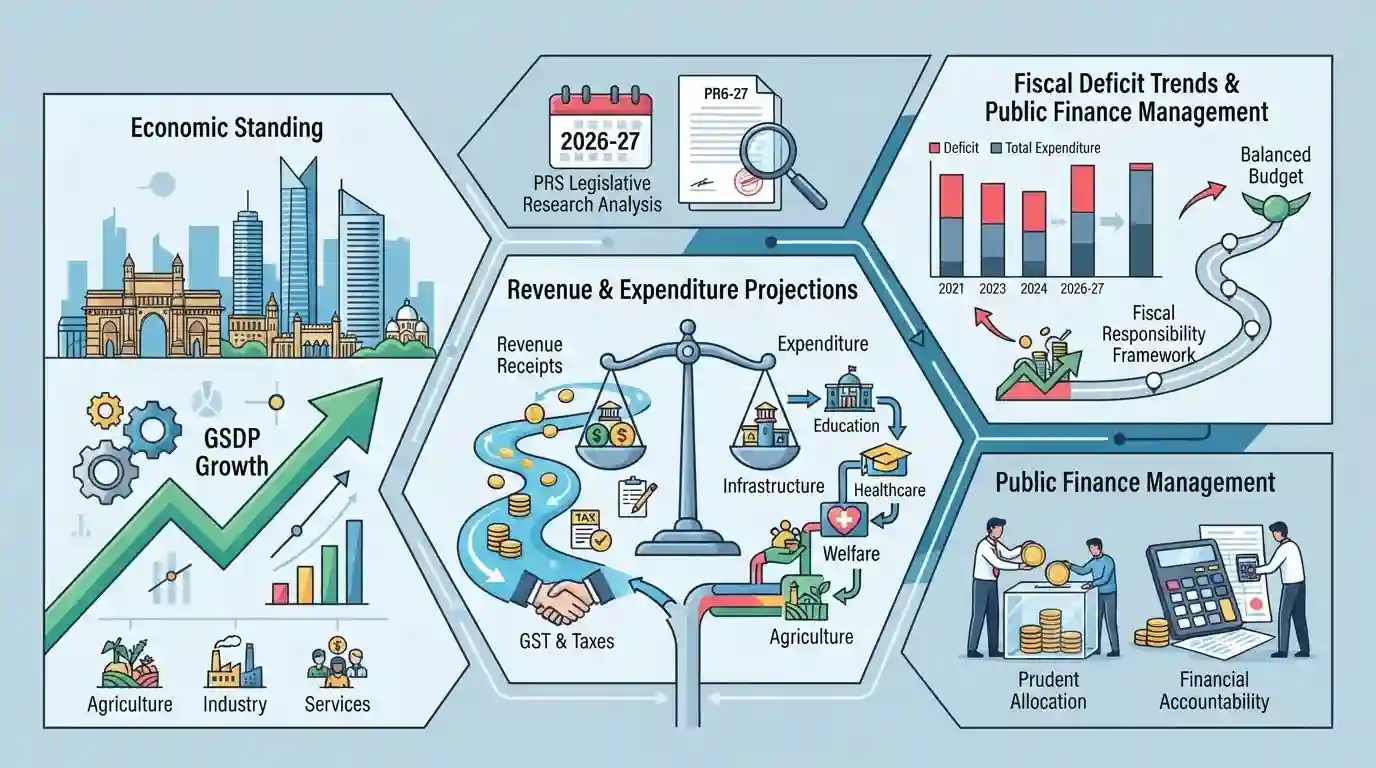
An analysis of the Maharashtra Budget for 2026-27 by PRS Legislative Research, detailing the state's economic standing, revenue and expenditure projections, fiscal deficit trends, and public finance management under the framework of fiscal responsibility.
Key Points
- Maharashtra Budget Analysis for 2026-27 highlights key fiscal indicators including total receipts, expenditure, revenue deficit, and fiscal deficit relative to the Gross State Domestic Product (GSDP).
- State finances focus on resource mobilization, capital outlay allocations for infrastructure, and social sector spending in Maharashtra.
- Adherence to the targets set under the Maharashtra Fiscal Responsibility and Budget Management (FRBM) Act is a critical element of the state's budget formulation.
Important Terms
Fiscal Responsibility and Budget Management (FRBM) Act

A statutory framework governing fiscal discipline, requiring states to eliminate revenue deficits and limit fiscal deficits to targeted percentages of GSDP under specific legislative rules.
UPSC context
MPSC Economy & State Finances: Tests understanding of fiscal consolidation targets, debt management, and statutory limitations on state borrowings.
PRS Legislative Research
An independent research organization that analyzes legislative bills, policies, and state budgets in India, providing clear public data summaries.
UPSC context
MPSC Public Administration & Economy: Essential for analyzing state budget trends, public expenditure, and policy allocations.
Static Concepts Connected
What are the core mandates and deficit ceilings under the Maharashtra FRBM Act, 2005?
- Deficit Ceiling: Mandates capping the fiscal deficit at 3% of the Gross State Domestic Product (GSDP) in normal fiscal years.
- Revenue Deficit: Aims at the progressive elimination of revenue deficits and prudent debt management to ensure long-term sustainability.
- Fiscal Transparency: Requires medium-term fiscal policy statements to be tabled alongside the annual budget to ensure legislative transparency.
When was Gender Budgeting officially adopted by the Government of Maharashtra?
- Adoption Year: Officially adopted by the state government in January 2013 to mainstream gender perspectives into state financial planning.
- Two Parts: Comprises two parts: Part A highlights women-specific schemes (100% allocation), and Part B highlights pro-women schemes (at least 30% allocation).
Cross-Topic Patterns
State FRBM and Article 293 Borrowing Limits
State budget borrowing limits are bound by Article 293(3) of the Constitution if the state has outstanding loans from the Centre, intersecting state fiscal autonomy with Union oversight.

MPSC frequently asks matching questions on FRBM deficit targets, gender budgeting adoption year, and Maharashtra GSDP share.
Linked PYQs · 2
Linked PYQs · 2
- 2022MPSC_PRELIMSGS1
Government of Maharashtra has adopted gender budgeting from the year ________.
- 2026MPSC_PRELIMSGS1
Consider the following statements regarding the Public Distribution System (PDS) in Maharashtra. (a) By December 2025, there were 270.48 lakh ration card holders in the state. (b) As of 31 October 2025, 51,636 Fair price shops were functioning in the state. (c) By October 2025, about 1.55 crore families received food grains through Aadhaar - based biometric authentication. Which of the statements given above is/are correct ?
