Maharashtra Budget 2026-27 Fiscal Health and Sectoral Allocations
Source:prsindia ↗
Why It Matters
State budget analysis is vital for understanding public finance management, fiscal discipline, state-specific revenue mobilization, and developmental priorities in Maharashtra, directly aligning with MPSC syllabus requirements on economy and governance.
Summary
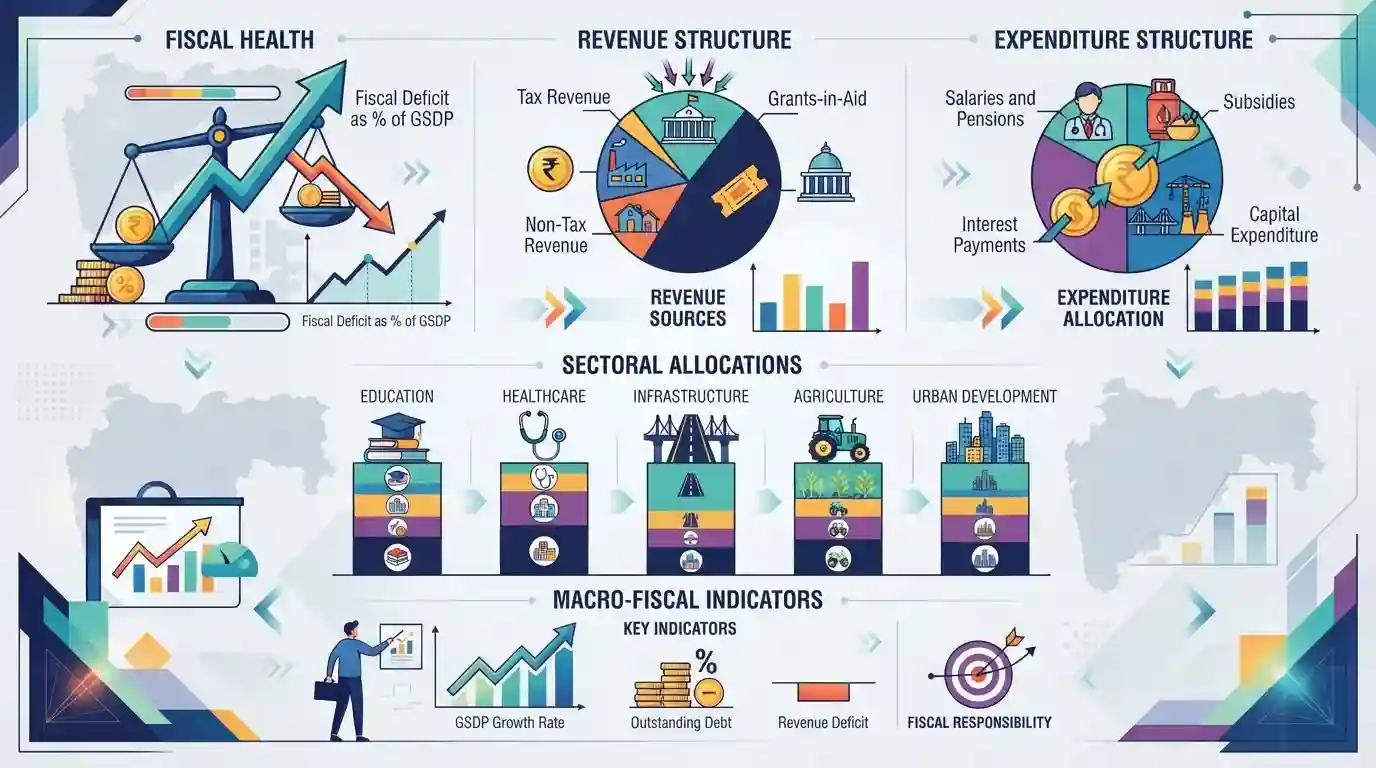
An analysis of the Maharashtra Budget for 2026-27, detailing fiscal health, revenue and expenditure structures, sectoral allocations, and macro-fiscal indicators published by PRS Legislative Research.
Key Points
- The Maharashtra Budget for 2026-27 outlines the state's fiscal indicators including total receipts, expenditures, tax revenues, and capital outlay.
- The budget provides allocations across key development sectors such as agriculture, infrastructure, social welfare, and education.
- Fiscal parameters such as fiscal deficit, revenue deficit, and outstanding debt relative to the Gross State Domestic Product (GSDP) are analyzed in alignment with fiscal responsibility targets.
- The analysis highlights trends in state own tax revenues, central tax devotions, and grants-in-aid.
Important Terms
Maharashtra Budget 2026-27

The annual financial statement of the Government of Maharashtra detailing revenue receipts, capital expenditure, fiscal deficit targets, and sector-wise allocations such as welfare schemes and infrastructure projects.
UPSC context
Crucial for MPSC Paper III (Economy - State Finances and Public Finance), testing current state fiscal indicators, GSDP growth, and budgetary trends.
FRBM Act
A legislative framework enacted in India to institutionalize fiscal discipline, reduce fiscal and revenue deficits, and ensure long-term macroeconomic stability through transparent public finance management.
UPSC context
Important for MPSC Economy syllabus covering fiscal policy, government debt management, and statutory deficit limits for state and central governments.
PRS Legislative Research
An independent, non-partisan research organization in India that provides data, bill summaries, and detailed fiscal analyses of central and state budgets to lawmakers and the public.
UPSC context
Valuable reference source for MPSC governance and economic analysis, testing understanding of state budget structures and public expenditure accountability.
Static Concepts Connected
What are the key fiscal parameters and FRBM targets for state governments in India?
- Fiscal Deficit Limit: Fiscal Deficit ceiling is generally recommended at 3% of GSDP by the Finance Commission, with calibrated relaxations for power sector reforms.
- Revenue Deficit Goal: Revenue Deficit ideally targeted at zero under FRBM principles, though states often run revenue deficits due to high committed expenditures.
- Debt-GSDP Ratio: Outstanding Liabilities limit for states is generally recommended around 20-25% of GSDP by successive Finance Commissions.
Cross-Topic Patterns
State Finances vs Union Fiscal Deficit Trends
State budget committed expenditures (salaries, pensions, interest) consume over half of revenue receipts, mirroring similar fiscal rigidities seen at the Union level under the 15th Finance Commission framework.
Sub-national Tax Autonomy & Property Cycles
Maharashtra's heavy reliance on SGST, stamp duty, and state excise highlights the vulnerability of sub-national revenue structures to property market cycles and consumption shocks.

MPSC loves matching state fiscal metrics (fiscal deficit % of GSDP, debt-GSDP ratio) with FRBM statutory limits in statement-based questions.
Linked PYQs · 3
Linked PYQs · 3
- 2022MPSC_PRELIMSGS1
Government of Maharashtra has adopted gender budgeting from the year ________.
- 2026MPSC_PRELIMSGS1
Consider the following statements regarding the Public Distribution System (PDS) in Maharashtra. (a) By December 2025, there were 270.48 lakh ration card holders in the state. (b) As of 31 October 2025, 51,636 Fair price shops were functioning in the state. (c) By October 2025, about 1.55 crore families received food grains through Aadhaar - based biometric authentication. Which of the statements given above is/are correct ?
- 2018MPSC_PRELIMSGS1
Government of Maharashtra's Sumatibai Sukalikar Udyogini Mahila Sakshamikaran Yojana is related to
