Maharashtra Bill Dictates Child Religion in Unlawful Conversions
Source:Indian Express ↗
Why It Matters
State-level anti-conversion laws frequently appear in UPSC discussions on fundamental rights (Article 21 and 25). The novel provision dictating a child's religion adds a unique angle touching upon secularism, privacy (Puttaswamy judgment), and the right to marry a person of choice (Hadiya case).
Summary
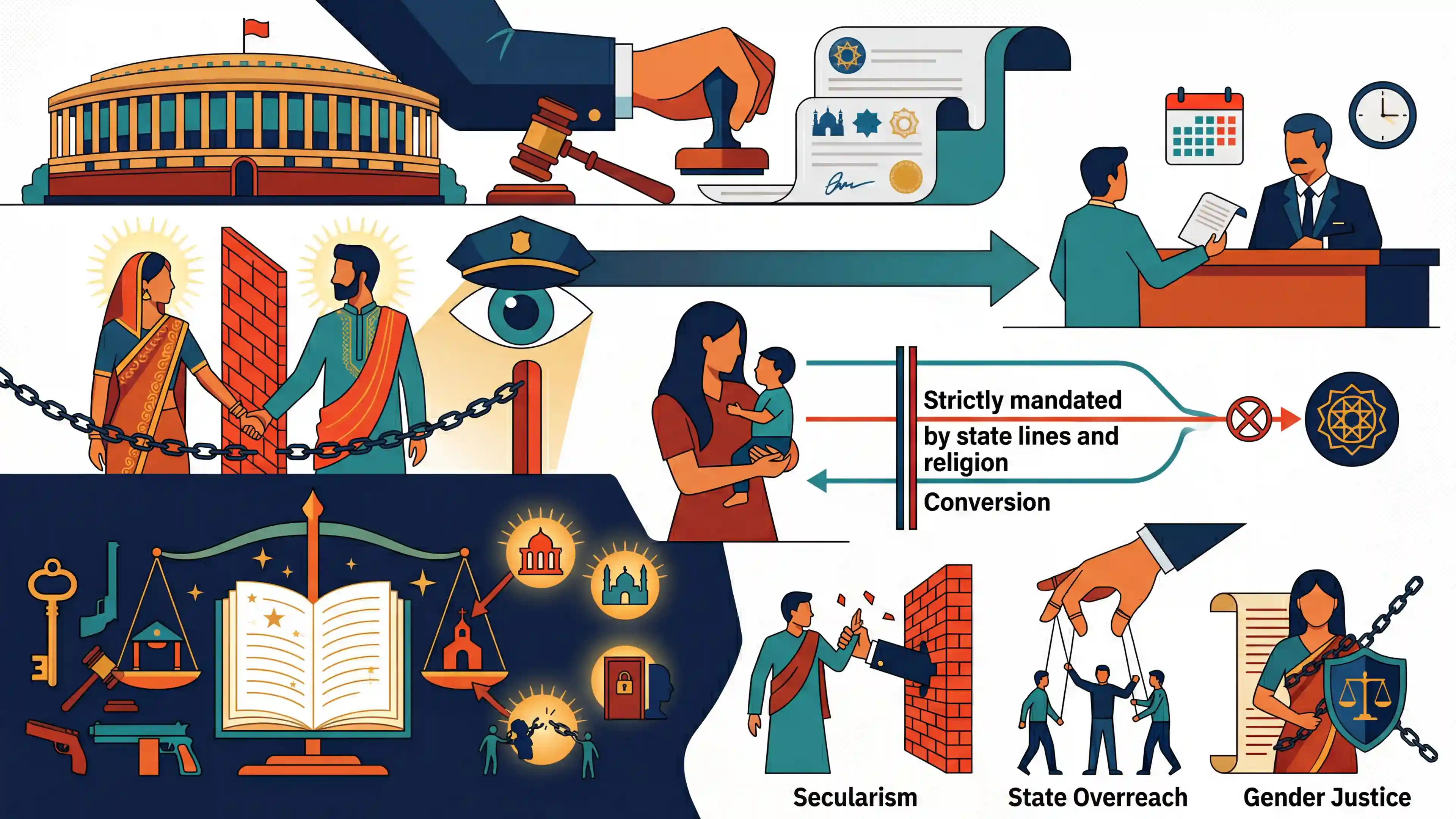
The Maharashtra government has introduced a stringent anti-conversion bill aimed at preventing unlawful religious conversions through marriage or coercion. A highly debated provision in the bill dictates that children born out of a marriage deemed as an 'unlawful' conversion will automatically belong to the mother's original religion. The proposed law mandates prior notification to the District Magistrate for any religious conversion. This legislative move has triggered intense scrutiny over its constitutional validity, as critics argue it violates fundamental rights under Article 25 (freedom of religion) and Article 21 (right to privacy, life, and personal liberty). By granting the state power to determine a child's religious identity and policing inter-faith marriages, the bill brings up complex debates surrounding secularism, state overreach, and gender justice.
Key Points
- The Maharashtra government has introduced an anti-conversion bill to penalize forced, fraudulent, or allurement-based religious conversions, primarily targeting inter-faith marriages.
- A contentious new clause mandates that any child born out of an 'unlawful' conversion marriage will automatically be designated as belonging to the mother’s original religion.
- The bill requires individuals seeking religious conversion to provide advance notice to the District Magistrate for scrutiny.
- The legislation raises significant constitutional concerns regarding the infringement of Article 21 (right to privacy and right to marry a person of one's choice) and Article 25 (freedom of conscience and religion).
- Legal experts and critics argue that state dictation of a child's religion undermines India's secular principles and interferes with personal laws and autonomy.
Important Terms
Maharashtra Freedom of Religion Bill, 2026

Also known as the Dharma Swatantrya Bill 2026, it aims to prevent conversions via coercion or marriage; uniquely stipulates that children from 'unlawful' marriages belong to the mother's original religion.
UPSC context
GS Paper II: Government policies, state legislation, and issues arising out of their design and implementation.
Article 25 of the Indian Constitution
Guarantees freedom of conscience and the right to profess, practice, and propagate religion; used by states to justify regulating 'forced' conversions for public order.
UPSC context
GS Paper II: Fundamental Rights and the balance between individual liberty and state-imposed reasonable restrictions.
Article 21 of the Indian Constitution
Protects the right to life and personal liberty; interpreted by the Supreme Court to encompass the right to privacy and the right to choose a life partner.
UPSC context
GS Paper II: Judiciary and Fundamental Rights; focuses on evolving interpretations of 'liberty' and 'privacy'.
Rev. Stanislaus v. State of Madhya Pradesh (1977)
A 1977 Supreme Court ruling that the right to 'propagate' religion does not include a fundamental right to convert others, upholding state power to regulate conversions.
UPSC context
GS Paper II: Landmark Supreme Court judgments shaping the constitutional validity of state-led religious regulations.
Hadiya v. Ashokan K.M. (2018)
A landmark 2018 Supreme Court judgment affirming that an adult's right to choose their religion and life partner is central to identity and personal liberty.
UPSC context
GS Paper II: Protection of individual autonomy against state and parental interference in inter-faith marriages.
Reversed Burden of Proof
A legal provision in many anti-conversion laws where the accused must prove the conversion was voluntary, rather than the prosecution proving it was coerced.
UPSC context
GS Paper II: Criminal Justice System and legal principles; tests understanding of 'due process' and 'presumption of innocence'.
Prelims Trap
"The fundamental right to propagate religion under Article 25 includes the right to convert another person."
The Supreme Court ruled in Rev. Stanislaus (1977) that 'propagate' means transmitting tenets, not converting others, as that would infringe upon their freedom of conscience.
Static Concepts Connected
Under which constitutional entry do States enact anti-conversion legislations?
- State List Entry 1: States legislate anti-conversion laws under 'Public Order', arguing that forced, fraudulent, or coerced conversions disrupt social peace.
- Judicial Backing: The SC upheld this legislative competence in the 1977 Rev. Stanislaus judgment, affirming Public Order falls strictly under state jurisdiction.
How do judicial precedents protect the right to marry and choose religion?
- Shafin Jahan Case: The SC ruled that the right to marry a person of one's choice is an integral part of Article 21 (Right to Life and Liberty).
- Puttaswamy Judgment: Recognized decisional autonomy and privacy as fundamental rights under Article 21, forming the basis for challenging mandatory DM notifications for inter-faith marriage or conversion.
Cross-Topic Patterns
Special Marriage Act vs State Laws
State laws requiring DM notice for conversion echo the Special Marriage Act's 30-day public notice clause, both facing intense Article 21 privacy challenges.
UCC and Personal Law Intersections
Assigning a child the mother's religion bypasses traditional patrilineal personal laws, feeding directly into broader debates around gender justice, secularism, and the Uniform Civil Code (UCC).

Expect a 2026 Prelims multi-statement question testing the boundaries of Article 25 (Rev. Stanislaus) alongside Article 21 right to marry.
Linked PYQs · 4
Linked PYQs · 4
- 2024MainsGS2
Discuss India as a secular state and compare with the secular principles of the US constitution.
- 2017MainsGS2
Examine the scope of Fundamental Rights in the light of the latest judgement of the Supreme Court on Right to Privacy.
- 2023MainsGS2
Explain the constitutional perspectives of Gender Justice with the help of relevant Constitutional Provisions and case laws.
- 2019PrelimsGS1
Which Article of the Constitution of India safeguards one's right to marry the person of one's choice?
