Maharashtra Wildlife Protection Amendment Act and Forest Management
Source:hindustantimes ↗
Why It Matters
State-specific legislative amendments to environmental and wildlife acts are frequently targeted in MPSC exams under regional current affairs and polity/environment intersections.
Summary
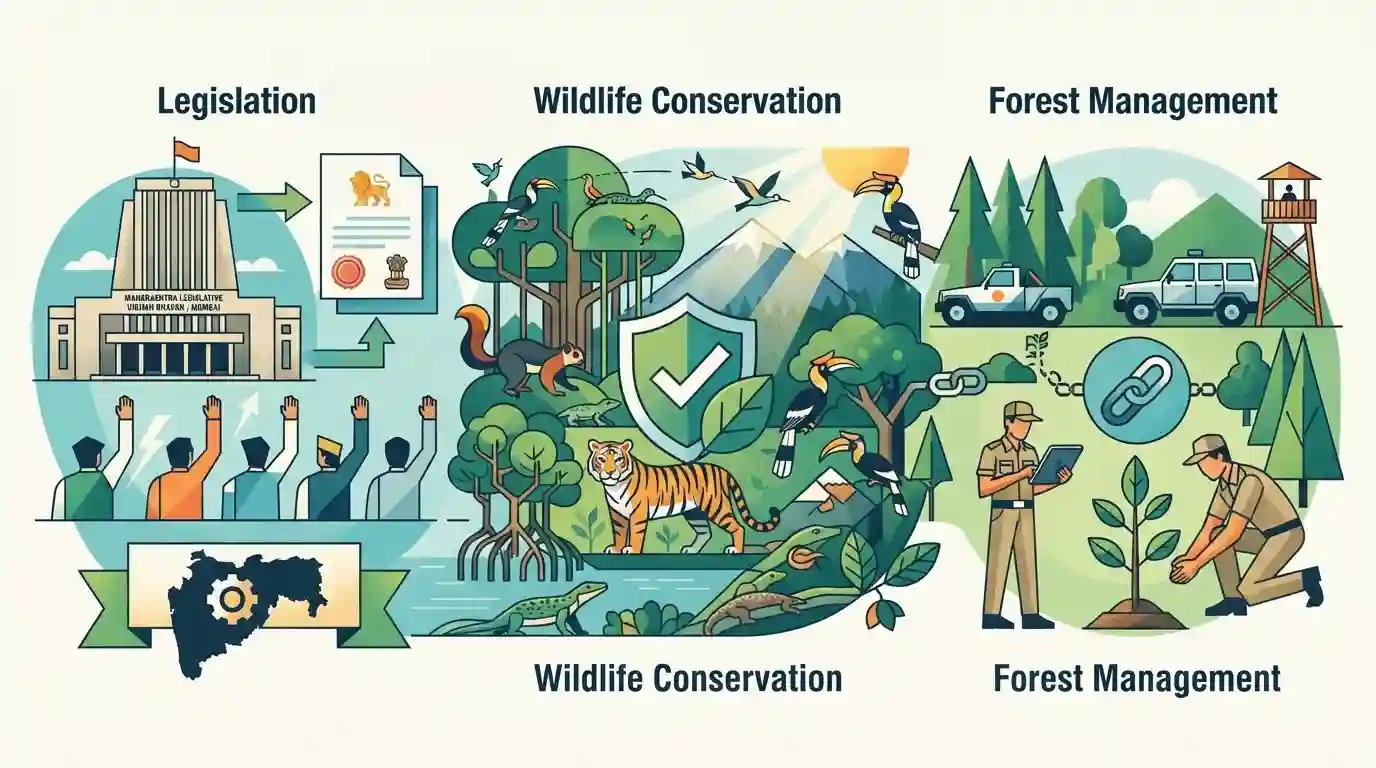
The Maharashtra Legislative Assembly passed the Wildlife Protection Amendment Bill, aimed at enhancing wildlife conservation, strengthening legal provisions against wildlife offenses, and empowering state-level forest management.
Key Points
- The Maharashtra Assembly passed the Wildlife Protection Amendment Bill to strengthen the conservation framework within the state.
- The amendment aligns state-level legal provisions with changing environmental and ecological challenges.
- It focuses on empowering local forest authorities and streamlining penalties for wildlife crimes in Maharashtra.
Important Terms
Wildlife Protection Amendment Bill

A state-level legislative enactment proposed to handle intensifying human-wildlife conflicts by empowering the chief wildlife warden to authorize actions like translocation, sterilization, and population management.
UPSC context
Important for MPSC Mains (Environment & Governance): Tests knowledge of state-level legislative competence and administrative mechanisms for human-wildlife conflict mitigation.
Wildlife Protection Act, 1972
A landmark central legislation enacted in 1972 that provides a comprehensive framework for protecting wild animals, birds, and plants, establishing national parks, sanctuaries, and strict legal schedules.
UPSC context
Essential for MPSC Prelims and Mains (Environment and Ecology): Tests statutory provisions, schedules, and conservation laws.
State Wildlife Board
A statutory body established under Section 6 of the Wildlife Protection Act, 1972, headed by the Chief Minister, to formulate wildlife policies, review projects, and advise on protected areas.
UPSC context
Important for MPSC Polity and Administration: Tests the composition, constitutional/statutory status, and executive functions of state-level environmental advisory bodies.
Static Concepts Connected
What are the key constitutional provisions and schedules under the Wild Life (Protection) Act, 1972?
- Constitutional Status: Transferred to Concurrent List via the 42nd Constitutional Amendment Act, 1976, enabling both Parliament and State legislatures to legislate.
- Schedules: The Act comprises 6 schedules; Schedules I and II provide absolute protection with highest penalties, while Schedule VI covers specified plants.
- Statutory Bodies: Statutory bodies like the National Board for Wildlife (NBW) and State Boards for Wildlife (SBW) are mandated under the Act.
Cross-Topic Patterns
Wildlife Legislation + Constitutional Federalism
State wildlife amendments intersect with the Indian Constitution's 42nd Amendment Act (1976), which shifted 'Forests' and 'Protection of Wild Animals and Birds' from the State List to the Concurrent List.
State Amendments vs. Central Conservation Laws
Enhanced state penalties interact directly with Schedule I species protection under the central Wildlife Protection Act, testing the limits of delegated state legislation.

Expect a statement-based question comparing state amendment powers versus central provisions under the Wildlife Protection Act, 1972.
Linked PYQs · 3
Linked PYQs · 3
- 2023MPSC_PRELIMSGS1
Provisions of the Constitution relating to the administration of Scheduled Areas and Scheduled Tribes in Schedule - V
- 2021MPSC_PRELIMSGS1
Match the following : | National Park/Sanctuary | State | |---|---| | (a) Bandipur | (i) Rajasthan | | (b) Keoladeo | (ii) Assam | | (c) Indravati | (iii) Karnataka | | (d) Manas | (iv) Chattisgarh | Code: (a) (b) (c) (d)
- 2026MPSC_PRELIMSGS1
Match the following forest circles with their share in percentage to total forest area of Maharashtra. | (Forest circles of Maharashtra) | (Percentage to total forest area Economic survey of Maharashtra (2024)) | |---|---| | (a) Gadchiroli | (1) 12.5 | | (b) Nagpur | (2) 20.8 | | (c) Dhule | (3) 9.5 | | (d) Thane | (4) 10.4 | Code: (a) (b) (c) (d)
