Maharashtra Freedom Of Religion Act Provisions And Implementation
Source:ndtvprofit ↗
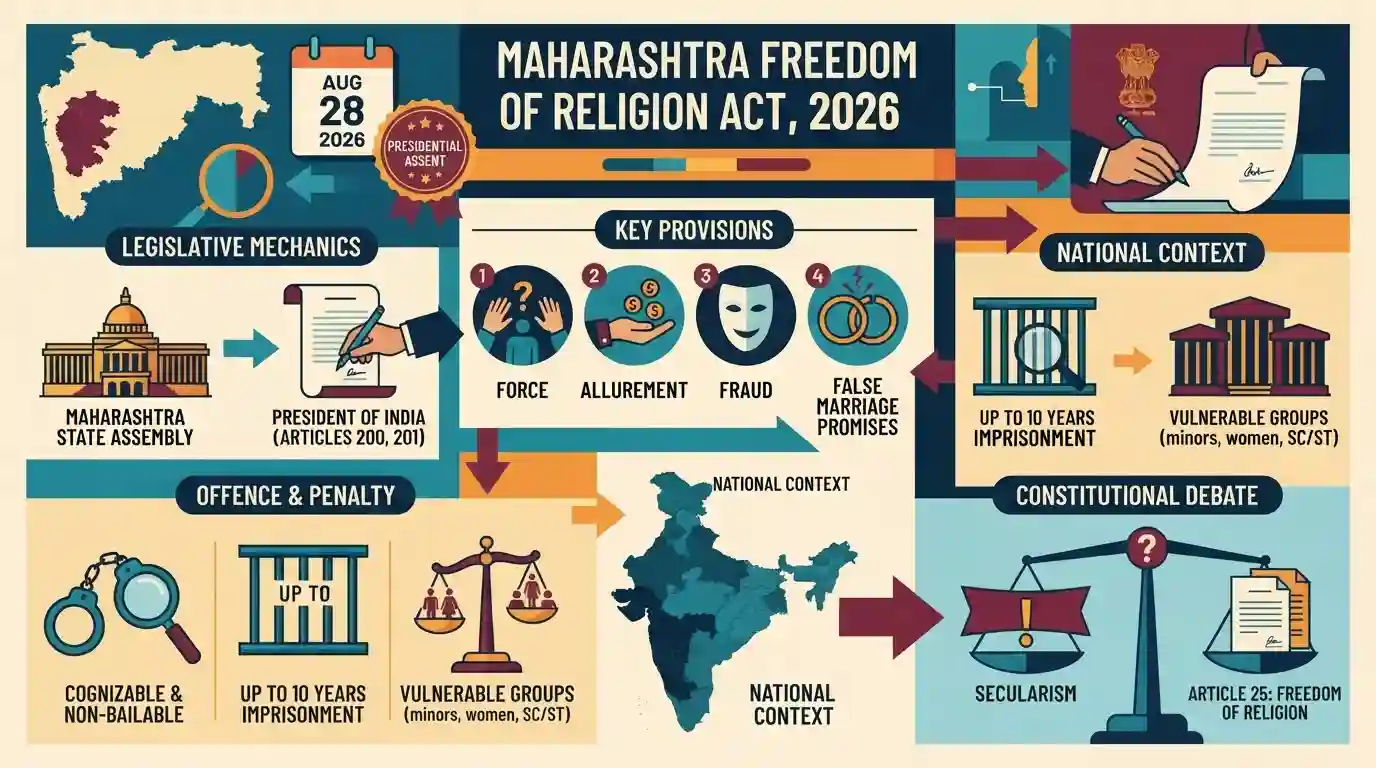
Why It Matters
Anti-conversion laws frequently feature in constitutional debates regarding secularism and fundamental rights (Article 25). Additionally, the mechanism of a State Bill receiving Presidential Assent makes it an important applied example of Articles 200 and 201, which are recurring themes in MPSC Prelims.
Summary
The Maharashtra Freedom of Religion Act, 2026 comes into force on August 28, 2026, after receiving presidential assent. The legislation makes religious conversions by force, allurement, fraud, or false marriage promises a cognizable and non-bailable offence, shifting the burden of proof onto the accused. The law establishes strict penalties, including up to 10 years imprisonment for mass conversions and enhanced punishments for converting vulnerable groups such as minors, women, and SC/ST individuals. With this, Maharashtra joins 12 other states in implementing anti-conversion laws, intersecting heavily with constitutional debates regarding secularism, Article 25 (Freedom of Religion), and the legislative mechanics of Presidential assent to state bills under Articles 200 and 201.
Key Points
- The Maharashtra Freedom of Religion Act, 2026 comes into effect on August 28, following presidential assent.
- The law prohibits religious conversions through force, allurement, fraud, or false promises of marriage.
- Offences under the Act are cognizable and non-bailable, with the burden of proof placed on the accused rather than the victim.
- Penalties include up to 7 years in prison, extending to 10 years and a ₹5 lakh fine for mass conversions.
- Harsher punishments are prescribed for illegal conversions involving minors, women, and members of Scheduled Castes (SC) or Scheduled Tribes (ST).
- Maharashtra becomes the 13th Indian state to enact an anti-conversion law, bringing focus to the constitutional scope of Article 25 (Freedom of Religion) and Article 200/201 (Presidential assent to State Bills).
Important Terms
Maharashtra Freedom of Religion Act, 2026

A state legislation enacted to prevent and criminalise unlawful religious conversions carried out through force, coercion, fraud, allurement, or deceitful marriages, with strict penalties.
UPSC context
GS-II (Polity & Law). Tests knowledge of regional social legislations and state-specific regulatory frameworks.
Article 25 of the Indian Constitution
A fundamental right guaranteeing freedom of conscience and the right to freely profess, practice, and propagate religion, subject to public order, morality, and health.
UPSC context
GS-II (Polity & Constitution). Tests understanding of fundamental rights, judicial interpretations, and limits on propagation.
Article 200 of the Indian Constitution
A constitutional provision outlining the Governor’s options—granting assent, withholding assent, returning, or reserving a state legislative bill for the President’s consideration.
UPSC context
GS-II (Polity). Tests gubernatorial powers, legislative procedures, and the friction points in cooperative federalism.
Article 201 of the Indian Constitution
A constitutional article specifying the President's options—granting assent, withholding assent, or directing the Governor to return a reserved state bill for reconsideration.
UPSC context
GS-II (Polity). Tests federal balance of power and presidential oversight over state-level legislations.
Cognizable and Non-Bailable Offence
A class of serious offences where police can arrest without a warrant (cognizable) and bail is granted strictly at judicial discretion (non-bailable).
UPSC context
GS-II (Polity & Law). Tests legal literacy, criminal procedures, and state-level enforcement of penal provisions.
Prelims Trap
The fundamental right to propagate religion under Article 25 includes the right to convert another person to one's own faith.
The Supreme Court in the landmark Rev. Stainislaus case (1977) explicitly ruled that the right to propagate does not grant a fundamental right to convert another person, as it would violate their freedom of conscience.
Static Concepts Connected
How do Articles 200 and 201 govern Presidential assent to State Bills?
- Governor's options: Under Art 200, the Governor can give assent, withhold assent, return the bill, or reserve it for the President.
- President's options: Under Art 201, the President can declare assent, withhold assent, or direct the Governor to return the bill.
- No time limit: The Constitution does not prescribe a specific time limit for the President to decide on reserved bills.
How is the Right to Freedom of Religion (Article 25) restricted?
- Constitutional restrictions: Subject to public order, morality, health, and other provisions relating to fundamental rights.
- Stainislaus case (1977): SC held that 'propagation' means to transmit or spread tenets, but does not grant a right to convert.
- State legislative power: Entry 1 of the State List (Public Order) empowers State Legislatures to legislate on religious conversions.
Cross-Topic Patterns
State Bill vetoes & federal friction
The frequent reservation of controversial state bills for the President's assent highlights the tension between state legislative autonomy and federal executive veto powers.
Burden of proof vs Article 21
Shifting the burden of proof to the accused in anti-conversion laws challenges the 'presumption of innocence', intersecting with personal liberty under Article 21.

MPSC will likely combine Article 25's interpretation on conversion with the mechanics of Presidential assent (Articles 200 & 201).
Linked PYQs · 3
Linked PYQs · 3
- 2024MPSC_PRELIMSGS1
The Indian Constitution establishes a secular state, meaning : (A) The state makes discrimination on the basis of religion in matters of employment. (B) The state avoids preferential treatment for any particular religion. (C) The state treats all religions equally. (D) Freedom of faith and worship is allowed to all the people. (E) Educational institutions, without exception, are free to impart religious instructions.
- 2020MPSC_PRELIMSGS1
Which one of the following statements is not correct ?
- 2019MPSC_PRELIMSGS1
In the case of a bill passed by the State Legislature, Governor can reserve it for the consideration of the President. a. The President may declare or withhold his assent to the bill. b. The President may return the bill for reconsideration to the State Legislature. c. State Legislature must reconsider the bill within three months and if passed again it is obligatory upon the President to give his assent. d. In case of reconsidered bill which is passed again by State Legislature, President shall declare his assent within a period of six months. Which of the statements given above are correct ? Answer Options :
