Public Health: Amravati Government Hospital Fire Safety Failures
Source:thehindu ↗
Why It Matters
This incident highlights the critical state of safety compliance and disaster preparedness in public health infrastructure. It directly relates to municipal administration (as fire services fall under the Twelfth Schedule of the Indian Constitution) and regional development goals under the National Population Policy to minimize neonatal and infant mortality.
Summary
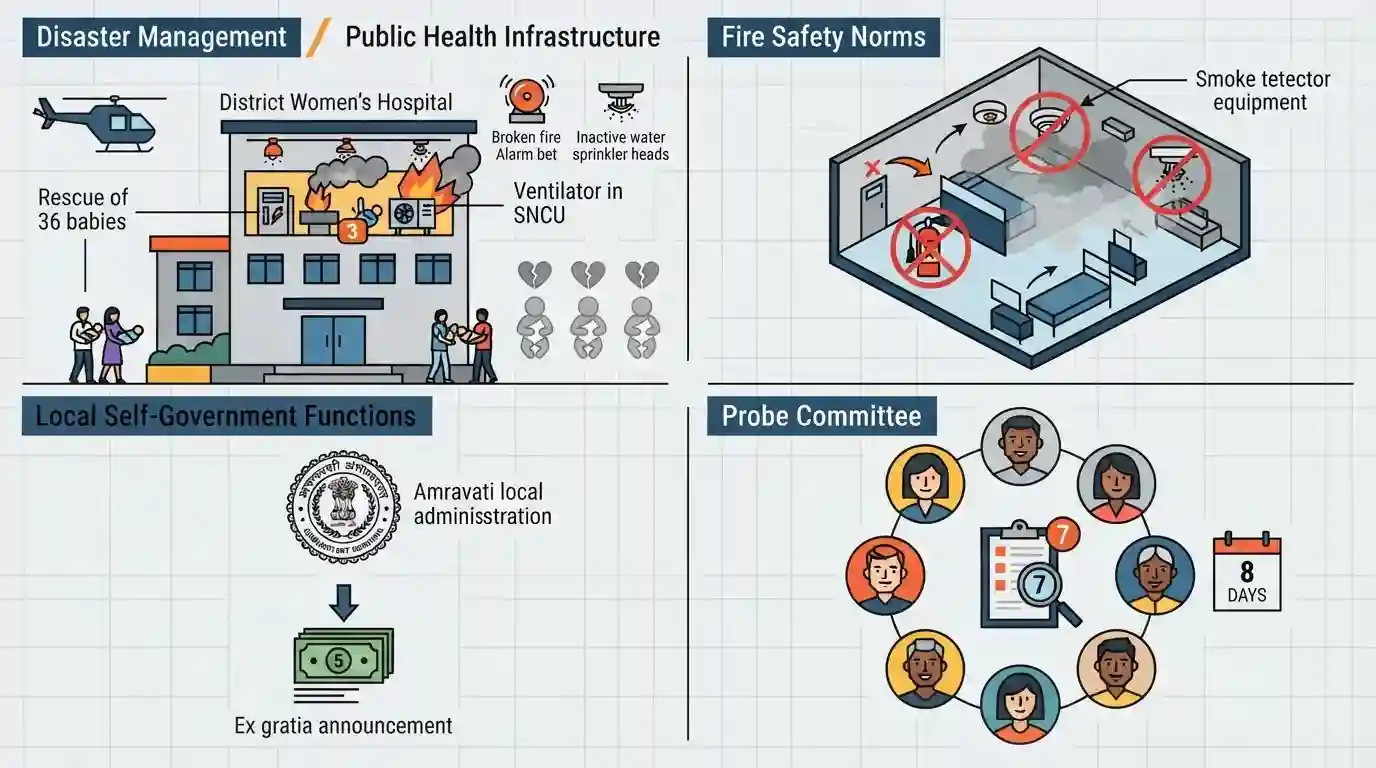
In the early hours of August 24, 2026, a devastating fire broke out at the Special Newborn Care Unit (SNCU) of the District Women's Hospital in Amravati, Maharashtra, leading to the death of three newborns. The blaze originated from a ventilator explosion on the third floor of the unit. While 36 babies were saved due to swift action by hospital staff and parents, the tragedy highlighted major safety failures, as the newly built hospital's fire alarms and automatic water sprinklers failed to activate. Chief Minister Devendra Fadnavis announced an ex gratia of ₹5 lakh for the victims' families, and Health Minister Prakash Abitkar instituted a seven-member committee to probe 'grave irregularities' and submit a report within eight days.
Key Points
- A tragic fire broke out in the Special Newborn Care Unit (SNCU) of the District Women's Hospital in Amravati, Maharashtra, resulting in the death of three newborns.
- Out of 39 admitted infants, 36 were successfully rescued by doctors, nurses, security guards, and parents.
- The fire was triggered by a ventilator explosion on the third floor of the unit, which was built only two years prior.
- Eyewitnesses and investigators reported critical failures in safety equipment: the hospital's fire alarms failed to ring and the automatic water sprinkler system did not activate.
- Maharashtra Chief Minister Devendra Fadnavis ordered a high-level inquiry and announced an ex gratia of ₹5 lakh for the families of the deceased.
- State Health Minister Prakash Abitkar flagged 'grave' irregularities and constituted a seven-member panel to investigate the incident and submit a report within eight days.
Important Terms
Maharashtra Fire Prevention and Life Safety Measures Act, 2006

A state law mandating building owners to implement strict fire safety measures and obtain compliance NOCs. It empowers the Chief Fire Officer to inspect premises, enforce norms, and penalize safety violations.
UPSC context
Crucial for MPSC GS-3 (Disaster Management) and GS-2 (Governance) regarding statutory frameworks enforcing public infrastructure safety.
Special Newborn Care Unit (SNCU)
A specialized neonatal facility at district hospitals under the National Health Mission. It provides 24/7 care for sick and low-birth-weight newborns to reduce infant mortality rates through facility-based interventions.
UPSC context
Important for MPSC GS-2 (Health and Social Justice) to understand government interventions addressing infant mortality and child health infrastructure.
National Health Mission (NHM)
A centrally sponsored umbrella program integrating the rural and urban health missions. It aims to provide universal, equitable, and quality public healthcare, with a strong focus on maternal and child survival.
UPSC context
A fundamental topic for MPSC GS-2 (Government Policies & Interventions), testing knowledge of India's primary healthcare funding and architecture.
Prelims Trap
"Fire services are governed under the Concurrent List and fall directly under the Union Ministry of Home Affairs."
Under Article 243W and the 12th Schedule, 'Fire services' is Item 7, making it a functional responsibility of Urban Local Bodies (Municipalities).
Static Concepts Connected
What is the Constitutional mandate for managing Fire Services in India?
- Twelfth Schedule: Added by the 74th Constitutional Amendment Act, 1992, listing 18 functional items for municipalities.
- Item 7: Specifically designates 'Fire Services' as a responsibility of Urban Local Bodies (ULBs).
- Article 243W: Empowers state legislatures by law to devolve powers and responsibilities, including fire safety administration, to municipalities.
How is the State Disaster Management Authority (SDMA) structured?
- Statutory Basis: Constituted under Section 14 of the Disaster Management Act, 2005.
- Ex-officio Chairperson: The Chief Minister of the respective state serves as the head of the SDMA.
- Execution: Assisted by a State Executive Committee, which acts as the coordinating body and is headed by the Chief Secretary.
Cross-Topic Patterns
ULB Capacity + Urban Disaster Management
Frequent public infrastructure fires highlight gaps in 74th CAA implementation, where Urban Local Bodies (ULBs) struggle with the technical and financial capacity to enforce safety norms like the Maharashtra Fire Prevention Act.
Health Infra + Infant Mortality Targets
Preventable tragedies in Special Newborn Care Units (SNCUs) directly undermine hard-won national gains in reducing the Infant Mortality Rate (IMR) to meet NPP 2000 and SDG targets.

Expect multi-statement questions linking Article 243W (12th Schedule municipal functions) with urban fire safety and disaster management.
Linked PYQs · 2
Linked PYQs · 2
- 2026MPSC_PRELIMSGS1
Which of the following matters are included in the 12th schedule of the Constitution of India ? (a) Promotion of artistic vision, fire fighting services (b) Cremation ground and electric crematorium (c) Market | fairs, rural housing (d) Protection of the interest of the handicapped and mentally retarded, protection of the environment. Answer Options :
- 2017MPSC_PRELIMSGS1
The National Population Policy, 2000 aimed to a. Reduce maternal mortality rate below 100 per 1 lakh live births and infant mortality to below 30 per one thousand live births. b. Prevent and control communicable diseases. c. Reduce maternal mortality rate below 130 per 1 lakh live births and infant mortality to below 35 per one lakh live births.
