Maharashtra Action Plan for Live Entertainment and Concert Economy
Source:Indian Express ↗
Why It Matters
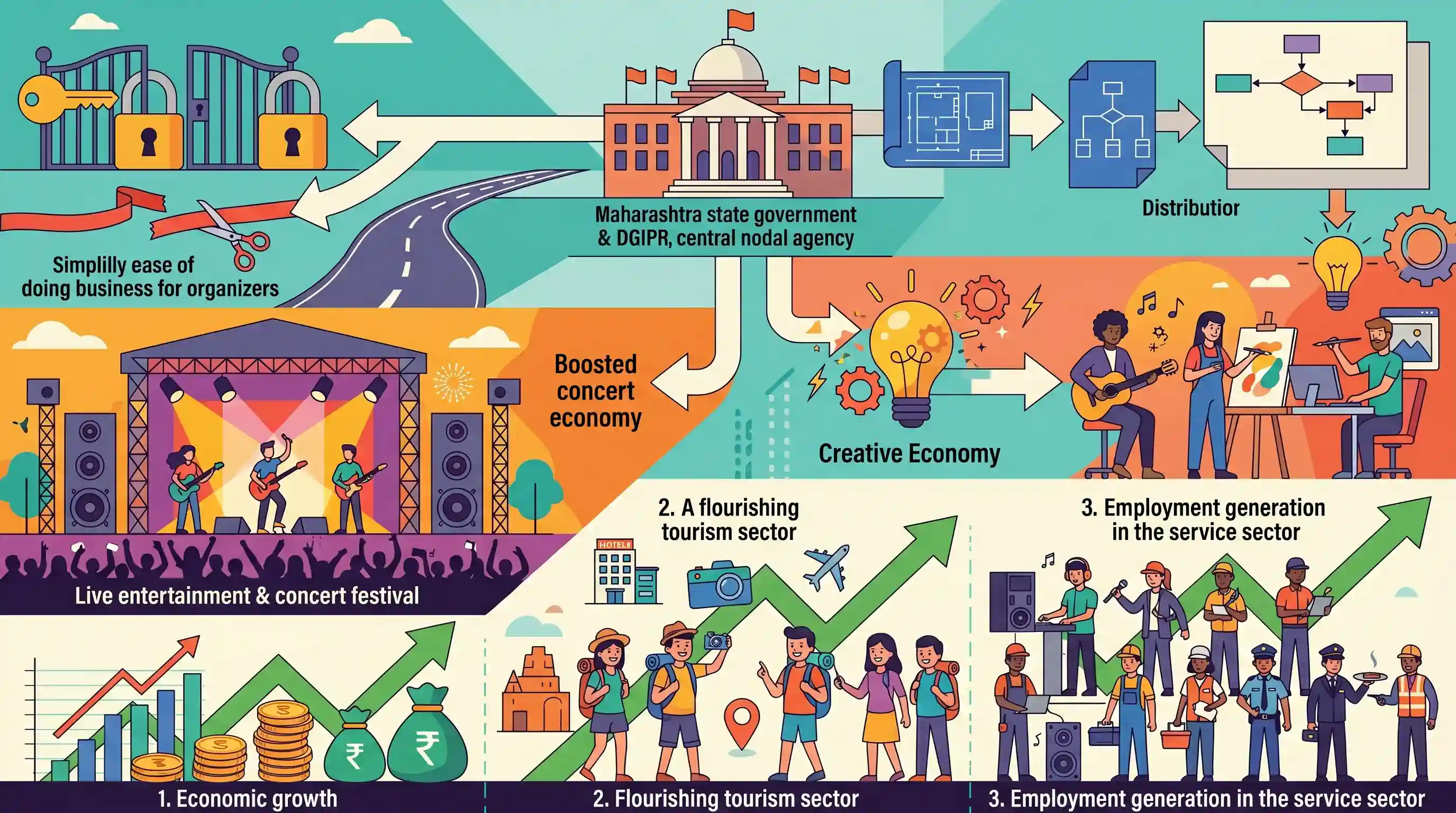
Highlights how state governments are recognizing the 'creative and concert economy' as an emerging pillar of the service sector. It showcases state-level governance reforms to improve the ease of doing business, which directly contributes to employment generation and tourism growth.
Summary
The Maharashtra government has designated the Directorate General of Information and Public Relations (DGIPR) as the central nodal agency to draft an action plan aimed at boosting the state's live entertainment and concert economy. The move is designed to streamline administrative permissions, improve the ease of doing business for event organizers, and harness the 'creative economy' to drive revenue, tourism, and job creation in the service sector.
Key Points
- The Maharashtra government has appointed the DGIPR as the nodal agency to develop a comprehensive action plan for the live entertainment and concert economy.
- The initiative aims to improve the Ease of Doing Business (EoDB) for event organizers by creating streamlined, single-window clearance mechanisms for concerts and cultural events.
- By promoting the creative economy, the state hopes to generate substantial revenue, boost related sectors like hospitality and tourism, and create both formal and gig-economy jobs.
- This policy shift recognizes live entertainment as a viable economic driver rather than just a cultural activity, aligning with global models of urban economic growth.
Important Terms
Directorate General of Information and Public Relations (DGIPR)

A department of the Maharashtra government responsible for disseminating official news, public relations, and government publicity to bridge the gap between administration and citizens.
UPSC context
Relevant for GS Paper 2 (Governance) regarding information dissemination and departmental roles in state policy implementation.
Creative Economy
Also known as the 'Orange Economy,' it encompasses economic activities based on creativity, culture, and intellectual property, including media, arts, and live entertainment.
UPSC context
Tests GS Paper 3 topics like Economic Development and Employment, focusing on emerging sectors beyond traditional manufacturing.
Service Sector
The tertiary sector of the economy providing intangible products like IT, tourism, and entertainment, contributing over 50% to India's GDP.
UPSC context
Key for GS Paper 3 (Indian Economy) concerning drivers of growth, sectoral contributions, and structural shifts.
Ease of Doing Business (EoDB)
A regulatory environment index measuring the simplicity and efficiency of procedures for starting and operating businesses, often improved through digital reforms.
UPSC context
Important for GS Paper 2 and 3 regarding regulatory reforms, investment climate, and ease of compliance.
Nodal Agency
A central coordinating department designated to lead a specific project or policy, ensuring seamless cooperation among various government bodies.
UPSC context
Relevant for GS Paper 2 (Governance) under government policies and institutional frameworks for policy execution.
Single-Window Clearance
A streamlined administrative process allowing businesses to obtain multiple permits and approvals through a single application or portal.
UPSC context
Crucial for GS Paper 3 (Investment Models) and GS Paper 2 (E-governance) as a tool for administrative efficiency.
Prelims Trap
"The 'Orange Economy' refers to the commercial cultivation and export of citrus fruits under agricultural schemes."
The 'Orange Economy' has nothing to do with agriculture; it refers to the creative economy (arts, culture, intellectual property, and live entertainment).
Static Concepts Connected
What is the "Orange Economy" in macroeconomic terms?
- Definition: Economic activities generating wealth through cultural, artistic, and knowledge-based goods and services.
- Key Components: Includes live entertainment, cinema, architecture, design, digital media, and cultural tourism.
- Multiplier Effect: Acts as an economic multiplier, generating heavy ancillary revenue and temporary jobs in hospitality, tourism, and local transport.
How are Gig Workers regulated under Indian labour laws?
- Legal Recognition: The Code on Social Security (2020) explicitly recognizes gig and platform workers, separating them from traditional employer-employee relationships.
- Social Security Fund: The Code mandates setting up a dedicated Social Security Fund for life, disability, health, and maternity benefits.
- Platform Contribution: Digital aggregators/platforms must contribute 1-2% of their annual turnover to this fund to support gig workers.
Cross-Topic Patterns
Orange Economy + Urban Sociology
The shift toward experience-based consumption connects GS3 (Creative Economy) with GS1 (Urbanization), reflecting how evolving middle-class disposable income drives urban service-sector growth.
Service Sector + Ease of Doing Business
Single-window clearance mechanisms, traditionally focused on heavy manufacturing and FDI, are increasingly being adapted to formalize domestic, gig-heavy service sectors like live events.

The 'Orange Economy' is highly likely to appear as a Prelims term-match or a GS3 Mains question on urban gig-job creation.
Linked PYQs · 2
Linked PYQs · 2
- 2022MainsGS3
Economic growth in the recent past has been led by increase in labour productivity." Explain this statement. Suggest the growth pattern that will lead to creation of more jobs without compromising labour productivity.
- 2021MainsGS1
Examine the role of 'Gig Economy' in the process of empowerment of women in India.
