Mahabodhi Temple Administrative Control and Buddhist Monks Protests
Source:Indian Express ↗
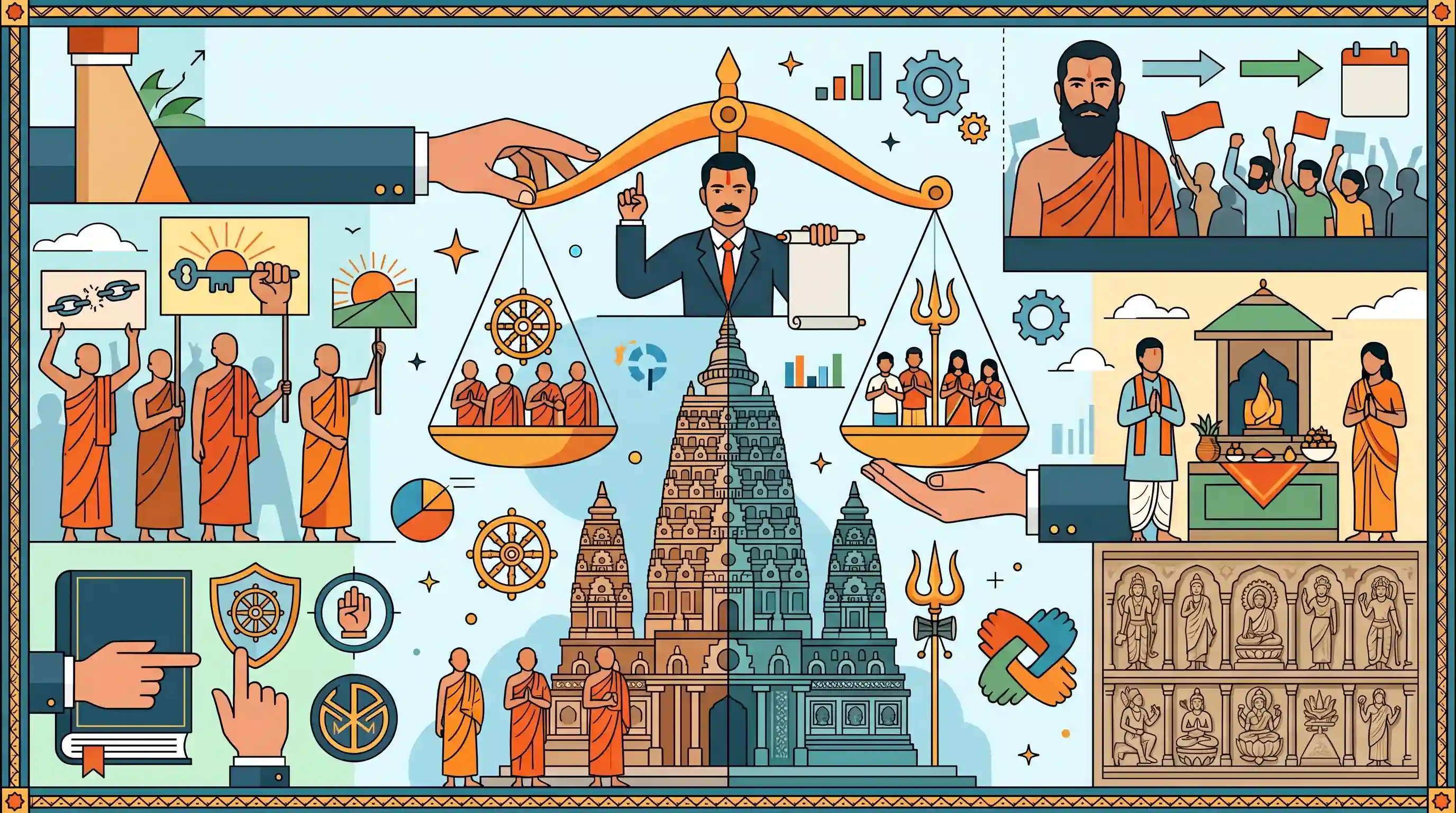
Why It Matters
The conflict highlights the friction between historical syncretic traditions and modern assertions of distinct religious identity, offering a critical case study for UPSC aspirants on freedom of religion (Article 26) and state intervention in temple management.
Summary
The article examines the renewed protests by Buddhist monks seeking exclusive administrative control over the Mahabodhi Temple in Bodh Gaya. Under the Bodh Gaya Temple Act of 1953, the temple's management is legally shared equally between Hindus and Buddhists, with a Hindu District Magistrate acting as the chairman. While Buddhists argue this arrangement violates their fundamental right to freely manage their religious institutions (Article 26), the Hindu side emphasizes the site's shared religious heritage. The dispute is deeply rooted in the late 19th-century Buddhist revival movement led by Anagarika Dharmapala and highlights ongoing constitutional complexities around secularism and state control of religious institutions in India.
Key Points
- Buddhist monks are protesting for exclusive control over the Mahabodhi Temple, demanding an amendment to the Bodh Gaya Temple Act of 1953.
- The 1953 Act mandates a shared management committee consisting of four Hindus and four Buddhists, chaired ex-officio by the District Magistrate (who must be Hindu).
- Historically, the temple was controlled by a Saivite Mahant until Sri Lankan Buddhist revivalist Anagarika Dharmapala launched a reclamation movement in 1891.
- Buddhists argue that the shared administration infringes upon their constitutional right to manage their religious affairs (Article 26), while Hindus claim the site as a shared cultural and religious heritage.
- The issue highlights the broader contemporary debates on Indian secularism, minority rights, and the legitimacy of state intervention in the administration of religious shrines.
Important Terms
Bodh Gaya Temple Act, 1949

A Bihar legislation enacted to manage the Mahabodhi Temple. It mandates a committee with equal Hindu and Buddhist representation, a structure often challenged by Buddhists seeking exclusive administrative autonomy.
UPSC context
GS Paper II (Polity/Governance); tests understanding of state legislation governing religious institutions and secularism.
Article 26 of the Indian Constitution
A Fundamental Right granting religious denominations the collective freedom to manage their own religious affairs, establish institutions, and administer property, subject to public order, morality, and health.
UPSC context
GS Paper II (Polity); essential for questions on communal rights vs. state regulation of temples.
Bodh Gaya Temple Management Committee (BTMC)
A statutory body established to oversee the Mahabodhi Temple. It consists of nine members, including the Gaya District Magistrate (Chairman) and four members each from Hindu and Buddhist communities.
UPSC context
GS Paper II (Governance); represents a case study of state-led multi-faith institutional management.
Anagarika Dharmapala
A Sri Lankan Buddhist monk who founded the Mahabodhi Society (1891). He pioneered the global movement to restore Buddhist control and sanctity to the Mahabodhi Temple in Bodh Gaya.
UPSC context
GS Paper I (Modern History/Culture); relevant for the Buddhist revival movement and 19th-century socio-religious reforms.
Article 25 of the Indian Constitution
Guarantees individuals the freedom of conscience and the right to profess, practice, and propagate religion. It allows the state to regulate secular activities associated with religious practice.
UPSC context
GS Paper II (Polity); tests the boundary between individual religious liberty and state reformative powers.
UNESCO World Heritage Site
A status awarded to the Mahabodhi Temple Complex in 2002. It recognizes the site as one of the earliest and best-preserved examples of brick architecture in India.
UPSC context
GS Paper I (Art & Culture); tests knowledge of India's heritage landmarks and their architectural evolution.
Prelims Trap
The Mahabodhi Temple Management Committee is composed entirely of Buddhist monks to protect their minority rights.
This is false. The Bodh Gaya Temple Act of 1953 legally mandates equal shared management between Hindus and Buddhists, ex-officio chaired by a Hindu District Magistrate.
Static Concepts Connected
What are the constitutional limitations on Article 26 (Freedom to manage religious affairs)?
- Subject to restrictions: The freedom to manage religious affairs is not absolute; it is explicitly subject to public order, morality, and health.
- Secular activities: The State can legally regulate or restrict any economic, financial, political, or other secular activity associated with religious practice under Article 25(2)(a).
- Property acquisition: While denominations can own property (Article 26c), the state can lawfully acquire religious property; denominations do not have absolute immunity from state acquisition.
What are the key architectural and historical features of the Mahabodhi Temple complex?
- Brick architecture: Recognized as a UNESCO World Heritage site, it is one of the earliest and best-preserved surviving examples of Indian brick temple architecture from the late Gupta period.
- Vajrasana: The temple houses the Diamond Throne (Vajrasana), historically believed to mark the exact spot where Gautama Buddha attained enlightenment under the Bodhi Tree.
- Maha Bodhi Society: Founded by Sri Lankan revivalist Anagarika Dharmapala in 1891, the society spearheaded the modern campaign to restore the temple from the local Shaivite Mahant's control.
Cross-Topic Patterns
State control of religious endowments
Connects to the broader Polity debate over state administration of temples (e.g., TN's HR&CE Act), contrasting Hindu efforts to exit state control with Buddhist efforts to exclude Hindu administrators.
19th Century Buddhist Revivalism
Anagarika Dharmapala represents the international dimension of the 19th-century Indian renaissance. He represented Theravada Buddhism at the 1893 Chicago Parliament of Religions alongside Swami Vivekananda.
Contested syncretic heritage spaces
Mirrors disputes at sites with overlapping religious histories (e.g., Gyanvapi). The 1590 Shaivite Bodh Gaya Math established a shared heritage now contested by demands for exclusive religious control.

Expect a multi-statement Prelims question blending Mahabodhi's Gupta-era brick architecture with Anagarika Dharmapala's revival movement.
Linked PYQs · 3
Linked PYQs · 3
- 2024PrelimsGS1
Consider the following properties included in the World Heritage List released by UNESCO: 1. Shantiniketan 2. Rani-ki-Vav 3. Sacred Ensembles of the Hoysalas 4. Mahabodhi Temple Complex at Bodhgaya How many of the above properties were included in 2023 ?
- 2024MainsGS2
Discuss India as a secular state and compare with the secular principles of the US constitution.
- 2020MainsGS1
Pala period is the most significant phase in the history of Buddhism in India. Enumerate.
