Maharashtra irrigation and floodwater diversion planning for safety
Source:timesofindia-indiatimes ↗
Why It Matters
Important for MPSC aspirants regarding Maharashtra's economic geography, regional water resource planning, irrigation potential, and disaster mitigation strategies for droughts and floods.
Summary
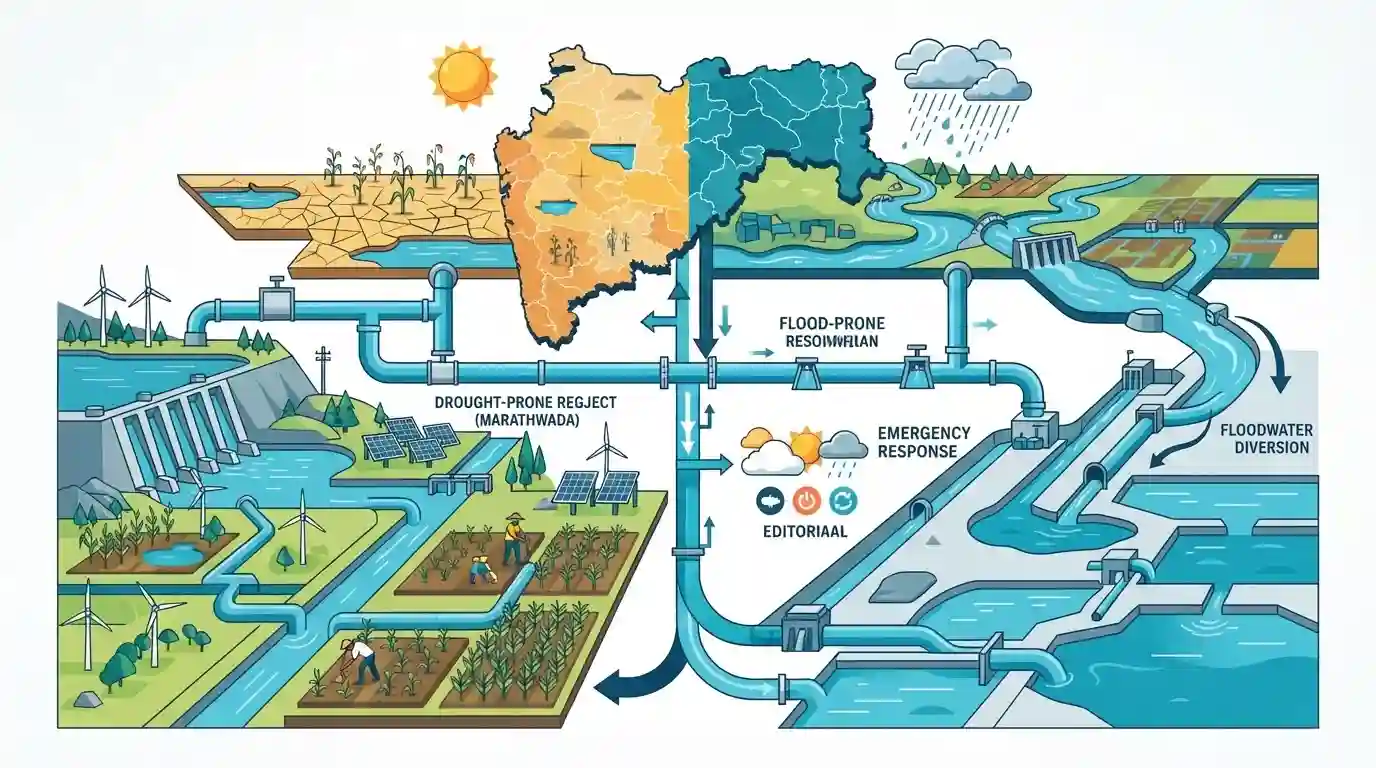
The Maharashtra government has announced strategic initiatives aimed at making the state completely drought- and flood-free by undertaking major irrigation projects and floodwater diversion plans. The initiative focuses on optimal water resource distribution, addressing regional disparities in water availability, and handling extreme weather events like floods and droughts across vulnerable regions in Maharashtra.
Key Points
- Maharashtra has initiated comprehensive planning to make the state drought- and flood-free through new irrigation projects and floodwater diversion plans.
- The state is focusing on addressing regional imbalances in irrigation, particularly targeting drought-prone regions like Marathwada and parts of Vidarbha, alongside flood mitigation measures.
- Integration of river basins and surplus floodwater redirection forms a key pillar of the state's long-term water resource management strategy.
Prelims Trap
The Wainganga-Nalganga project is a centrally funded inter-state river linking scheme executed solely by the Union Ministry of Jal Shakti.
Aspirants often confuse intra-state river linking projects like Wainganga-Nalganga with national inter-state projects overseen directly by the NWDA without state-level customization.
Static Concepts Connected
What are the major geographical regions and river systems of Maharashtra relevant to irrigation imbalances?
- Konkan Surplus: Konkan region experiences high rainfall and surplus runoff, draining westward into the Arabian Sea through short, swift rivers.
- Marathwada Shadow: Marathwada lies in the rain-shadow zone of the Western Ghats, making it chronically drought-prone and heavily dependent on Godavari basin tributaries.
- Vidarbha Basins: Vidarbha features major river systems like the Wainganga, Wardha, and Penganga, forming the Godavari basin catchment with significant irrigation potential.
Cross-Topic Patterns
Water Security + International Agri-Tech Collaboration
The Marathwada Water Grid leverages Israeli technology (Mekorot), connecting state water resource planning with international agri-tech partnerships and desertification combat frameworks.
Intra-State River Linking + Federal Water Policy
Intra-state river linking (Wainganga-Nalganga) tests Maharashtra's ecological governance capabilities alongside the National Interlinking of Rivers Programme (NWDA).

MPSC often tests specific river-linking projects (e.g. Wainganga-Nalganga) and target districts. Prepare dam locations and beneficiary zones.
Linked PYQs · 3
Linked PYQs · 3
- 2025MPSC_PRELIMSGS1
Match the following. | River Confluence | Rivers | |---|---| | a. Prakashe | I. Tapi-Panzara | | b. Mudavad | II. Tapi-Gomati | | c. Mahuli | III. Bhima-Indrayani | | d. Tulapur | IV. Krishna-Venna | Code: a b c d
- 2024MPSC_PRELIMSGS1
Which type of drainage pattern is found in Maharashtra ? (a) Dendritic (b) Parallel (c) Indefinite (d) Trellis Answer options :
- 2023MPSC_PRELIMSGS1
Which of the following is/are correct statements ? In Maharashtra, in order from north, the major hill ranges on the plateau and the river basins to their south are as follows : a. Tapi Purna basin to the south of the Satpura mountain range. b. Godavari river valley to the south of Satmala Ajintha hills. c. Harishchandra Balaghat hill and Bhima river basin to its south. d. Shambhu Mahadeva hills and Krishna river basin to its south.
