Kamchatka Peninsula Earthquake and Tsunami Warning
Source:The Hindu ↗
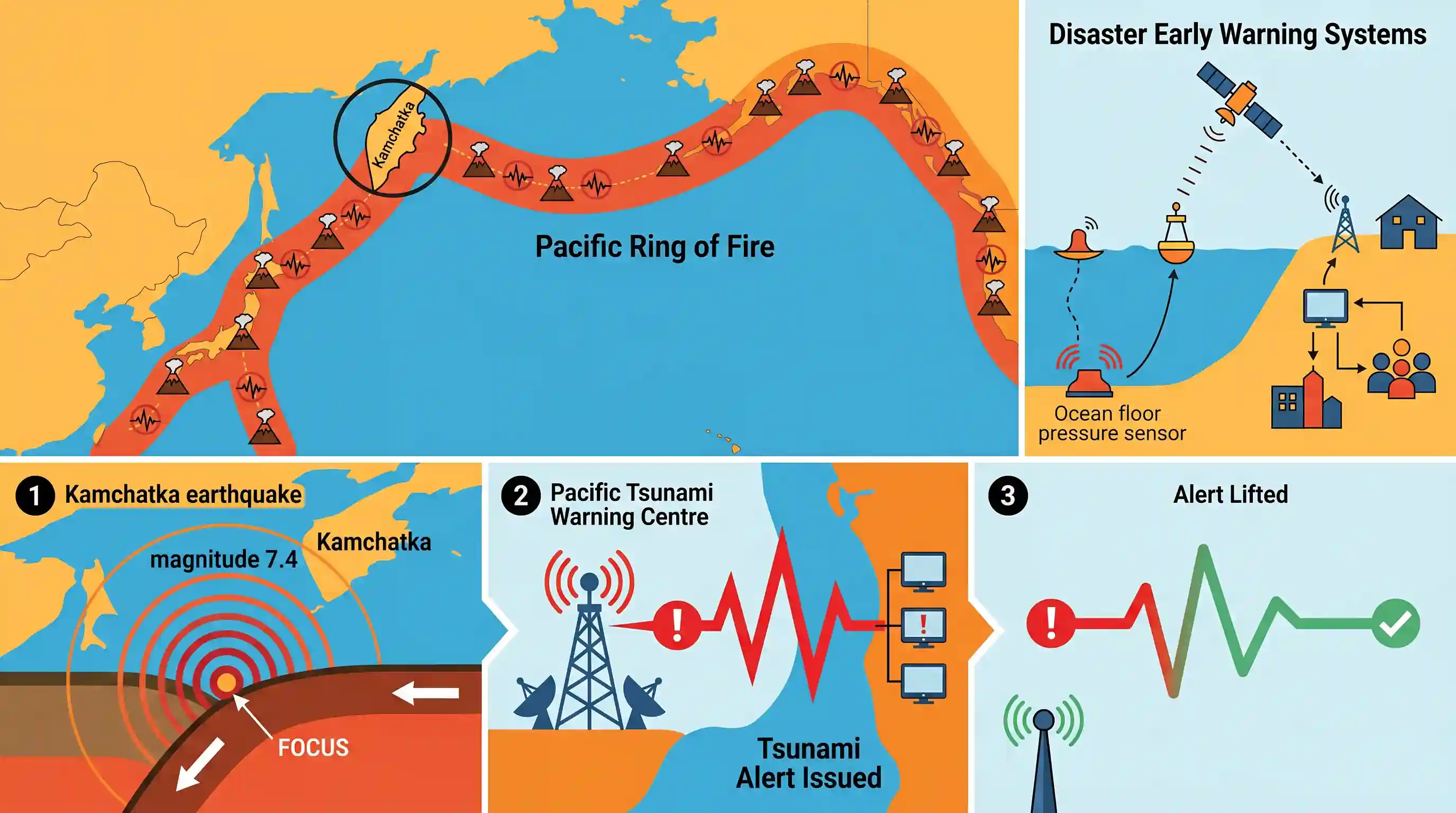
Why It Matters
The event serves as a practical geographical case study of tectonic activity along the Pacific Ring of Fire. It is directly relevant to GS1 topics on important geophysical phenomena like earthquakes and tsunamis, and GS3 disaster management topics regarding early warning mechanisms like the Pacific Tsunami Warning Centre.
Summary
A powerful magnitude 7.4 earthquake occurred off the coast of the Kamchatka Peninsula in the Russian Far East. Although the Pacific Tsunami Warning Centre initially issued a tsunami alert, it was later lifted. The event underscores the intense tectonic activity in the region, which is a prominent segment of the Pacific Ring of Fire and prone to significant seismic events.
Key Points
- A magnitude 7.4 earthquake struck off the Kamchatka Peninsula in the Russian Far East at a depth of 39.5 kilometres.
- The epicentre was located about 111 kilometres east of the city of Petropavlovsk-Kamchatsky.
- The Pacific Tsunami Warning Centre initially issued a tsunami threat for coastal areas but subsequently lifted the warning.
- The Kamchatka Peninsula is situated on the seismically and volcanically active Pacific 'Ring of Fire', making it highly susceptible to major earthquakes.
Important Terms
Pacific Ring of Fire

A 40,000 km horseshoe-shaped zone in the Pacific Ocean basin where roughly 90% of the world's earthquakes and 75% of active volcanoes occur due to tectonic plate movements.
UPSC context
GS Paper I (Physical Geography). Essential for understanding plate tectonics, subduction zones, and global seismic patterns.
Kamchatka Peninsula
A 1,250-kilometre-long peninsula in the Russian Far East, situated between the Pacific Ocean and the Sea of Okhotsk, known for high volcanic activity and UNESCO World Heritage landscapes.
UPSC context
Prelims (Mapping/Places in News). Important due to frequent major earthquakes and its location at a critical tectonic junction.
Pacific Tsunami Warning Centre (PTWC)
A Hawaii-based operational center managed by NOAA that monitors seismic data to provide real-time tsunami advisories and information to nations across the Pacific and Caribbean regions.
UPSC context
GS Paper III (Disaster Management). Represents international institutional frameworks for disaster risk reduction and technical cooperation.
Tsunami
A series of powerful ocean waves triggered by sudden large-scale water displacement, typically caused by undersea earthquakes, landslides, or volcanic eruptions in subduction zones.
UPSC context
GS Paper I and III. Core topic for geomorphology and disaster management, focusing on wave mechanics and coastal preparedness.
Early Warning Systems (EWS)
Integrated systems that combine risk knowledge, monitoring, and communication to provide timely alerts to populations, enabling them to take protective action before a disaster strikes.
UPSC context
GS Paper III (Disaster Management). Vital for assessing global and national strategies like the Sendai Framework for reducing disaster mortality.
Subduction Zone
A tectonic boundary where one plate slides beneath another into the Earth's mantle, often creating deep ocean trenches and generating high-magnitude earthquakes and volcanic arcs.
UPSC context
GS Paper I (Physical Geography). Fundamental geomorphological process explaining the origin of trenches, volcanoes, and mega-thrust earthquakes.
Prelims Trap
"Deep-focus underwater earthquakes are the primary trigger for devastating tsunamis."
Tsunamis require shallow-focus earthquakes (0-70km) with massive vertical displacement (thrust faults). Deep-focus quakes lose too much energy before reaching the seafloor.
Static Concepts Connected
What explains the destructive nature of tsunamis upon reaching coastal areas?
- Deep Ocean Behavior: In open water, tsunami waves travel at high speeds with long wavelengths and low amplitude (height), often passing unnoticed by ships.
- Shoaling Effect: As waves approach shallow coasts, bottom friction slows them down. This causes wavelength to decrease and amplitude to surge massively, resulting in destructive inundation.
Which tectonic interactions define the Pacific Ring of Fire's intense seismic activity?
- Convergent Plate Boundaries: Characterized by subduction zones where denser oceanic plates (like the Pacific Plate) are forced underneath lighter continental or micro-plates (like the Okhotsk Plate).
- Trench and Arc Formation: This subduction creates deep oceanic trenches (e.g., Kuril-Kamchatka Trench) and drives mantle melting, causing ~80% of global earthquakes and vast volcanic arcs.
Cross-Topic Patterns
Russian Far East geopolitics
Kamchatka's geography overlaps with India's strategic push into the resource-rich Russian Far East, particularly the Chennai-Vladivostok maritime corridor (GS2 IR).
Global vs Indian early warning systems
The Pacific Tsunami Warning Centre's role directly parallels India's INCOIS (Hyderabad), which operates the Indian Ocean Tsunami Early Warning System (GS3 Disaster Management).

Expect a prelims mapping question linking circum-Pacific trenches (Kuril-Kamchatka, Mariana) to specific convergent plate boundaries.
Linked PYQs · 3
Linked PYQs · 3
- 2025MainsGS1
What are Tsunamis? How and where are they formed? What are their consequences? Explain with examples.
- 2014MainsGS1
Why are the world's fold mountain systems located along the margins of continents? Bring out the association between the global distribution of fold mountains and the earthquakes and volcanoes.
- 2022PrelimsGS1
If a major solar storm (solar flare) reaches the Earth, which of the following are the possible effects on the Earth? 1. GPS and navigation systems could fail. 2. Tsunamis could occur at equatorial regions. 3. Power grids could be damaged. 4. Intense auroras could occur over much of the Earth. 5. Forest fires could take place over much of the planet. 6. Orbits of the satellites could be disturbed. 7. Shortwave radio communication of the aircraft flying over polar regions could be interrupted. Select the correct answer using the code given below:
