Solar Corona Heating Mechanism and Magnetic Waves Research
Source:Indian Express ↗
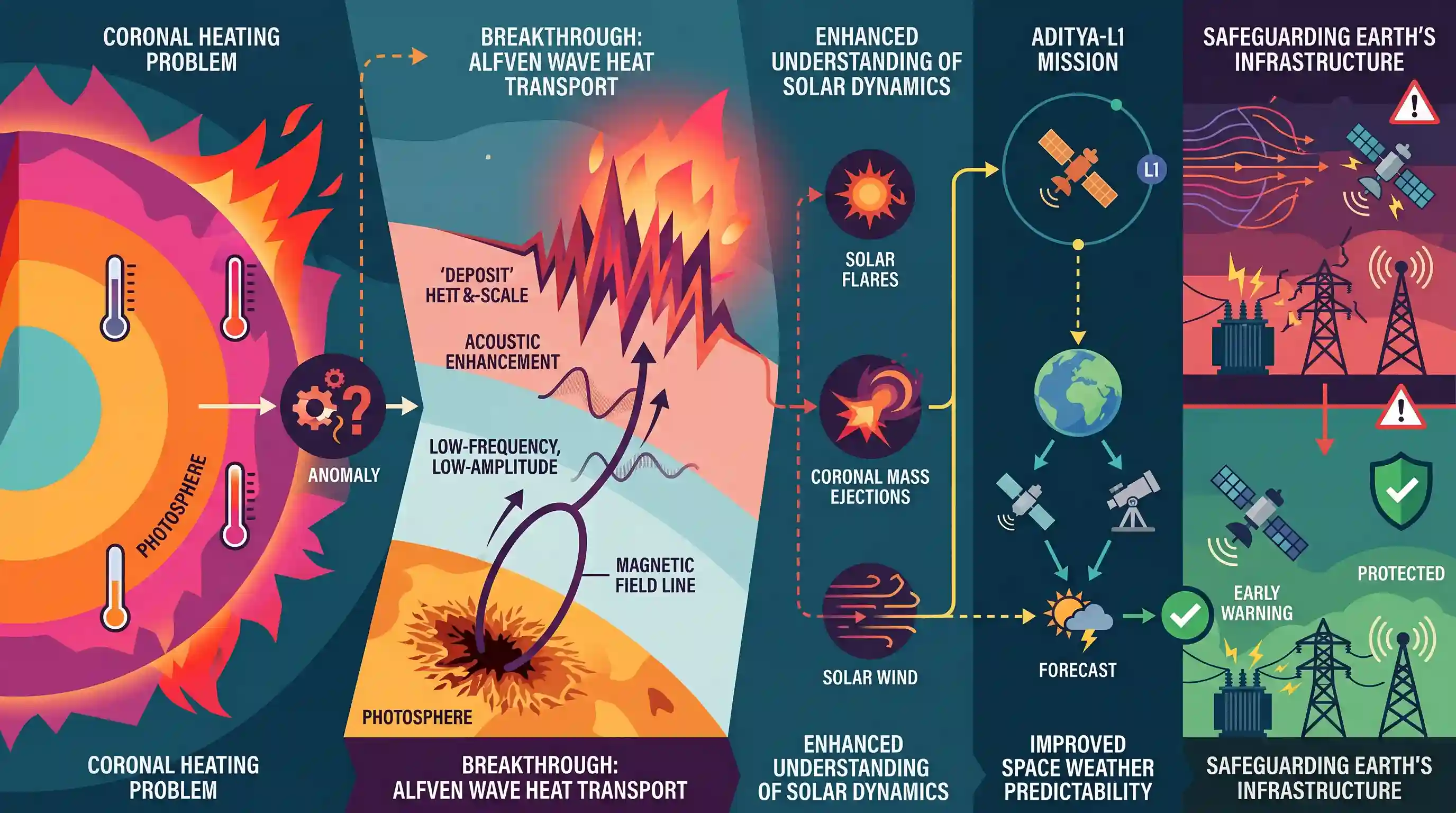
Why It Matters
The study unravels fundamental mechanisms behind solar coronal heating, directly relevant to the generation of space weather. Understanding these dynamics is critical for protecting Earth's strategic infrastructure (power grids, GPS, communication satellites) from solar storms, and conceptually overlaps with the scientific objectives of India's Aditya-L1 mission.
Summary
A study utilizing the Daniel K. Inouye Solar Telescope has provided breakthrough insights into the 'coronal heating problem'—the longstanding anomaly where the Sun's outer atmosphere is significantly hotter than its surface. Researchers discovered that low-frequency magnetic waves, or Alfven waves, travel along magnetic field lines rooted in sunspots and undergo 'acoustic enhancement' to efficiently transport and deposit immense heat into the corona. Resolving this thermodynamic mystery enhances our understanding of solar dynamics and improves the predictability of space weather events, such as solar flares and coronal mass ejections, which are vital for safeguarding Earth's critical space and ground-based infrastructure.
Key Points
- The solar corona (outer atmosphere) exceeds a million degrees Celsius, vastly hotter than the photosphere (surface) at 6,000 degrees, creating the 'coronal heating problem'.
- Low-frequency magnetic waves, known as Alfven waves, traveling along magnetic field lines act as efficient energy transporters from the cooler surface to the hotter corona.
- The Daniel K. Inouye Solar Telescope (DKIST) in Hawaii captured these magnetic waves within sunspots, utilizing Doppler shifts to track plasma movement.
- The study reveals that these low-frequency waves undergo 'acoustic enhancement,' allowing them to effectively convert magnetic energy into intense heat in the upper atmosphere.
- Understanding coronal heating is essential for predicting severe space weather, such as coronal mass ejections, which can disrupt Earth's power grids, navigation satellites, and communication networks.
Important Terms
Coronal Heating Problem

A paradox where the Sun’s outer atmosphere (corona) is millions of degrees hotter than its surface (photosphere), contrary to the thermodynamic expectation of temperature decreasing away from a heat source.
UPSC context
GS Paper 3 (S&T); tests knowledge of solar dynamics and mysteries central to missions like Aditya-L1.
Alfven Waves
Low-frequency magnetic waves in plasma that travel along magnetic field lines. They transport energy from the solar surface to the corona, recently identified as a key driver of coronal heating.
UPSC context
GS Paper 3 (S&T); relevant for space physics, magnetohydrodynamics, and energy transfer mechanisms.
Aditya-L1 Mission
India's first dedicated space-based observatory for solar research, positioned at the Lagrange Point 1 (L1). It carries seven indigenous payloads to study solar atmospheric layers and space weather.
UPSC context
GS Paper 3 (Space Tech); tests awareness of major national space achievements and their scientific objectives.
Space Weather
Variable environmental conditions in space, primarily driven by solar activity. These conditions, such as solar winds and flares, can disrupt satellites, GPS navigation, and terrestrial power grids.
UPSC context
GS Paper 3 (S&T / Disaster Management); vital for understanding risks to global technology infrastructure.
Daniel K. Inouye Solar Telescope (DKIST)
The world’s largest and most powerful ground-based solar telescope, located in Hawaii. It uses a 4-meter mirror to capture high-resolution data on the Sun’s magnetic fields and atmosphere.
UPSC context
GS Paper 3 (S&T); represents global state-of-the-art solar observation technology complementing Indian missions.
Coronal Mass Ejection (CME)
Massive expulsions of magnetized plasma and magnetic fields from the Sun's corona into space. They are the primary drivers of geomagnetic storms that can affect Earth’s electronic systems.
UPSC context
GS Paper 3 (S&T); important for solar-terrestrial physics and its impacts on communication infrastructure.
Prelims Trap
The Sun's photosphere is vastly hotter than its corona due to its proximity to the nuclear core.
This is the exact opposite of reality. The 'coronal heating problem' refers to the anomaly where the corona is >1 million °C while the surface (photosphere) is just ~5,500 °C.
Static Concepts Connected
What are the three main layers of the Sun's atmosphere?
- Photosphere: The lowest visible layer (surface) of the Sun, with an average temperature of about 5,500 °C to 6,000 °C.
- Chromosphere: The middle layer, appearing red during solar eclipses due to hydrogen alpha emissions, located just above the photosphere.
- Corona: The extended outermost layer, reaching temperatures over 1 million °C. It is the primary focus of the coronal heating problem.
What are Alfvén waves in solar physics?
- Plasma waves: They are low-frequency magnetohydrodynamic (MHD) waves that travel through electrically conducting fluids like plasma.
- Energy transport: They propagate along magnetic field lines, carrying massive amounts of magnetic energy from the cooler solar surface outward to the corona.
Cross-Topic Patterns
Space weather & Earth's magnetic shield
High-energy particles from CMEs interact with Earth's magnetosphere, creating auroras but also inducing currents (GICs) that can fry ground-based transformers and disrupt low-Earth orbit satellites.
Aditya-L1 vs Ground Observatories
Ground telescopes like DKIST rely on massive mirrors but face atmospheric distortion. Space missions like Aditya-L1 at L1 can view deep UV and X-ray emissions that Earth's atmosphere completely absorbs.

The 'coronal heating problem' and Alfvén waves are prime targets for a 2026 multi-statement question paired with Aditya-L1's objectives.
Linked PYQs · 2
Linked PYQs · 2
- 2025PrelimsGS1
Consider the following statements : Statement I: Scientific studies suggest that a shift is taking place in the Earth's rotation and axis. Statement II: Solar flares and associated coronal mass ejections bombarded the Earth's outermost atmosphere with tremendous amount of energy. Statement III : As the Earth's polar ice melts, the water tends to move towards the equator. Which one of the following is correct in respect of the above statements?
- 2022PrelimsGS1
If a major solar storm (solar flare) reaches the Earth, which of the following are the possible effects on the Earth? 1. GPS and navigation systems could fail. 2. Tsunamis could occur at equatorial regions. 3. Power grids could be damaged. 4. Intense auroras could occur over much of the Earth. 5. Forest fires could take place over much of the planet. 6. Orbits of the satellites could be disturbed. 7. Shortwave radio communication of the aircraft flying over polar regions could be interrupted. Select the correct answer using the code given below:
