US Venezuela Geopolitical Tensions Escalate Over Counter Narcotics Ops
Source:Indian Express ↗
Why It Matters
The ongoing US-Venezuela friction exemplifies the use of transnational organized crime (narcotics trafficking) as a geopolitical flashpoint, relevant to GS2 International Relations and GS3 Internal Security. It also carries significance for Prelims map-based questions concerning the Caribbean and Latin America.
Summary
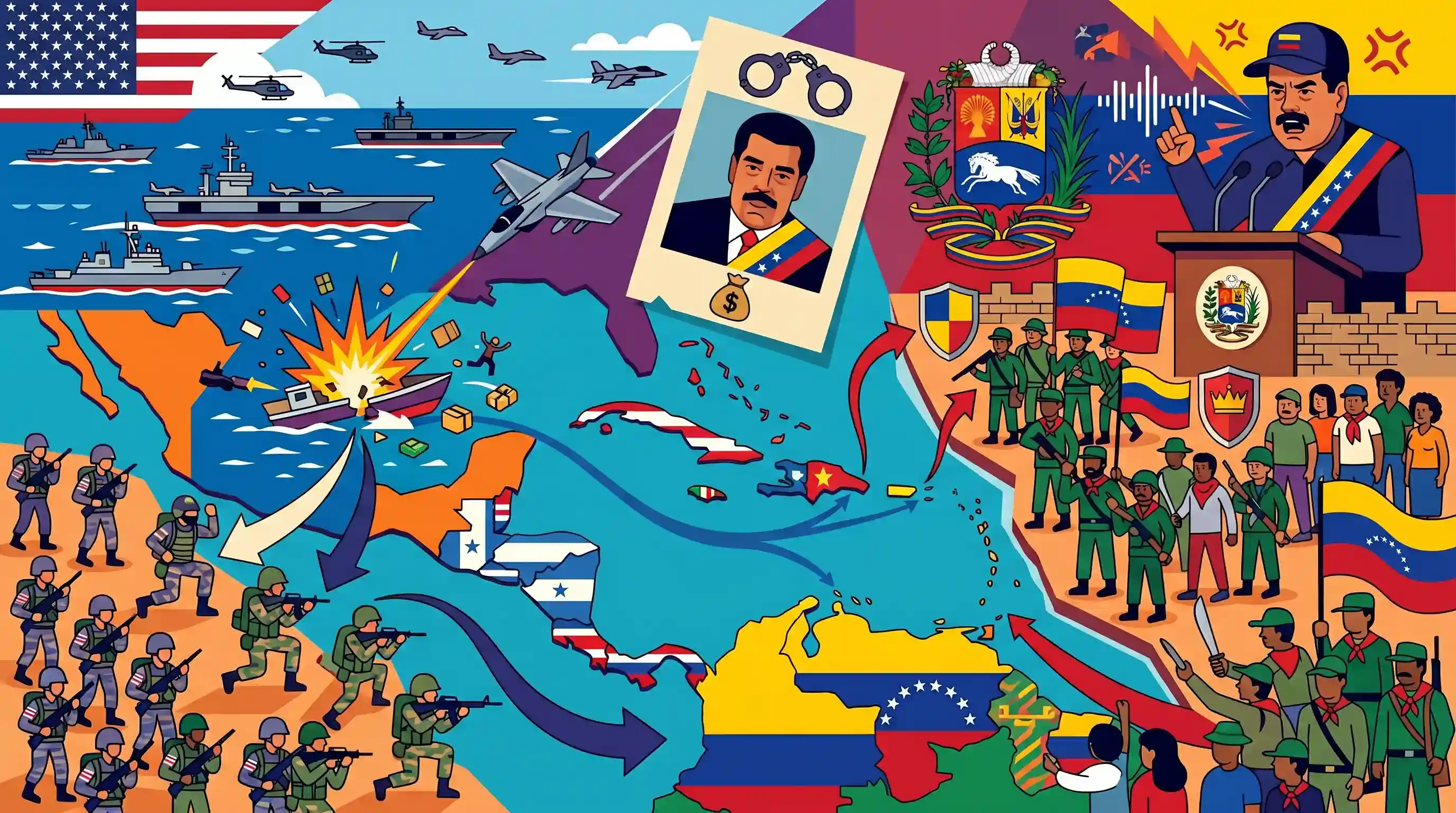
Venezuelan President Nicolás Maduro has pledged to defend the nation's sovereignty in response to escalating tensions with the United States. Following a recent US strike in the Caribbean that destroyed a boat purportedly linked to the Venezuelan transnational gang Tren de Aragua, the US expanded its counter-narcotics operations, deploying naval assets and over 4,000 troops to the region. The US also doubled its reward for Maduro's arrest to $50 million. Maduro has denounced these actions as a thinly veiled attempt at regime change disguised as anti-drug operations and has mobilized civilian militias, warning of an armed struggle against any direct US intervention.
Key Points
- Tensions between the US and Venezuela have escalated following a US anti-narcotics strike in the Caribbean Sea that sank a vessel allegedly tied to the Tren de Aragua gang, resulting in 11 deaths.
- The US has intensified its presence in the region by deploying over 4,000 troops and naval assets for counter-drug operations and doubled the bounty for Maduro's arrest to $50 million.
- Venezuelan President Nicolás Maduro condemned the military build-up, accusing the US of using fabricated drug-trafficking claims as a pretext to initiate regime change.
- In response to perceived US aggression, Maduro is overseeing the mobilization of civilian militias and has warned of an "armed struggle" to defend Venezuela's sovereignty.
Important Terms
Tren de Aragua

A Venezuelan-origin transnational criminal organization that expanded across the Americas; it engages in trafficking, extortion, and murder, often embedded within migrant communities.
UPSC context
GS Paper II/III: Important for topics on regional security, transnational crime, and international relations in the Western Hemisphere.
Narco-terrorism
The symbiotic relationship between drug trafficking networks and terrorist/state actors, where drug profits fund violent activities to achieve political or strategic objectives.
UPSC context
GS Paper III: Central to internal security and the nexus between organized crime and terrorism.
State Sovereignty
The international law principle that a state has supreme authority over its territory and domestic affairs, generally prohibiting external interference in another country's internal matters.
UPSC context
GS Paper II: Essential for debates on unilateralism, the UN Charter, and rules-based international order.
Monroe Doctrine
A 1823 US policy opposing external interference in the Americas; its modern 'corollaries' are often cited to justify US military and political intervention in Latin America.
UPSC context
GS Paper II: Historical and geopolitical context for US-Latin America relations and major power rivalry.
Transnational Organized Crime
Criminal activities coordinated across national borders by groups using illegal methods (trafficking, money laundering) to gain power or profit, often challenging state authority.
UPSC context
GS Paper III: Security challenges; also GS Paper II regarding international cooperation and conventions like UNTOC.
Narcotics Rewards Program (NRP)
A US government initiative offering financial rewards for information leading to the arrest or conviction of major international drug traffickers and their associates.
UPSC context
GS Paper II: Tool of foreign policy and extraterritorial judicial reach used by major powers.
Prelims Trap
"Saudi Arabia holds the world's largest proven crude oil reserves."
While the US and Saudi Arabia are often the world's leading oil producers, Venezuela actually holds the world's largest proven crude oil reserves (over 300 billion barrels).
Static Concepts Connected
What are the key geographical features of Venezuela?
- Bordering Nations: Shares land borders with Colombia (west), Brazil (south), and Guyana (east).
- Maritime Access: Opens to the Caribbean Sea and the Atlantic Ocean to the north, offering strategic maritime access.
- Resource Geography: Holds the world's largest proven crude oil reserves, largely concentrated in the Orinoco Belt and Lake Maracaibo.
How does international law view unilateral military action against non-state actors?
- UN Charter Prohibition: Article 2(4) of the UN Charter prohibits the threat or use of force against the territorial integrity or political independence of any state.
- Self-Defense Limits: Article 51 permits self-defense, but applying this to strike cartels or gangs in foreign territory without host-state consent is highly contested in international law.
- Sovereignty vs Intervention: Unilateral military operations disguised as counter-narcotics often spark debates over the violation of state sovereignty versus global security necessities.
Cross-Topic Patterns
Organised crime and terrorism nexus
The 'Tren de Aragua' case directly maps to GS-3 Security, highlighting how transnational syndicates blur the lines between narco-trafficking and terrorism, mirroring India's own challenges with the Golden Crescent/Triangle.
Geopolitics of oil and sanctions
Venezuela's paradox of holding massive oil reserves yet facing hyperinflation serves as a classic GS-2 case study on the crippling impact of unilateral US sanctions on a nation's economy.

Expect a 2026 Prelims mapping question matching South American countries with their bordering water bodies or key resource hubs (Orinoco).
Linked PYQs · 4
Linked PYQs · 4
- 2024MainsGS3
Explain how narco-terrorism has emerged as a serious threat across the country. Suggest suitable measures to counter narco-terrorism.
- 2022MainsGS3
Discuss the types of organised crimes. Describe the linkages between terrorists and organised crime that exist at the national and transnational levels.
- 2024PrelimsGS1
Consider the following statements : Statement-I : Recently, Venezuela has achieved a rapid recovery from its economic crisis and succeeded in preventing its people from fleeing/emigrating to other countries. Statement-II : Venezuela has the world's largest oil reserves. Which one of the following is correct in respect of the above statements?
- 2025PrelimsGS1
Consider the following countries : I. Bolivia II. Brazil III. Colombia IV. Ecuador V. Paraguay VI. Venezuela Andes mountains pass through how many of the above countries?
