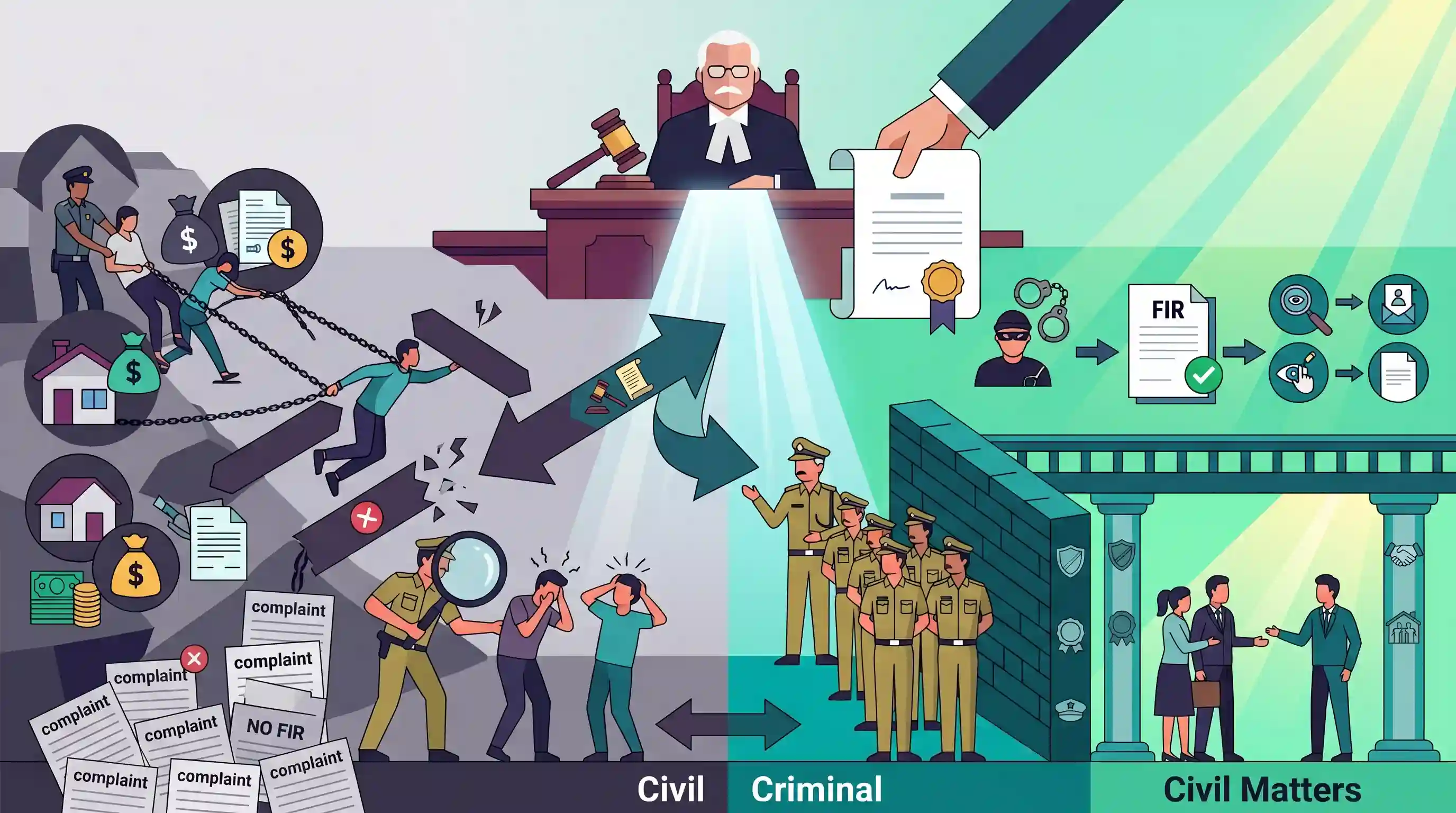
Madras High Court cracks down on police overreach in civil disputes
Source:The Hindu ↗
Why It Matters
Highlights the ongoing governance challenge of police overreach and the unauthorized use of procedural laws (like CrPC summons) to settle civil disputes. It is highly relevant for GS2 (Governance, Police Reforms, Functioning of the Executive) and GS4 (Code of Conduct, Ethics in Public Administration, Misuse of Authority).
Summary
The Madurai Bench of the Madras High Court ordered the Director General of Police (DGP) of Tamil Nadu to take stringent action against police officers who unlawfully interfere in civil disputes under the guise of conducting criminal investigations. Justice B. Pugalendhi noted a persistent trend where police officers summon individuals involved in civil, money, or property disputes by misusing Sections 91 and 160 of the Code of Criminal Procedure (CrPC). The court emphasized that these sections can only be invoked after a First Information Report (FIR) has been officially registered for a criminal offense. Conducting inquiries or issuing summons for unregistered complaints of a civil nature violates the Police Standing Orders (PSO), Supreme Court directives, and multiple DGP circulars. The judgment reinforces the boundary between civil and criminal jurisdictions, aiming to prevent police overreach and the harassment of citizens.
Key Points
- The Madras High Court directed the Tamil Nadu DGP to take strict disciplinary action against police officers interfering in civil disputes.
- The court clarified that Sections 91 and 160 of the Code of Criminal Procedure (CrPC) can only be used to issue summons after a criminal case is registered, not during the preliminary enquiry of civil complaints.
- Police intervention in matters like money, property, or intellectual property disputes violates the Police Standing Orders (PSO), Supreme Court guidelines, and explicit DGP circulars from 2008 and 2024.
- The ruling aims to curb the misuse of police power, where officers effectively run parallel 'kangaroo courts' to harass citizens and unlawfully mediate civil disputes.
Important Terms
Code of Criminal Procedure (CrPC)

The primary legislation governing criminal investigation and trial procedures in India; now replaced by the Bharatiya Nagarik Suraksha Sanhita (BNSS) as of July 2024.
UPSC context
GS Paper-II (Governance/Judiciary); fundamental for understanding the legal framework and recent overhauls in the criminal justice system.
Section 160 of CrPC
A legal provision empowering police to summon witnesses acquainted with a case for investigation, provided an FIR has been officially registered.
UPSC context
GS Paper-II (Statutory Powers); critical for analyzing police accountability and citizen protections against arbitrary executive summons.
Section 91 of CrPC
A provision allowing courts or police to order the production of documents or items necessary for an investigation, inquiry, or trial.
UPSC context
GS Paper-II/III; highlights the balance between investigative powers, the right to privacy, and executive overreach.
Police Standing Orders (PSO)
State-specific administrative manuals governing police conduct, station management, and investigation protocols; they serve as binding executive instructions for law enforcement.
UPSC context
GS Paper-II (Governance); essential for understanding internal administrative checks on police discretion and state-level law enforcement frameworks.
Police Reforms
Systemic measures, such as the Prakash Singh directives, aimed at professionalizing the force and insulating it from political interference to ensure the rule of law.
UPSC context
GS Paper-II/III (Governance/Security); a recurring topic regarding institutional integrity, transparency, and human rights.
Separation of Jurisdictions
The legal boundary preventing the criminal justice system from being used to adjudicate private money or property disputes, which belong to civil courts.
UPSC context
GS Paper-II (Judiciary/Rule of Law); tests understanding of the limits of police power and the prevention of harassment.
Prelims Trap
"Police officers possess statutory powers to issue summons for preliminary inquiries into civil disputes to maintain public order."
Police cannot issue legal summons under CrPC/BNSS for unregistered civil disputes. Summons for documents/witnesses strictly require a formally registered criminal FIR first.
Static Concepts Connected
What are the Lalita Kumari (2014) guidelines regarding FIR registration?
- Mandatory FIR: Police must compulsorily register an FIR if a complaint discloses a cognizable offense; no preliminary inquiry is permitted in such clear-cut cases.
- Preliminary Inquiry Scope: Only permitted in specific categories (matrimonial, commercial, medical negligence) strictly to ascertain if a cognizable offense occurred, not to verify the complaint's truthfulness.
- Strict Timeframe: Such inquiries must generally be concluded within 7 days, preventing police from indefinitely dragging cases to unlawfully mediate or harass parties.
How do statutory provisions regulate police summons for witnesses (CrPC 160 / BNSS 179)?
- Post-FIR Constraint: Summons for witness appearance can only be legally issued after a criminal FIR is officially registered, strictly barring their use in civil matters.
- Vulnerable Groups Exemption: Women, children under 15, persons over 65, and persons with disabilities cannot be summoned to a police station; they must be examined at their residence.
Cross-Topic Patterns
Police Reforms & Prakash Singh directives
Unauthorized police mediation highlights the ongoing failure to implement State Police Complaints Authorities, mandated by the Supreme Court in the Prakash Singh case to check arbitrary power misuse.
Article 21 vs. Extra-legal summons
Using criminal investigative powers for civil debt recovery acts as unlawful state coercion, linking administrative overreach directly to violations of fundamental rights under Article 21.

Expect a Prelims statement testing the limits of police summons under BNSS and the Lalita Kumari guidelines on mandatory FIR registration.
Linked PYQs · 3
Linked PYQs · 3
- 2021PrelimsGS1
With reference to India, consider the following statements : 1. Judicial custody means an accused is in the custody of the concerned magistrate and such accused is locked up in police station, not in jail. 2. During judicial custody, the police officer in charge of the case is not allowed to interrogate the suspect without the approval of the court. Which of the statements given above is/are correct?
- 2024MainsGS4
“The 'Code of Conduct' and 'Code of Ethics' are the sources of guidance in public administration. There is code of conduct already in operation, whereas code of ethics is not yet put in place. Suggest a suitable model for code of ethics to maintain integrity, probity and transparency in governance.”
- 2020MainsGS2
Judicial Legislation is antithetical to the doctrine of separation of powers as envisaged in the Indian Constitution. In this context justify the filing of large number of public interest petitions praying for issuing guidelines to executive authorities.
