Madras High Court upholds Tamil Nadu comprehensive mini bus scheme
Source:The Hindu ↗
Why It Matters
This article provides an excellent contemporary example of the judiciary interpreting fundamental rights (Article 19) in the context of state infrastructure policies. It also reinforces the doctrine of separation of powers, specifically the limitations on judicial review over executive policy decisions, which is a frequent theme in GS Paper 2.
Summary
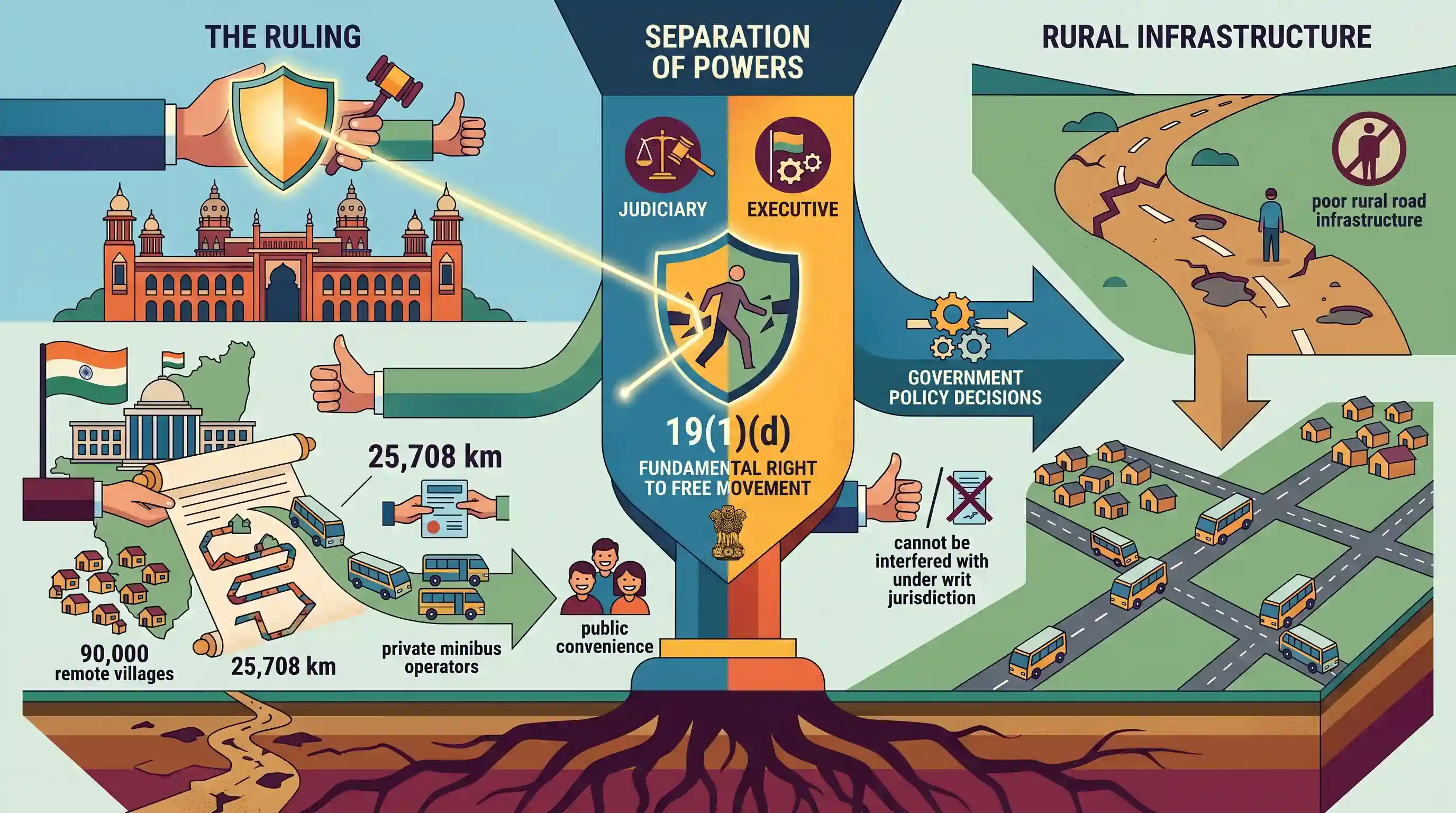
The Madras High Court has upheld the Tamil Nadu government’s New Comprehensive Mini Bus Scheme, which permits private minibus operators to run services on 25,708 km of routes, aimed at connecting 90,000 remote villages. Justice N. Mala validated the scheme on the grounds of public convenience and constitutional rights, agreeing with Advocate General P.S. Raman that it facilitates the fundamental right to free movement under Article 19(1)(d). Furthermore, the ruling emphasized the separation of powers by stating that government policy decisions made for public welfare, such as addressing poor rural road infrastructure through minibuses, cannot be interfered with under writ jurisdiction.
Key Points
- The Madras High Court upheld the Tamil Nadu government's New Comprehensive Mini Bus Scheme, which grants permits to private minibus operators.
- The scheme aims to ensure last-mile connectivity by covering 25,708 km to reach 90,000 unserved rural villages and hamlets.
- The court ruled that providing connectivity to remote areas furthers the constitutional right to free movement under Article 19(1)(d).
- Justice N. Mala reiterated that government policy decisions cannot be reviewed by the courts under writ jurisdiction, underscoring the limits of judicial review.
Important Terms
New Comprehensive Mini Bus Scheme

A 2024-25 Tamil Nadu initiative permitting private minibuses on routes up to 25 km, primarily (65-70%) in unserved rural areas to provide last-mile connectivity.
UPSC context
GS Paper 2: Government Policies; GS Paper 3: Infrastructure. Tests understanding of rural-urban connectivity and public transport regulation.
Article 19(1)(d)
A Fundamental Right guaranteeing Indian citizens the freedom to move freely throughout the country's territory, subject to reasonable restrictions.
UPSC context
GS Paper 2: Indian Constitution. Tests knowledge of individual liberties and their application in upholding welfare schemes.
Judicial Review of Policy
The power of the Judiciary to examine the constitutionality of legislative and executive actions, though courts typically exercise restraint regarding policy matters.
UPSC context
GS Paper 2: Separation of Powers and Judiciary. Tests understanding of the boundaries between judicial oversight and executive policymaking.
Last-mile Connectivity
The final segment of a journey connecting remote habitations to main transport hubs like bus stands or railway stations.
UPSC context
GS Paper 3: Infrastructure and Development. Key term for transportation planning and rural accessibility challenges.
Writ Jurisdiction
The authority of High Courts (Article 226) and the Supreme Court (Article 32) to issue orders for enforcing rights or for any other purpose.
UPSC context
GS Paper 2: Judiciary. Tests knowledge of constitutional remedies and the scope of court intervention in administrative decisions.
Prelims Trap
Government policy decisions are absolutely immune from judicial review under the writ jurisdiction of High Courts.
Courts practice restraint regarding executive policies, but they are not absolutely immune. Courts can strike down policies if they are unconstitutional, manifestly arbitrary, or ultra vires.
Static Concepts Connected
When can courts interfere in executive policy under writ jurisdiction?
- Manifest Arbitrariness: Policies can be struck down if they are unreasonable, capricious, or violate the right to equality under Article 14.
- Constitutional Violation: If the policy contravenes Fundamental Rights (Part III) or other provisions enshrined in the Constitution.
- Statutory Overreach: If the executive policy is ultra vires, meaning it exceeds the powers explicitly granted by the parent statute.
How does Article 19(1)(d) differ from Article 21 regarding freedom of movement?
- Internal Movement: Article 19(1)(d) guarantees the right to move freely only *within* the territory of India, subject to restrictions like public interest or ST protection.
- Foreign Travel: The right to travel abroad is not covered by Article 19(1)(d). It falls under the broader right to personal liberty in Article 21 (established in Maneka Gandhi case).
Cross-Topic Patterns
Infrastructure as a Rights-Enabler
The judiciary increasingly links physical infrastructure (like transport schemes or Kerala's internet fiber network) to Part III rights, treating state utilities as essential enablers of fundamental freedoms.
Union PMGSY + State utility synergy
PMGSY (Centrally Sponsored Scheme) builds the physical all-weather rural roads, but state-level utility policies (like TN's minibus scheme) are required to actually operationalize these routes and drive socio-economic integration.

Expect a Mains GS2 question on how the judiciary expands Part III rights by interpreting physical infrastructure as essential enablers.
Linked PYQs · 3
Linked PYQs · 3
- 2020MainsGS2
Judicial Legislation is antithetical to the doctrine of separation of powers as envisaged in the Indian Constitution. In this context justify the filing of large number of public interest petitions praying for issuing guidelines to executive authorities.
- 2022MainsGS3
Why is Public Private Partnership (PPP) required in infrastructural projects ? Examine the role of PPP model in the redevelopment of Railway Stations in India.
- 2024MainsGS3
What is the need for expanding the regional air connectivity in India? In this context, discuss the government's UDAN Scheme and its achievements.
