Madras High Court Restrains ECI From Notifying Five Byelections
Source:The Hindu ↗
Why It Matters
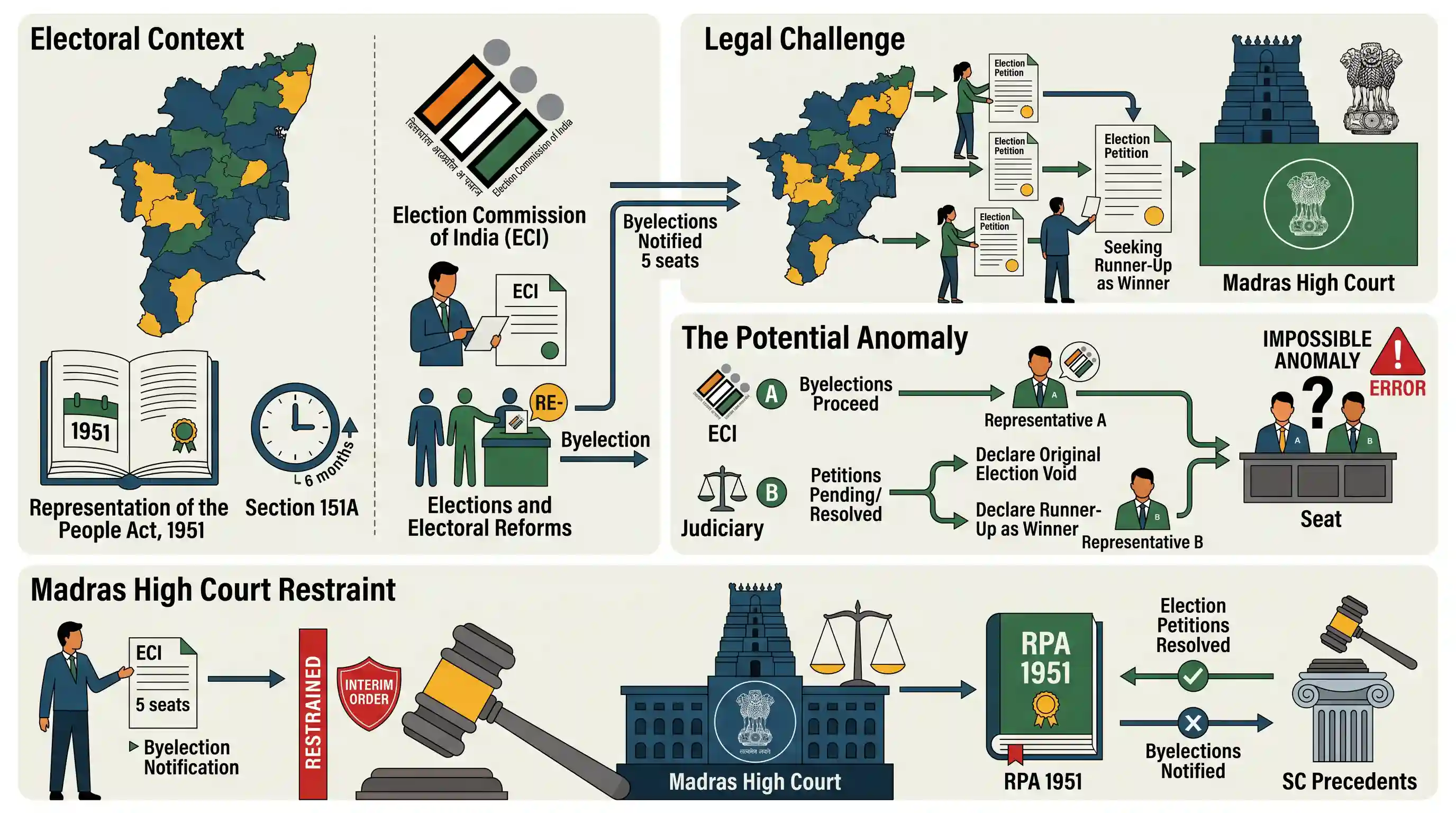
This development demonstrates the legal limits on the Election Commission of India's mandate to hold byelections (Section 151A of RPA, 1951) when elections are challenged in court. It provides a real-world case study on the mechanism of election petitions, judicial review of electoral processes under Article 329(b), and the prevention of democratic/constitutional anomalies.
Summary
The Madras High Court has restrained the Election Commission of India (ECI) from notifying byelections in five Tamil Nadu assembly constituencies because the validity of the original elections in those seats is currently being challenged through active election petitions. The court's interim ruling avoids a potential legal anomaly where a constituency could end up with two representatives if a byelection is held while a petition seeking to declare a runner-up as the winner is still pending. The case revolves around Section 151A of the Representation of the People Act, 1951, and key Supreme Court precedents establishing that byelections cannot proceed until pending election petitions are resolved.
Key Points
- The Madras High Court issued an interim stay restraining the ECI from notifying byelections in five Tamil Nadu assembly constituencies (Tiruchi East, Perundurai, Ambasamudram, Viralimalai, and Karur) until July 31, 2026.
- The order came in response to a PIL highlighting that original victories in these constituencies from the 2026 state assembly elections have been challenged via pending election petitions.
- The PIL argued that holding byelections before the disposal of pending election petitions could create an anomalous situation where two individuals legally claim to represent a single constituency if the election petitions are later allowed.
- Section 151A of the Representation of the People Act (RPA), 1951 mandates filling casual vacancies within six months, but Supreme Court rulings dictate that a vacancy is not 'clear' if election petitions are actively pending adjudication.
- Key Supreme Court precedents cited include Sanjeevayya v. ECI (1967), ECI v. Telangana Rashtra Samithi (2011), and Pramod Laxman Gudadhe v. ECI (2018), which bar byelections under such sub-judice conditions.
- The Advocate General presented a nuanced argument distinguishing between representatives who resigned prior to the filing of the election petitions and those who resigned after. The court will examine this aspect during the next hearing.
- The High Court rejected locus standi objections against the PIL petitioner, stating that a narrow interpretation of standing cannot apply to matters concerning the 'purity of the democratic process'.
Important Terms
Representation of the People Act, 1951

A parliamentary Act that governs the actual conduct of elections to both Houses of Parliament and State Legislatures, including qualifications, disqualifications, corrupt practices, and election disputes.
UPSC context
GS Paper II: Salient features of the Representation of the People Act, critical for understanding electoral governance and legislative accountability.
Election Petition
A specialized legal proceeding used to challenge the validity of an election result in Parliament or State Assemblies, filed exclusively in the High Court under Article 329(b) of the Constitution.
UPSC context
GS Paper II: Dispute redressal mechanisms, testing knowledge of judicial oversight and constitutional remedies in the democratic process.
Section 151A of the RP Act, 1951
A statutory provision mandating that casual legislative vacancies must be filled via bye-elections within six months, subject to specific exceptions like a remaining term of less than a year.
UPSC context
GS Paper II: Electoral reforms and procedures, testing statutory timelines and exceptions for holding bye-elections in vacant constituencies.
Election Commission of India
A permanent, autonomous constitutional body established under Article 324 of the Constitution to administer union and state election processes in India.
UPSC context
GS Paper II: Constitutional bodies, testing structural powers, functions, and autonomous role of the election watchdog.
Constitution of India
The supreme legal document that lays down the framework defining fundamental political principles, establishing the structure, procedures, powers, and duties of government institutions.
UPSC context
GS Paper II: Indian Constitution, core foundational topic testing the bedrock of political system, fundamental rights, and division of powers.
Prelims Trap
The ECI must conduct a byelection within six months of any vacancy, subject only to the remaining term being less than one year.
Section 151A also allows exceptions if ECI and Central Govt certify difficulty, or if judicial precedents deem a vacancy 'unclear' due to pending election petitions.
Static Concepts Connected
How are election disputes adjudicated under the RPA, 1951?
- Original Jurisdiction: The High Court holds original jurisdiction to try election petitions, rather than dedicated administrative tribunals.
- Locus Standi: Only a candidate or an elector from the respective constituency has the standing to file an election petition.
- Strict Timeline: Petitions must be filed within 45 days of result declaration; trials should ideally conclude within 6 months.
What is the 'clear vacancy' doctrine for legislative byelections?
- Section 151A RPA: Mandates filling casual vacancies within six months unless the remaining term of the legislature is under one year.
- Judicial Restriction: A vacancy is not 'clear' if an active election petition seeks to declare the runner-up as the winner.
- Constitutional Anomaly: Prevents a constitutional deadlock where a single constituency is simultaneously claimed by two separate representatives.
Cross-Topic Patterns
Voter representation vs electoral purity
Balances the voter's right to prompt legislative representation against the judicial duty to ensure the purity of the democratic process by resolving electoral malpractice claims first.
Judicial Review vs Article 329(b)
Highlights the boundary between Article 329(b)'s bar on court interference in elections and the High Court's Article 226 power to review administrative ECI notifications.

The 2026 Prelims will likely test exceptions to RPA Section 151A and the specific locus standi rules governing election petitions.
Linked PYQs · 2
Linked PYQs · 2
- 2022MainsGS2
Discuss the procedures to decide the disputes arising out of the election of a Member of the Parliament or State Legislature under The Representation of the People Act, 1951. What are the grounds on which the election of any returned candidate may be declared void ? What remedy is available to the aggrieved party against the decision ? Refer to the case laws.
- 2019MainsGS2
On what grounds a people's representative can be disqualified under the Representation of Peoples Act, 1951? Also mention the remedies available to such person against his disqualification.
