CDSCO Medical Device Rules and Retrospective Regulation Challenges
Source:The Hindu ↗
Why It Matters
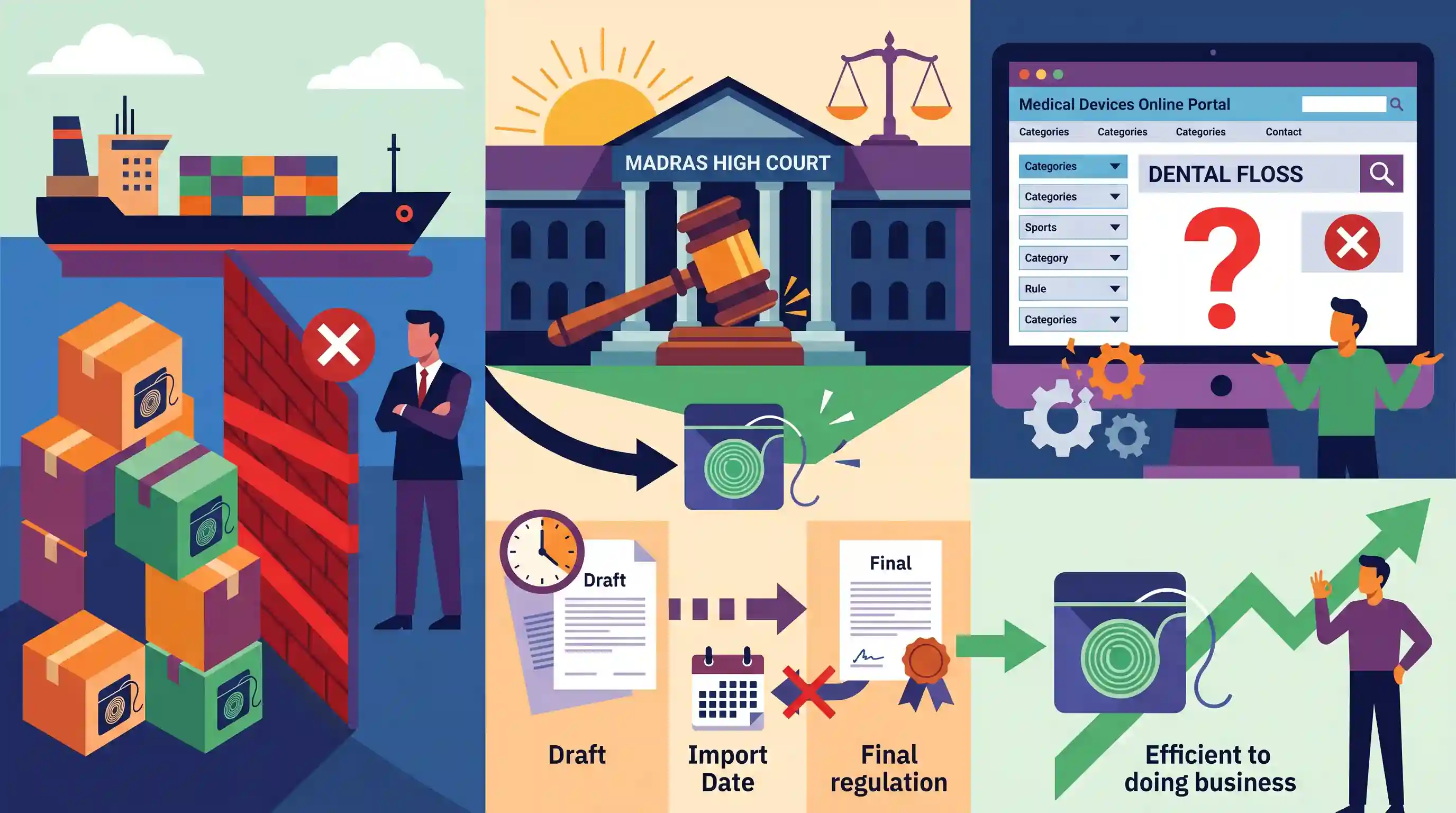
This case illustrates key principles of administrative law, specifically the non-retrospective application of draft rules. It also highlights the challenges businesses face due to inadequate digital regulatory infrastructure (like missing portal options), underscoring the need for transparent, predictable, and functional regulatory bodies (like CDSCO) to ensure ease of doing business and steady supply chains.
Summary
The Madras High Court ruled in favor of Gillette India Limited, allowing the company to take possession of imported dental floss without registering it as a medical device under the Medical Devices Rules, 2017. The court quashed the CDSCO's refusal to issue a No Objection Certificate (NOC), noting that the mandatory registration notification was only in a draft stage when the goods were imported and thus could not be enforced retrospectively. Furthermore, the court observed that the medical devices online portal lacked an option for registering dental floss, making compliance practically impossible and highlighting systemic gaps in regulatory enforcement.
Key Points
- The Madras High Court permitted Gillette India Limited to clear its imported consignment of dental floss without registering it as a medical device under the Medical Devices Rules, 2017.
- The court set aside the CDSCO's refusal to grant a No Objection Certificate (NOC), noting that the mandatory registration requirement was formalized on January 6, 2025, long after the goods were imported.
- The court reiterated the legal principle that draft rules and notifications cannot be enforced retrospectively to penalize or restrict actions taken before their finalization.
- The judgment highlighted a flaw in the regulatory infrastructure, pointing out that the CDSCO's online portal lacked a category to register dental floss, making legal compliance impossible for the importer.
Important Terms
Central Drugs Standard Control Organisation (CDSCO)

India’s national regulatory body for pharmaceuticals, cosmetics, and medical devices. It functions under the Directorate General of Health Services and oversees clinical trials, quality standards, and import/manufacturing licenses.
UPSC context
GS Paper II: Statutory and Regulatory Bodies. Tests knowledge of specialized health agencies and their role in public safety.
Medical Devices Rules, 2017
A comprehensive regulatory framework that classifies medical devices into four risk categories (Class A to D). It harmonizes Indian standards with global practices and streamlines licensing for manufacturers and importers.
UPSC context
GS Paper II & III: Governance and Economy. Relevant for healthcare regulation and the 'Make in India' initiative.
Drugs and Cosmetics Act, 1940
The foundational legislation governing the import, manufacture, sale, and distribution of drugs and cosmetics in India. It ensures that medical products meet prescribed safety and quality standards.
UPSC context
GS Paper II: Social Justice/Health. Essential for understanding the legal framework of India’s pharmaceutical and healthcare sectors.
Drugs Controller General of India (DCGI)
The head of the CDSCO and the central licensing authority for drugs and specialized medical devices. The DCGI is responsible for approving new drugs and clinical trials across India.
UPSC context
GS Paper II: Regulatory Bodies. Important for administrative hierarchy and the execution of health laws.
Ministry of Health and Family Welfare (MoHFW)
The nodal ministry responsible for health policy, family welfare, and the administrative oversight of departments like the CDSCO. It manages national health programs and health infrastructure.
UPSC context
GS Paper II: Executive and Ministries. Tests knowledge of the central government’s health administration structure.
Retrospective Enforcement
An administrative law principle preventing the application of new rules to actions occurring before the rules were enacted. It protects entities from being penalized for non-compliance with non-existent or draft laws.
UPSC context
GS Paper II: Administrative Law/Judiciary. Tests understanding of the limits of executive power and judicial protection of rights.
Prelims Trap
Delegated legislation can never be applied retrospectively under any circumstances in India.
Subordinate or delegated legislation can be applied retrospectively, but only if the parent statute expressly authorizes it. Without explicit statutory authorization, executive rules are prospective.
Static Concepts Connected
What is the statutory mandate and structure of the CDSCO?
- Parent Statute: Derives regulatory authority from the Drugs and Cosmetics Act, 1940, functioning as India's National Regulatory Authority (NRA).
- Nodal Ministry: Operates under the Directorate General of Health Services within the Ministry of Health and Family Welfare.
- Core Functions: Responsible for approval of new drugs, clinical trials, and laying down standards for drugs and medical devices.
How does the Medical Devices Rules, 2017 classify products?
- Risk-Based Classification: Devices are categorized into four classes (A to D) based on their potential risk, aligning with Global Harmonization Task Force guidelines.
- Risk Categories: Class A is low-risk (e.g., thermometers, dental floss), while Class D encompasses high-risk, life-sustaining devices (e.g., heart valves).
Cross-Topic Patterns
Limits of delegated legislation
Quashing retrospective enforcement of a draft notification illustrates judicial checks on executive overreach, a core GS-2 theme regarding the limits of subordinate rule-making.
E-governance gaps and legal maxims
The court's use of 'Lex non cogit ad impossibilia' links GS-2 e-governance failures (missing portal categories) with administrative law, showing how technical glitches excuse regulatory non-compliance.

Expect a 2026 Prelims statement testing the rule that delegated legislation cannot be retrospective unless allowed by the parent Act.
Linked PYQs · 2
Linked PYQs · 2
- 2015MainsGS2
For achieving the desired objectives, it is necessary to ensure that the regulatory institutions remain independent and autonomous. Discuss in the light of the experiences in recent past.
- 2020MainsGS2
Judicial Legislation is antithetical to the doctrine of separation of powers as envisaged in the Indian Constitution. In this context justify the filing of large number of public interest petitions praying for issuing guidelines to executive authorities.
