Caste Discrimination and Judicial Intervention in Temples
Source:The Hindu ↗
Why It Matters
This case serves as a prime example of the ongoing struggle against caste-based spatial and religious segregation (untouchability). For UPSC aspirants, it provides a critical case study in administrative ethics (GS4) and governance (GS2) regarding how civil servants often prioritize 'law and order' over constitutional rights by coercing marginalized groups, and highlights the active role of Legal Services Authorities in ensuring grassroots justice.
Summary
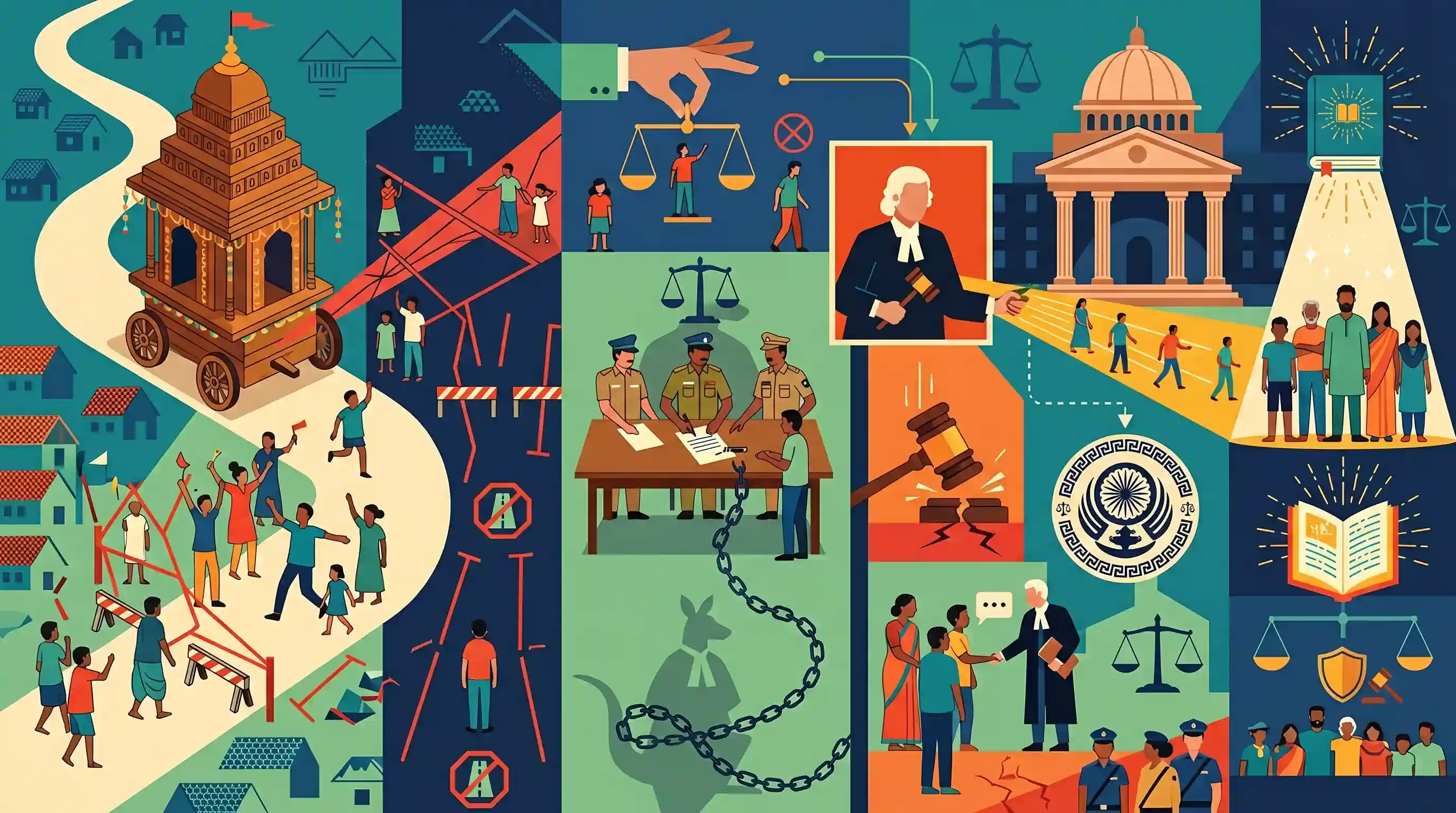
The Madras High Court has directed the Perambalur District Legal Services Authority (DLSA) to investigate a dispute over taking a village temple car through streets predominantly inhabited by Scheduled Caste residents in Veppanthattai village, Tamil Nadu. While the State argued the streets are too narrow for the car, petitioners alleged deliberate caste-based exclusion. Significantly, the court condemned revenue and police officials for forcing marginalized communities to sign compromise agreements during "peace committee" meetings, likening the practice to "kangaroo courts." The court underscored that civil servants must uphold constitutional morality and protect the fundamental rights of vulnerable sections rather than prioritizing superficial law and order at the cost of social justice.
Key Points
- The Madras High Court ordered the Perambalur District Legal Services Authority (DLSA) to conduct a field inquiry into whether a temple car could physically enter streets inhabited by Scheduled Caste residents.
- Scheduled Caste petitioners alleged that dominant caste Hindus were intentionally preventing the temple car from passing through their localities, enforcing untouchability.
- The State claimed the streets were too narrow for the 3.6-metre wide car, prompting the court to seek an independent assessment rather than relying on the state machinery.
- The High Court severely criticized revenue and police officials for running "kangaroo courts" disguised as peace committee meetings to coerce vulnerable groups into signing away their rights.
- The judgment reinforces that the primary duty of the administration is to protect the constitutional rights of marginalized sections, not to suppress them for the sake of majoritarian 'peace'.
Important Terms
Constitutional Morality

Adherence to core constitutional values like equality, liberty, and justice beyond literal text, prioritizing these over majoritarian views or prevailing social norms.
UPSC context
GS II: Indian Constitution, Judiciary. Tests interpretation of judicial doctrines and the transformative nature of the Constitution.
District Legal Services Authority (DLSA)
A statutory body at the district level established under the Legal Services Authorities Act to provide free legal aid and organize Lok Adalats.
UPSC context
GS II: Statutory Bodies, Social Justice. Tests knowledge of mechanisms for legal empowerment and access to justice.
Legal Services Authorities Act, 1987
The 1987 legislation enacted to fulfill Article 39A, providing free and competent legal services to weaker sections and establishing legal aid authorities.
UPSC context
GS II: Important Acts, Judiciary. Essential for understanding the institutional framework of India’s legal aid system.
Social Justice
The principle of ensuring fair distribution of resources and opportunities, particularly for marginalized sections, to correct historical and systemic inequalities.
UPSC context
GS II: Social Justice. Central pillar concerning welfare schemes and the protection of vulnerable sections.
Scheduled Castes (SC)
Communities identified under Article 341 who have historically faced social exclusion and untouchability, entitled to specific constitutional protections and affirmative action.
UPSC context
GS II: Vulnerable Sections. Tests knowledge of safeguards like Article 17 and the SC/ST (Prevention of Atrocities) Act.
Peace Committee
An administrative mechanism led by local officials to resolve communal or local disputes through mediation to maintain public order.
UPSC context
GS II: Governance, Social Justice. Tests administrative conflict resolution and potential misuse of executive power in marginalized areas.
Prelims Trap
The DLSA is purely an advisory body limited strictly to providing free legal counsel to the poor.
DLSAs are statutory bodies under the Legal Services Authorities Act, 1987. They can conduct independent fact-finding inquiries and organize Lok Adalats with civil court powers.
Static Concepts Connected
What is the mandate and composition of the District Legal Services Authority (DLSA)?
- Statutory Basis: Established under the Legal Services Authorities Act, 1987, to operationalize Article 39A (free legal aid).
- Leadership: It is headed by the District Judge who acts as its ex-officio Chairman.
- Functions: Provides free legal aid, organizes Lok Adalats, and can conduct court-mandated field inquiries to evaluate ground realities.
How do Fundamental Rights address spatial and religious segregation?
- Article 15(2): Prohibits the State and citizens from restricting access to public roads, wells, and places of public resort based on caste.
- Article 17: Abolishes 'untouchability', making its practice in any form, including restricting access to religious processions, a punishable offence.
- Statutory Enforcement: The Protection of Civil Rights Act, 1955 provides the legal framework to punish those enforcing religious or social disabilities.
Cross-Topic Patterns
Constitutional Morality vs. Law & Order
Coercing marginalized groups via 'peace committees' highlights the ethical failure of prioritizing short-term administrative expediency over fundamental rights, a recurring theme in GS4 case studies.
Statutory bodies as independent fact-finders
Bypassing local police to use the DLSA for a field inquiry demonstrates how statutory legal aid bodies can act as crucial, independent checks against biased local administration.

A GS4 case study on civil servants balancing 'Constitutional Morality' against majoritarian 'law and order' pressure is highly likely.
Linked PYQs · 4
Linked PYQs · 4
- 2024MainsGS1
Despite comprehensive policies for equity and social justice, underprivileged sections are not yet getting the full benefits of affirmative action envisaged by the Constitution. Comment.
- 2023MainsGS2
Who are entitled to receive free legal aid? Assess the role of the National Legal Services Authority (NALSA) in rendering free legal aid in India.
- 2025MainsGS4
"Constitutional morality is not a natural sentiment but a product of civil education and adherance of the rule of law." Examine the significance of constitutional morality for public servant highlighting the role in promoting good governance and ensuring accountability in public administration.
- 2022MainsGS4
Apart from intellectual competency and moral qualities, empathy and compassion are some of the other vital attributes that facilitate the civil servants to be more competent in tackling the crucial issues or taking critical decisions. Explain with suitable illustrations.
