Madras High Court Stay on Tamil Nadu VC Appointments
Source:Indian Express ↗
Why It Matters
This development is a highly relevant case study for GS-2 topics involving Centre-State friction, the dual role of the Governor (constitutional head vs statutory Chancellor), and the legal precedence of Central rules (UGC regulations) over State laws on subjects in the Concurrent List.
Summary
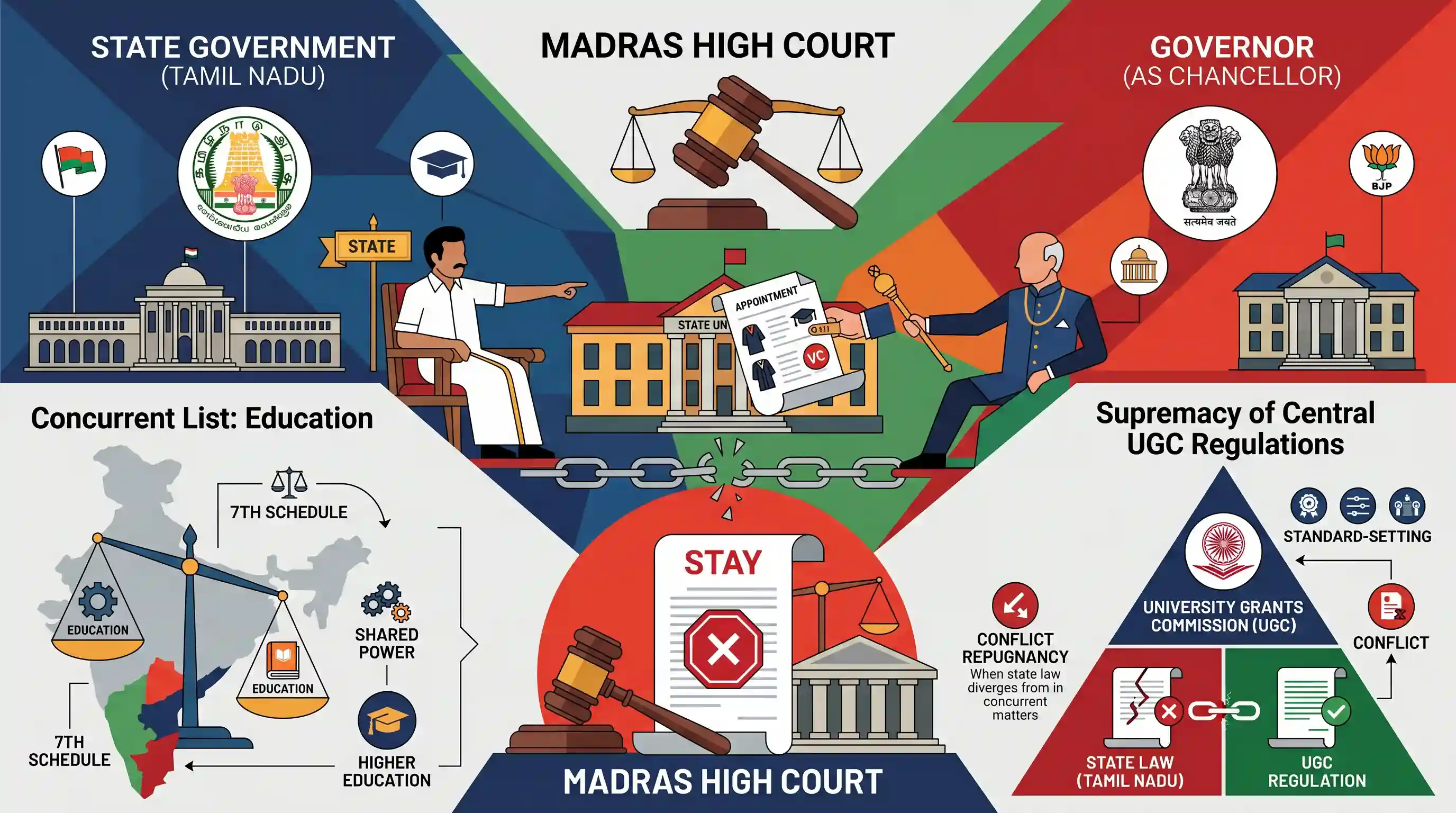
The Madras High Court has stayed the implementation of Tamil Nadu's legislative amendments that transferred the authority to appoint Vice-Chancellors (VCs) in state universities from the Governor (as Chancellor) to the State government. This judicial intervention highlights the escalating tensions between non-BJP state governments and Governors over university administration. The legal and constitutional debate centers on the Concurrent List status of Education, the statutory powers of the Governor, and the supremacy of central University Grants Commission (UGC) regulations over conflicting state laws.
Key Points
- The Madras High Court has stayed legislative amendments passed by the Tamil Nadu government that sought to transfer the power of appointing state university Vice-Chancellors from the Governor to the State government.
- The case reflects a broader, ongoing political and legal tussle in several states (including Kerala and West Bengal) over the Governor's role as Chancellor of state universities.
- State governments argue that as the primary funders of these universities, they should control administrative appointments, while proponents of the Governor's role argue it preserves academic autonomy.
- The legal crux of the dispute often involves the Concurrent List status of Education, pitting State legislation against central University Grants Commission (UGC) regulations, which stipulate the Chancellor's role in VC appointments.
Important Terms
University Grants Commission (UGC)

A central statutory body (established 1956) responsible for coordinating and maintaining standards in higher education; its 2018 regulations are mandatory for Vice-Chancellor appointments.
UPSC context
GS Paper 2: Statutory bodies and education governance. Focuses on central vs. state regulatory powers.
Tamil Nadu Universities Laws (Amendment) Act, 2022
State legislation passed to transfer the authority of appointing and removing Vice-Chancellors from the Governor (Chancellor) to the State Government.
UPSC context
GS Paper 2: Federalism and Centre-State relations. Tests knowledge of state legislative competence vs. central standards.
Chancellor (Governor’s Role)
An ex-officio statutory role of the Governor in state universities; the Governor acts as a separate legal entity, often independent of ministerial advice.
UPSC context
GS Paper 2: Appointment/role of Governor. Differentiates constitutional duties from statutory university functions.
Concurrent List (Entry 25)
Entry 25 of the Seventh Schedule where Education lies, allowing both levels of government to legislate, subject to Union standards under Entry 66.
UPSC context
GS Paper 2: Distribution of legislative powers. Key for federalism and constitutional schedules.
Doctrine of Repugnancy
A constitutional rule (Article 254) stating that Central law prevails over State law in the Concurrent List if they are inconsistent.
UPSC context
GS Paper 2: Constitutional principles. Essential for understanding legislative conflicts and the supremacy of central standards.
Madras High Court
The state judiciary body that exercised judicial review to stay the TN university amendments, citing their potential conflict with central UGC regulations.
UPSC context
GS Paper 2: Judiciary. Demonstrates the power of judicial review over state legislative and administrative actions.
Prelims Trap
"The Governor appoints Vice-Chancellors of state universities exercising their constitutional discretionary powers."
The Governor's role as Chancellor is purely statutory, derived from individual State University Acts. It is not a constitutional power or constitutional discretion (like Article 163).
Static Concepts Connected
What is the Doctrine of Repugnancy under Article 254?
- Concurrent List conflict: It applies when a State law contradicts a Central law on a Concurrent List subject (like Education).
- Central supremacy: The Central law (e.g., UGC regulations) prevails, and the State law becomes void to the extent of its repugnancy.
- Presidential assent exception: The State law can prevail within that state only if it was reserved for and received the President's assent, though Parliament can override it later.
What do major commissions say about the Governor's role as Chancellor?
- Punchhi Commission (2010): Recommended ending the practice of making Governors Chancellors to prevent the constitutional office from being dragged into local political and academic controversies.
- Sarkaria Commission (1988): Noted that the Governor as Chancellor acts in a statutory capacity, not a constitutional one, and therefore is not bound by the aid and advice of the Council of Ministers.
Cross-Topic Patterns
Union Entry 66 vs Concurrent Entry 25
The dispute over university control pivots from Entry 25 of the Concurrent List (Education) to Entry 66 of the Union List (determining higher education standards), which courts use to uphold UGC supremacy.
Governor as Chancellor vs President as Visitor
While Governors often exercise independent statutory powers as Chancellors of state universities, the President acts as 'Visitor' of Central Universities strictly on the aid and advice of the Union Government.

Expect a 2026 multi-statement Prelims question testing Article 254 repugnancy using UGC regulations and State University Acts as the case.
Linked PYQs · 3
Linked PYQs · 3
- 2022MainsGS2
Discuss the essential conditions for exercise of the legislative powers by the Governor. Discuss the legality of re-promulgation of ordinances by the Governor without placing them before the Legislature.
- 2024MainsGS2
What changes has the Union Government recently introduced in the domain of Centre-State relations ? Suggest measures to be adopted to build the trust between the Centre and the States and for strengthening federalism.
- 2015MainsGS2
The quality of higher education in India requires major improvements to make it internationally competitive. Do you think that the entry of foreign educational institutions would help improve the quality of higher and technical education in the country? Discuss.
