Madhya Pradesh Water Conservation Model Earns International Acclaim
Source:dd-news ↗
Why It Matters
Madhya Pradesh's environmental schemes, water resources, and cultural landmarks (like Bhopal's Bharat Bhavan) are frequently tested in the MPPSC State Service Prelims. This campaign represents a key contemporary development in the state's resource planning and community-led water management.
Summary
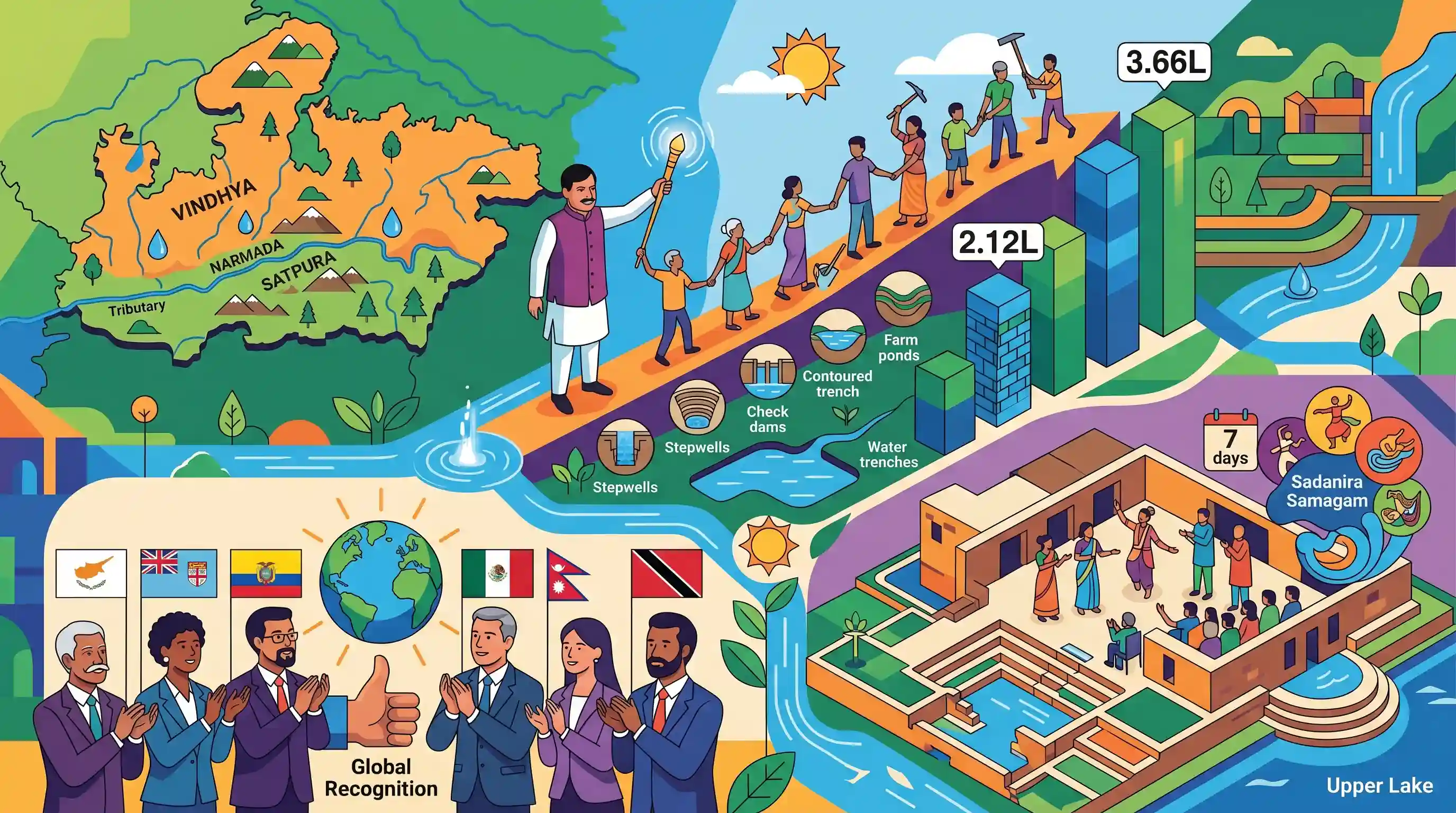
Madhya Pradesh's 'Jal Ganga Samvardhan Abhiyan,' launched under Chief Minister Mohan Yadav, has achieved global recognition for its public-driven water conservation and river rejuvenation model. During the seven-day 'Sadanira Samagam' held at Bharat Bhavan in Bhopal, diplomats from six nations (including Cyprus, Fiji, and Ecuador) praised the integration of ecological conservation with cultural heritage. Under this campaign, over 2.12 lakh water conservation structures have been completed against a target of 3.66 lakh.
Key Points
- The Jal Ganga Samvardhan Abhiyan is Madhya Pradesh's flagship water conservation campaign focusing on the rejuvenation of rivers, ponds, and traditional water bodies.
- Under the campaign, work on more than 2.12 lakh water conservation structures has been completed out of a total target of 3.66 lakh structures.
- A seven-day event named 'Sadanira Samagam' was held at the historic Bharat Bhavan in Bhopal to integrate water conservation with cultural heritage.
- The model has drawn global acclaim, with diplomats from Cyprus, Fiji, Mexico, Nepal, Trinidad and Tobago, and Ecuador attending the event and expressing interest in replicating MP's public-participation water management model.
Important Terms
Jal Ganga Samvardhan Abhiyan

A community-driven water conservation and river rejuvenation campaign in Madhya Pradesh aimed at restoring traditional water bodies, recharging groundwater, and building decentralized water harvesting structures through mass public participation.
UPSC context
GS II (Governance) & GS III (Water Security); tests decentralized environmental conservation and community-led resource governance models.
Sadanira Samagam
A unique multi-disciplinary cultural conclave held in Bhopal that integrates performing arts, literature, and science to advocate for the preservation of rivers, water heritage, and traditional water structures across India.
UPSC context
GS I (Art & Culture) & GS III (Environment); tests knowledge of using cultural mediums to foster environmental awareness and civic responsibility.
Bharat Bhavan
An autonomous multi-arts complex and museum in Bhopal, designed by renowned architect Charles Correa in 1982, established to create an interactive space for visual, verbal, and performing arts.
UPSC context
GS I (Indian Heritage & Architecture); tests familiarity with post-independence institutional architecture and cultural heritage centers promoting regional arts.
Prelims Trap
The 'Jal Ganga Samvardhan Abhiyan' is named because the main channel of the Ganga River flows directly through Madhya Pradesh.
The Ganga does not flow through MP. The campaign is named 'Jal Ganga' because MP's major northern rivers (Chambal, Betwa, Ken, Shipra) drain into the Yamuna, which is a principal tributary of the Ganga.
Static Concepts Connected
What are the core architectural features of Charles Correa's Bharat Bhavan in Bhopal?
- Terraced Non-Building: Designed to cascade down the Shamla Hills overlooking Bhojtal (Upper Lake), using sunken courtyards to blend into the natural landscape rather than dominating it.
- Stepwell Inspiration: Incorporates a labyrinthine spatial layout reminiscent of traditional Indian stepwells (baolis) to create shaded, interactive transitional spaces.
- Passive Ventilation: Employs 'top-lit cannons' (sky-facing circular concrete shafts) inspired by traditional chattris for natural illumination and passive convective cooling.
How does the drainage system of northern Madhya Pradesh connect to the Ganga Basin?
- Northward Flow: Major rivers like the Chambal, Betwa, Ken, and Parvati flow north and northeast due to the gentle northward tilt of the Malwa and Vindhyan plateaus.
- Yamuna Tributaries: These northern-flowing rivers serve as primary tributaries to the Yamuna River, which eventually merges with the Ganga River at Prayagraj.
Cross-Topic Patterns
Traditional Baolis + Modern Passive Design
Links ancient stepwell architecture with modern sustainable buildings, demonstrating how vernacular cooling and water conservation techniques can be integrated into civic public infrastructure.
River Basin Federalism & Water Security
Illustrates how upstream micro-watershed management in central India directly dictates the water security and siltation levels of downstream states within the larger Ganga basin.

Traditional water-retaining structures and Charles Correa's climate-responsive designs may converge in a GS1 Art & Culture question.
Linked PYQs · 2
Linked PYQs · 2
- 2016MPPSC_PRELIMSGS1
Where is Bharat Bhawan situated?
- 2022MPPSC_PRELIMSGS1
Which of the following is a major source of irrigation in Madhya Pradesh?
