Rupakheda Emerges as Protected Farming Model in Dhar
Source:air-news ↗
Why It Matters
Provides a concrete case study of crop diversification and the successful implementation of the MIDH scheme in Madhya Pradesh. This is highly relevant for MPPSC Prelims questions concerning the state's agricultural economy, district-specific specialties, and modern farming techniques.
Summary
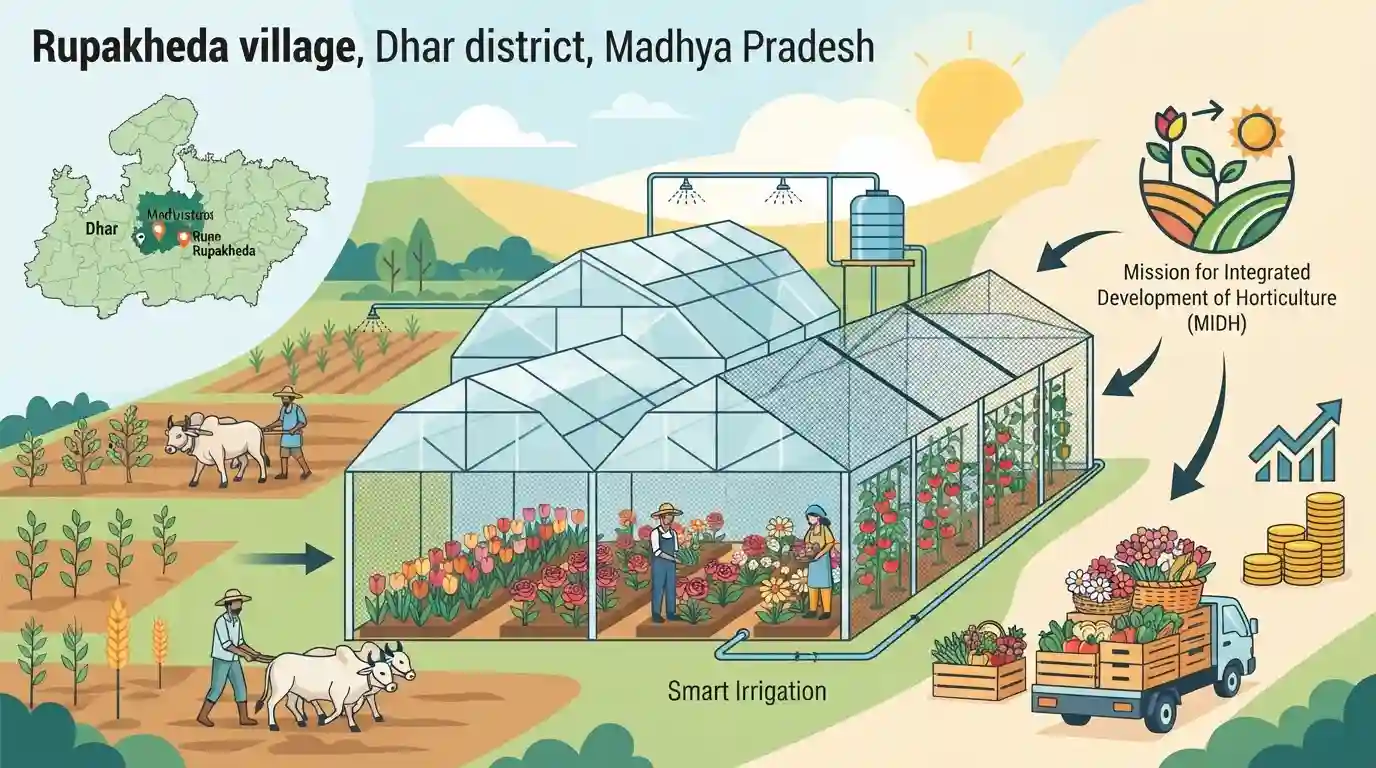
Rupakheda village in the Dhar district of Madhya Pradesh has emerged as a successful model of modern agriculture, earning the nickname 'Mini Holland of Madhya Pradesh.' Supported by the Government of India's Mission for Integrated Development of Horticulture (MIDH), local farmers have shifted from traditional crops to lucrative floriculture and protected vegetable farming. By adopting modern techniques like polyhouses and shade net houses, farmers are successfully saving water while significantly improving the yield and quality of their produce.
Key Points
- Rupakheda village in Dhar district has been dubbed the 'Mini Holland of Madhya Pradesh' due to its extensive flower cultivation.
- Farmers have transitioned from traditional crops like wheat and soybean to growing high-value flowers (roses, gerbera, lilies) and vegetables.
- The transformation is driven by modern protected farming techniques, utilizing 44 polyhouses and 13 shade net houses in the village.
- Financial and technical support was provided under the central government's Mission for Integrated Development of Horticulture (MIDH).
Important Terms
Mission for Integrated Development of Horticulture (MIDH)

A Centrally Sponsored Scheme to holistically develop India's horticulture sector. It provides technical and financial support for fruit, vegetable, and flower cultivation, covering planting material, protected farming techniques, and post-harvest management.
UPSC context
GS Paper 3 (Agriculture). Tests knowledge of government schemes for crop diversification, agricultural subsidies, and modern interventions.
Protected Cultivation
Cropping techniques where the microenvironment—like temperature, humidity, and light—is partially or fully controlled to protect crops from severe weather, reduce water use, and maximize agricultural yield.
UPSC context
GS Paper 3 (Agriculture). Crucial for questions on agricultural technology, climate-resilient farming, and enhancing productivity.
Polyhouse Farming
A form of protected cultivation using a polythene-covered structure that traps solar radiation. It creates a controlled environment for year-round, high-yield cultivation of exotic crops while conserving resources.
UPSC context
GS Paper 3 (Technology in aid of farmers). Relevant for modern farm infrastructure and strategies to double farmer incomes.
Floriculture
A specialized branch of horticulture involving the cultivation of flowering and ornamental plants for commercial use. It offers higher returns than traditional staples, enabling significant rural economic growth.
UPSC context
GS Paper 3 (Crop Diversification). Important for analyzing high-value agriculture and shifting commercial farming patterns in India.
Mini Holland of Madhya Pradesh
A nickname for Rupakheda village in Dhar district, awarded for its successful, large-scale transition from traditional cereal crops to commercial exotic floriculture using modern protected cultivation techniques.
UPSC context
GS Paper 3 (Agriculture). Serves as an excellent Mains case study for successful crop diversification and rural development.
Prelims Trap
"MIDH is a Central Sector Scheme that exclusively promotes the cultivation of fruits and vegetables."
MIDH is a Centrally Sponsored Scheme (shared funding), not Central Sector. Furthermore, it covers a broad spectrum including spices, flowers, bamboo, and cashew, not just fruits and vegetables.
Static Concepts Connected
What are the primary advantages of Protected Cultivation in agriculture?
- Micro-climate Regulation: Controls temperature, humidity, and light, shielding vulnerable crops from extreme weather patterns, frost, and pest attacks.
- Resource Efficiency: Enhances water use efficiency by 30-40% through the integration of targeted drip irrigation systems within polyhouses.
- Higher Yields: Produces 20-30% higher yields of superior quality compared to open-field farming, enabling lucrative off-season production.
What are the key features of the Mission for Integrated Development of Horticulture (MIDH)?
- Broad Coverage: Encompasses fruits, vegetables, spices, flowers, mushrooms, aromatic plants, coconut, cashew, cocoa, and bamboo.
- Funding Pattern: It is a Centrally Sponsored Scheme with a general 60:40 cost-sharing pattern between the Centre and States.
- Tech Interventions: Provides subsidies for high-tech horticulture adoption, including the establishment of polyhouses, shade nets, and micro-irrigation infrastructure.
Cross-Topic Patterns
Crop diversification & Dalwai Committee
Transitioning from traditional cereals to high-value floriculture directly aligns with the Ashok Dalwai Committee’s recommendations for doubling farmers' income through crop diversification.
Water stress & micro-climate farming
Protected cultivation naturally pairs with micro-irrigation (PMKSY), offering a synergistic solution to both groundwater depletion and low agricultural productivity in semi-arid regions.

Expect a multi-statement question in 2026 linking protected cultivation mechanisms (polyhouses) with crop diversification and MIDH scope.
Linked PYQs · 3
Linked PYQs · 3
- 2024MPPSC_PRELIMSGS1
UNNATI (Agri-GISl project of Madhya Pradesh Government is for :
- 2020MPPSC_PRELIMSGS1
Growth rate in crop sector of Madhya Pradesh for the year 2016-17 is
- 2024MPPSC_PRELIMSGS1
Match the following districts of Madhya Pradesh with their unique product : | District | Product | |-----------------|--------------------------------------| | (A) Ashoknagar | (i) Bananas | | (B) Khargone | (ii) Maheshwari Sarees and Tiger Print | | (C) Burhanpur | (iii) Chanderi Sarees | | (D) Mandsaur | (iv) Garlic | Choose the correct option : (A) (B) (C) (D)
