Madhya Pradesh Inaugurates Longest Flyover to Improve Urban Transit
Source:The Hindu ↗
Why It Matters
Illustrates the central government's infrastructure push via the Central Road and Infrastructure Fund (CRIF), which is important for GS3 Economy. The proposed 'tiger corridor' linking major reserves in Madhya Pradesh presents a dual use-case for GS3 Environment and Prelims geography by highlighting the intersection of developmental connectivity and wildlife conservation.
Summary
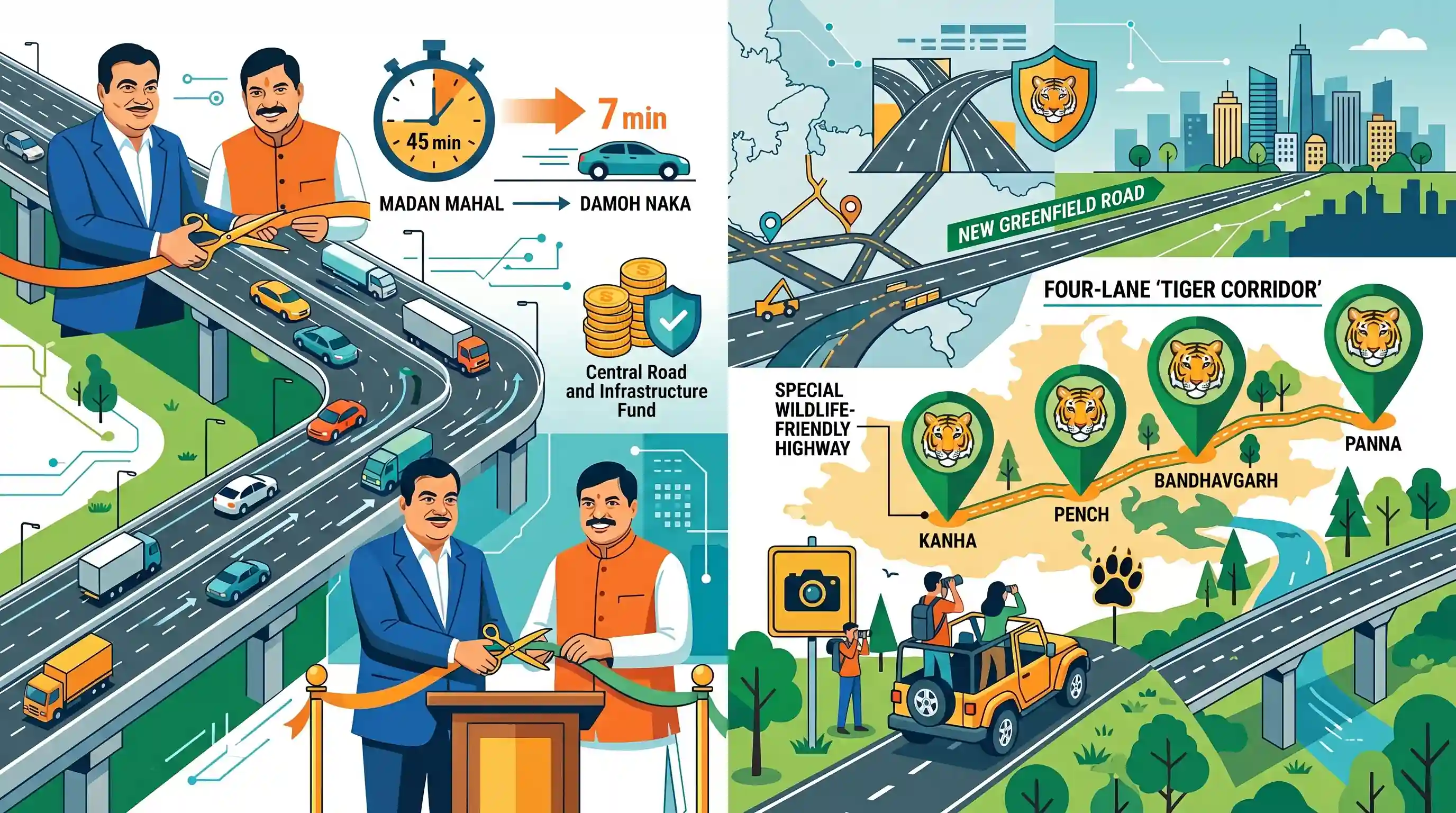
Union Minister Nitin Gadkari and Madhya Pradesh Chief Minister Mohan Yadav inaugurated a 6.85-km flyover in Jabalpur, the state's longest, reducing travel time between Madan Mahal and Damoh Naka from 45 to 7 minutes. Built with ₹1,200 crore from the Central Road and Infrastructure Fund (CRIF), the project is part of a broader infrastructure push. Additionally, Gadkari announced a ₹15,000-crore, four-lane 'tiger corridor' to link the Kanha, Pench, Bandhavgarh, and Panna tiger reserves, balancing regional connectivity with eco-tourism. Road projects worth ₹60,000 crore, including a greenfield highway to Bhopal, were also pledged.
Key Points
- Madhya Pradesh's longest flyover (6.85 km) was inaugurated in Jabalpur, reducing local travel time from 45 minutes to 7 minutes.
- The flyover project was completed at a cost of ₹1,200 crore, funded by the Central Road and Infrastructure Fund (CRIF).
- A ₹15,000 crore, four-lane 'tiger corridor' connecting Kanha, Pench, Bandhavgarh, and Panna tiger reserves was announced to boost tourism.
- Additional road infrastructure commitments include a greenfield highway connecting Jabalpur to Bhopal and a high-speed corridor between Lakhnadon and Raipur.
Important Terms
Central Road and Infrastructure Fund (CRIF)

A non-lapsable fund established under the Central Road Fund Act, 2000, primarily financed through a cess on petrol and diesel to support roads, railways, and other infrastructure.
UPSC context
GS Paper III (Economy/Infrastructure); tests knowledge of funding mechanisms for national and state infrastructure projects.
Tiger Corridor
A stretch of land or forest connecting separate tiger habitats, allowing safe passage, genetic flow, and dispersal of wildlife to prevent population isolation.
UPSC context
GS Paper III (Environment); focuses on biodiversity conservation, human-wildlife conflict, and the Wildlife (Protection) Act, 1972.
Greenfield Project
An infrastructure project initiated from scratch on a new site, such as a highway on a fresh alignment, rather than upgrading an existing facility.
UPSC context
GS Paper III (Infrastructure/Investment Models); tests understanding of development strategies and land acquisition challenges.
National Tiger Conservation Authority (NTCA)
A statutory body under the Ministry of Environment, Forest and Climate Change, established to oversee tiger conservation and implement the 'Project Tiger' initiative.
UPSC context
GS Paper III (Environment); critical for questions on institutional frameworks for wildlife protection in India.
Linear Infrastructure
Infrastructure such as roads, railways, and power lines that extend linearly across the landscape, often causing habitat fragmentation for migratory wildlife.
UPSC context
GS Paper III (Environment/Infrastructure); tests the balance between developmental needs and ecological preservation.
Prelims Trap
CRIF is administered by the Ministry of Road Transport and Highways.
Administrative control of CRIF was shifted to the Ministry of Finance in 2018, even though it heavily funds road and highway projects.
Static Concepts Connected
How is the Central Road and Infrastructure Fund (CRIF) structured?
- Funding Source: Funded primarily by a cess imposed on petrol and high-speed diesel.
- Administration: The 2018 amendment transferred its administrative control from the Ministry of Road Transport to the Ministry of Finance.
- Expanded Scope: Expanded beyond national highways to include waterways, railway infrastructure, and social infrastructure like educational and health facilities.
What are the geographical markers of Madhya Pradesh's key Tiger Reserves?
- Kanha TR: Located in the Maikal range of the Satpuras, globally recognized for conserving the endemic Hard-ground Barasingha.
- Panna TR: Situated in the Vindhya hill range, acting as a critical catchment area for the Ken River.
- Pench TR: Named after the Pench River, this reserve straddles the border of Madhya Pradesh and Maharashtra.
Cross-Topic Patterns
Linear infrastructure vs. wildlife
The push for highways through central India regularly triggers UPSC questions on habitat fragmentation, NTCA guidelines, and structural mitigation measures like eco-bridges.
Panna TR and River Interlinking
Connecting Panna Tiger Reserve to this corridor overlaps with the ongoing Ken-Betwa river interlinking project, drawing focus to the Vindhya range ecosystem and Ken river catchment.

Expect a multi-statement question mapping Central India's tiger reserves to their specific hill ranges (Maikal, Vindhya) and key rivers.
Linked PYQs · 3
Linked PYQs · 3
- 2021MainsGS3
“Investment in infrastructure is essential for more rapid and inclusive economic growth.” Discuss in the light of India's experience.
- 2022MainsGS3
Why is Public Private Partnership (PPP) required in infrastructural projects ? Examine the role of PPP model in the redevelopment of Railway Stations in India.
- 2020PrelimsGS1
Which one of the following protected areas is well-known for the conservation of a sub-species of the Indian swamp deer (Barasingha) that thrives well on hard ground and is exclusively graminivorous?
