Madhya Pradesh Garadu and Balam cucumber geographical indication tag
Source:deccanherald ↗
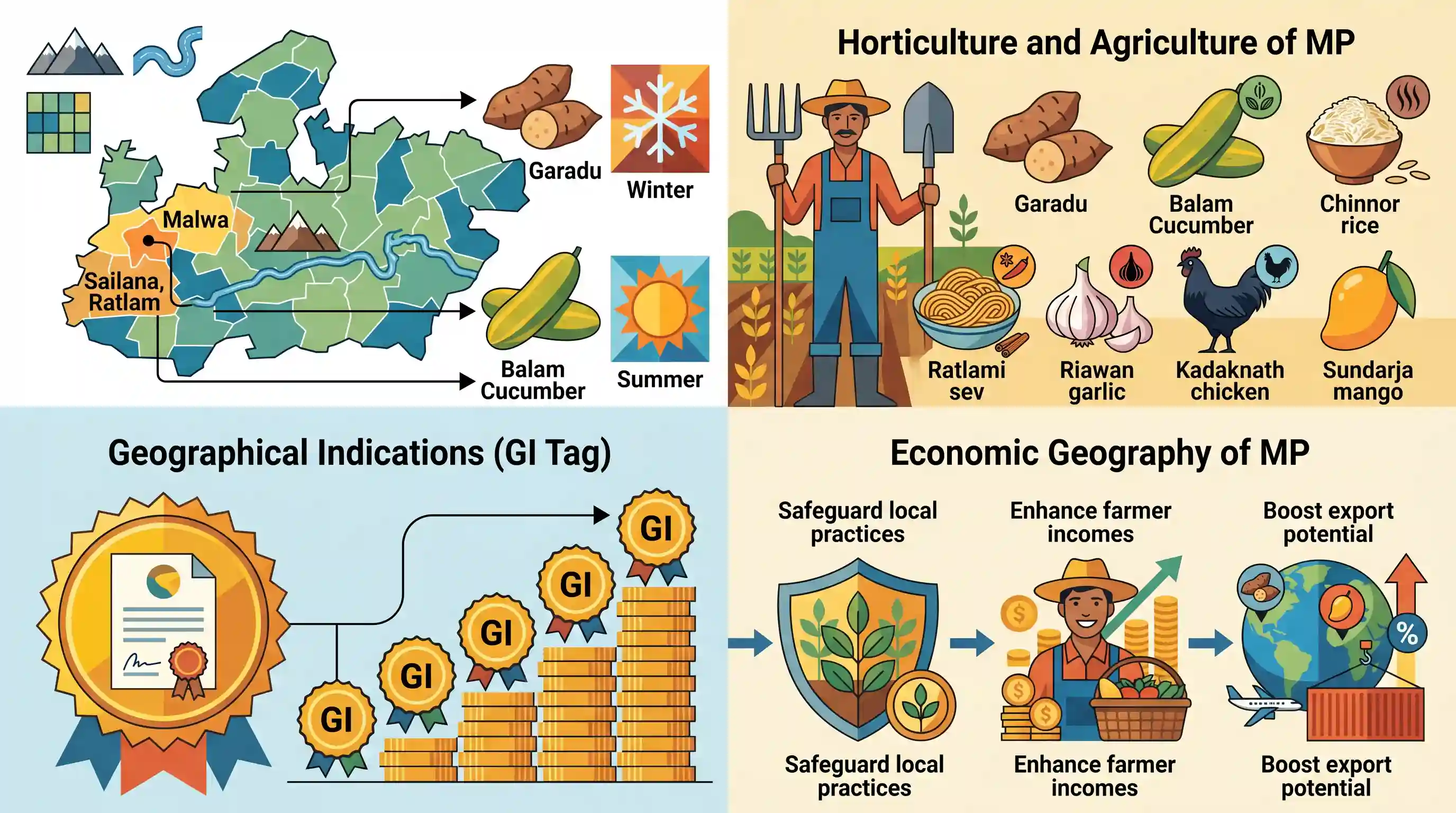
Why It Matters
MPPSC Prelims consistently tests candidates on Geographical Indications (GI tags), One District One Product (ODOP) designations, and agricultural crop specialties linked to specific districts of Madhya Pradesh (such as Chinnor rice in Balaghat, garlic in Mandsaur, and bananas in Burhanpur).
Summary
Madhya Pradesh's winter delicacy 'Garadu' (a starchy tuber grown across the Malwa region) and 'Balam Cucumber' (Balam Kakdi, a juicy summer snack grown in the Sailana area of Ratlam) have officially received Geographical Indication (GI) recognition. These registrations, facilitated by the state's Horticulture Department, aim to safeguard local horticultural practices, enhance farmer incomes, and boost export potential. They join an elite list of GI-certified regional delicacies from MP, including Chinnor rice, Ratlami sev, Riawan garlic, Kadaknath chicken, and Sundarja mango.
Key Points
- Garadu (a starchy tuber delicacy popular during winters in the Malwa region) and Balam Cucumber (Balam Kakdi, a juicy summer snack cultivated in the Sailana area of Ratlam) have received Geographical Indication (GI) tags.
- Both crops are cultivated widely in Ratlam district: Balam cucumber covers nearly 100 hectares, while Garadu is grown on about 120 hectares.
- The GI registration provides legal protection to these crops, helping protect their geographical origin, distinct qualities, and traditional horticultural practices of the Malwa plateau.
- Other prominent GI-tagged agricultural and food products of Madhya Pradesh include Balaghat's Chinnor Rice, Jhabua's Kadaknath Chicken, Ratlam's Riawan Garlic and Ratlami Sev, and Rewa's Sundarja Mango.
Important Terms
Geographical Indications of Goods (Registration and Protection) Act, 1999

The primary Indian legislation enacted to provide for the registration and better protection of geographical indications relating to goods, ensuring legal security for region-specific products.
UPSC context
GS Paper III (IPR/Agriculture); tests understanding of IPR laws, WTO TRIPS compliance, and regional economic protection.
Geographical Indications Registry
The statutory authority based in Chennai, operating under the DPIIT, responsible for administering and registering Geographical Indications in India to safeguard regional identities.
UPSC context
GS Paper II/III (Statutory Bodies, IPR); tests knowledge of administrative mechanisms for intellectual property and regional trade protection.
One District One Product (ODOP) Scheme
A central development initiative that identifies, brands, and promotes one unique regional product per district to revitalize local industries, preserve cultural heritage, and boost exports.
UPSC context
GS Paper III (Indian Economy, Agriculture); tests knowledge of government initiatives for balanced regional growth and rural livelihood promotion.
Horticulture Department of Madhya Pradesh
A state government body responsible for planning, executing, and promoting horticultural development, agricultural diversification, and value addition to enhance regional farming incomes.
UPSC context
GS Paper III (Agriculture, State Agri-extensions); tests knowledge of regional policies for crop diversification and doubling of agrarian incomes.
Prelims Trap
Agricultural and horticultural GI tags are evaluated and granted by the Ministry of Agriculture and Farmers Welfare.
GI registrations for agricultural goods are administered by the DPIIT under the Ministry of Commerce and Industry, not the Ministry of Agriculture.
Static Concepts Connected
What is the legal framework governing Geographical Indications (GI) in India?
- Parent Act: Governed by the Geographical Indications of Goods (Registration and Protection) Act, 1999, which came into force in 2003.
- Nodal Authority: Administered by the Controller General of Patents, Designs and Trade Marks under the Ministry of Commerce and Industry.
- Validity Period: Granted for a period of ten years, which can be renewed indefinitely for successive ten-year periods.
What biochemical properties make potatoes ideal for industrial chip processing?
- Low Reducing Sugars: High reducing sugars cause the Maillard reaction during high-temperature frying, turning chips dark brown and bitter.
- High Dry Matter: Higher starch and dry matter content minimizes oil absorption during frying, securing a crisp texture.
Cross-Topic Patterns
GI Tags + Bilateral FTA Negotiations
GI protection acts as a key offensive interest for India in bilateral Free Trade Agreement negotiations (like India-EU), preventing international exploitation of regional names.
Agro-biodiversity + Tribal Livelihoods
GI recognition of tribal-preserved crops safeguards traditional ecological knowledge against bio-piracy under the Biological Diversity Act, 2002.

Match-the-following questions pairing newly tagged tribal/horticultural GIs with their micro-regions and unique agro-climatic properties.
Linked PYQs · 3
Linked PYQs · 3
- 2024MPPSC_PRELIMSGS1
GI tagged, Chinnor rice is primarily produced in which district of Madhya Pradesh?
- 2024MPPSC_PRELIMSGS1
Match the following districts of Madhya Pradesh with their unique product : | District | Product | |-----------------|--------------------------------------| | (A) Ashoknagar | (i) Bananas | | (B) Khargone | (ii) Maheshwari Sarees and Tiger Print | | (C) Burhanpur | (iii) Chanderi Sarees | | (D) Mandsaur | (iv) Garlic | Choose the correct option : (A) (B) (C) (D)
- 2021MPPSC_PRELIMSGS1
Match the column. | District | Tentative Product | |----------------|--------------------------------------| | A. Balaghat | i. Split Pigeon Pea (Tuar) and Jaggery| | B. Betul | ii. Chilly and Chilly Product | | C. Khargone | iii. Teakwood (Sagon) | | D. Narsinghpur | iv. Kodo Kutki | Codes: A B C D
