Union Minister reviews summer moong procurement in Madhya Pradesh
Source:drishtiias ↗
Why It Matters
Madhya Pradesh is a frontrunner in agriculture, specifically ranking first in India for pulse production. MPPSC Prelims frequently asks questions about state crop rankings, specific regional crop seasons (like Zaid/summer crops), and state-level technological initiatives in agriculture such as the UNNATI (Agri-GIS) project. This current event directly links federal agricultural policy and state-level governance.
Summary
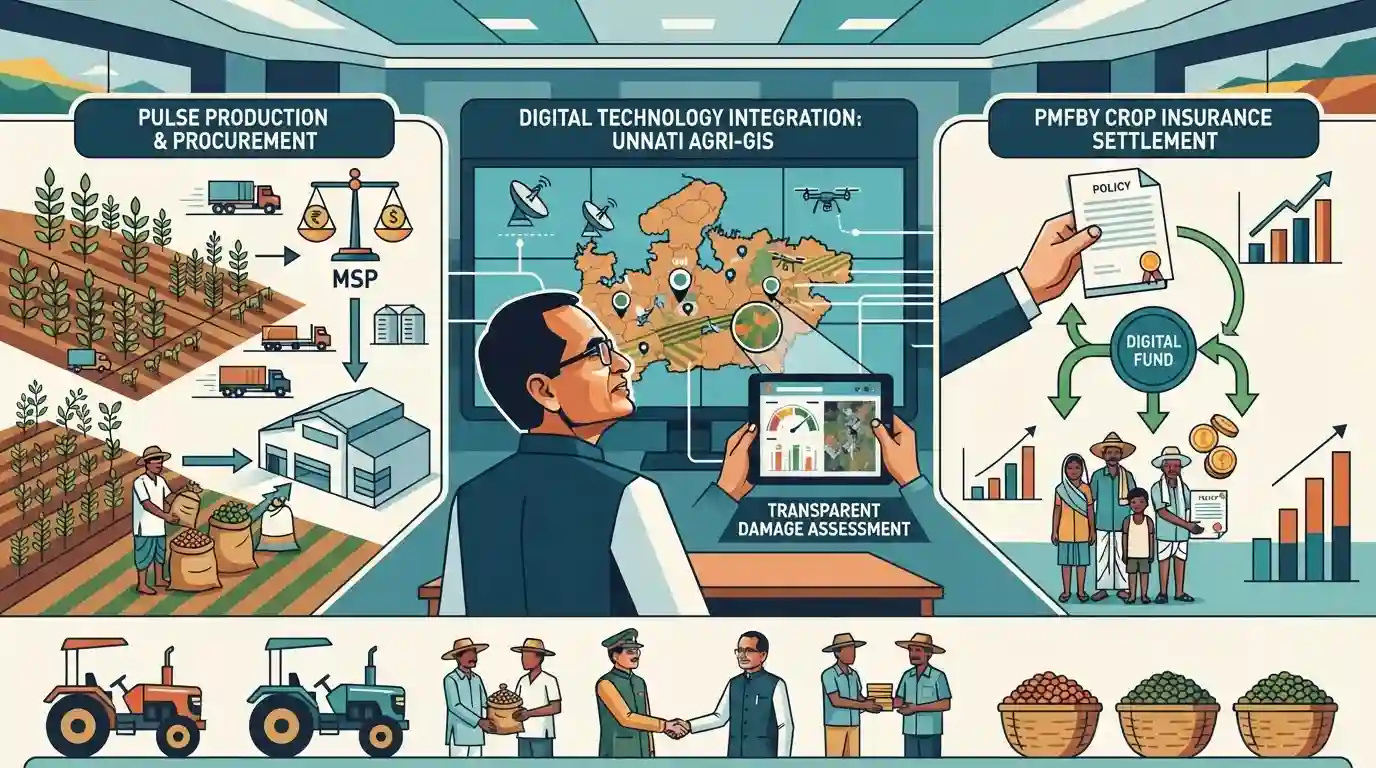
Union Minister Shivraj Singh Chouhan reviewed the procurement of summer moong and the settlement of crop insurance claims under PMFBY in Madhya Pradesh. The review emphasized leveraging digital technologies like the UNNATI Agri-GIS system for transparent damage assessment and ensuring hassle-free MSP-based procurement for pulses, reinforcing MP's status as a leading state in pulse cultivation.
Key Points
- Union Minister of Agriculture and Farmers Welfare Shivraj Singh Chouhan conducted a high-level review of summer moong (green gram) procurement and the Pradhan Mantri Fasal Bima Yojana (PMFBY) implementation in Madhya Pradesh.
- Summer moong is a crucial Zaid (summer) crop cultivated post-wheat harvest in MP, especially in regions like Narmadapuram, Harda, Jabalpur, Raisen, and Sehore. MP is the leading state in pulse production in India.
- The summer moong procurement is carried out under the Price Support Scheme (PSS) at the Minimum Support Price (MSP) to protect farmers from price volatility, utilizing Direct Benefit Transfer (DBT) for payments.
- For PMFBY, the review emphasized resolving pending claims quickly and leveraging high-tech tools like Madhya Pradesh's UNNATI (Agri-GIS) project, which uses satellite imagery, drone data, and AI/ML to assess crop damage accurately and hasten claim payouts.
- Promoting summer moong as a third crop increases cropping intensity, improves soil health through nitrogen fixation, and supplements farmer incomes in the state.
Important Terms
UNNATI (Agri-GIS) Project

A Madhya Pradesh state initiative integrating satellite imagery, drone data, GIS, and AI/ML for real-time crop mapping, land parcel tracking, and transparent crop-insurance claim settlement.
UPSC context
GS Paper III: Technology in Agriculture. Tests state-level digital e-governance and crop-monitoring reforms.
Pradhan Mantri Fasal Bima Yojana (PMFBY)
A central crop insurance scheme launched in 2016 offering comprehensive risk cover to farmers from pre-sowing to post-harvest against natural calamities, pests, and diseases at subsidized premiums.
UPSC context
GS Paper III: Agriculture & Welfare Schemes. Tests understanding of agricultural risk mitigation and farm-sector resilience.
Price Support Scheme (PSS)
A procurement mechanism under PM-AASHA where central agencies buy notified pulses, oilseeds, and copra directly from farmers at Minimum Support Price when market rates plummet.
UPSC context
GS Paper III: MSP and Procurement. Tests pricing policies, market interventions, and government safety nets for pulse cultivators.
PM-AASHA
An umbrella program launched in 2018 to guarantee Minimum Support Price (MSP) realization for pulses, oilseeds, and copra, comprising multiple pricing and procurement support schemes.
UPSC context
GS Paper III: Indian Agriculture & Economy. Tests core state-central pricing strategies and farm income support mechanisms.
Ministry of Agriculture and Farmers Welfare
The apex union ministry responsible for formulating agricultural policies, implementing welfare schemes, coordinating crop procurement, and fostering rural growth across India.
UPSC context
GS Paper II & III: Governance. Tests structure of agricultural administration and center-state developmental schemes.
Prelims Trap
Madhya Pradesh ranks first in both the total area under pulse cultivation and the total production of pulses in India.
While Madhya Pradesh leads the nation in total pulse production, Rajasthan holds the first position in the total area under pulse cultivation, with MP ranking second in area.
Static Concepts Connected
What are the crop insurance premium rates under PMFBY?
- Kharif Crops: A uniform premium of only 2.0% is payable by farmers for all Kharif crops.
- Rabi Crops: A premium of only 1.5% is payable by farmers for all Rabi crops.
- Commercial Crops: A premium of 5.0% is payable for annual commercial and horticultural crops.
What is the ecological and agronomic significance of Moong (Green Gram) as a Zaid crop?
- Nitrogen Fixation: Moong is a leguminous crop that hosts Rhizobium bacteria in its root nodules, fixing atmospheric nitrogen to naturally enrich soil fertility.
- Cropping Intensity: Sown post-wheat harvest, it utilizes the fallow period, increasing the state's overall cropping intensity index.
- Water Efficiency: It requires significantly less water compared to summer paddy, making it highly suitable for sustainable water management.
Cross-Topic Patterns
Space Tech + Disaster Compensation
Integrating platforms like UNNATI Agri-GIS and SARA with crop insurance leverages remote sensing to resolve disputes, bridging space-tech applications with rural social security.
Leguminous Crops + Soil Health
Encouraging summer moong as a third crop enhances cropping intensity and naturally restores soil nitrogen, directly addressing soil degradation and urea over-use.

MPPSC is highly likely to pair MP's pulse production rankings with state-specific agri-portals like SARA and UNNATI in a multi-statement question.
Linked PYQs · 3
Linked PYQs · 3
- 2024MPPSC_PRELIMSGS1
UNNATI (Agri-GISl project of Madhya Pradesh Government is for :
- 2024MPPSC_PRELIMSGS1
In the year 2021 - 22, which State of India, had the first rank in production of pulses ?
- 2025MPPSC_PRELIMSGS1
During the year 2021-22, which of these states was ranked second in area and first in production of pulses in the country?
