Madhya Pradesh Plea to Supreme Court on Reservation Cap Flexibility
Source:The Hindu ↗
Why It Matters
State-led efforts to breach the 50% reservation ceiling present a core constitutional debate around Articles 15 and 16. It tests the balance between affirmative action, meritocracy, and social justice, and could reshape India's reservation framework if the Supreme Court modifies the Indra Sawhney precedent.
Summary
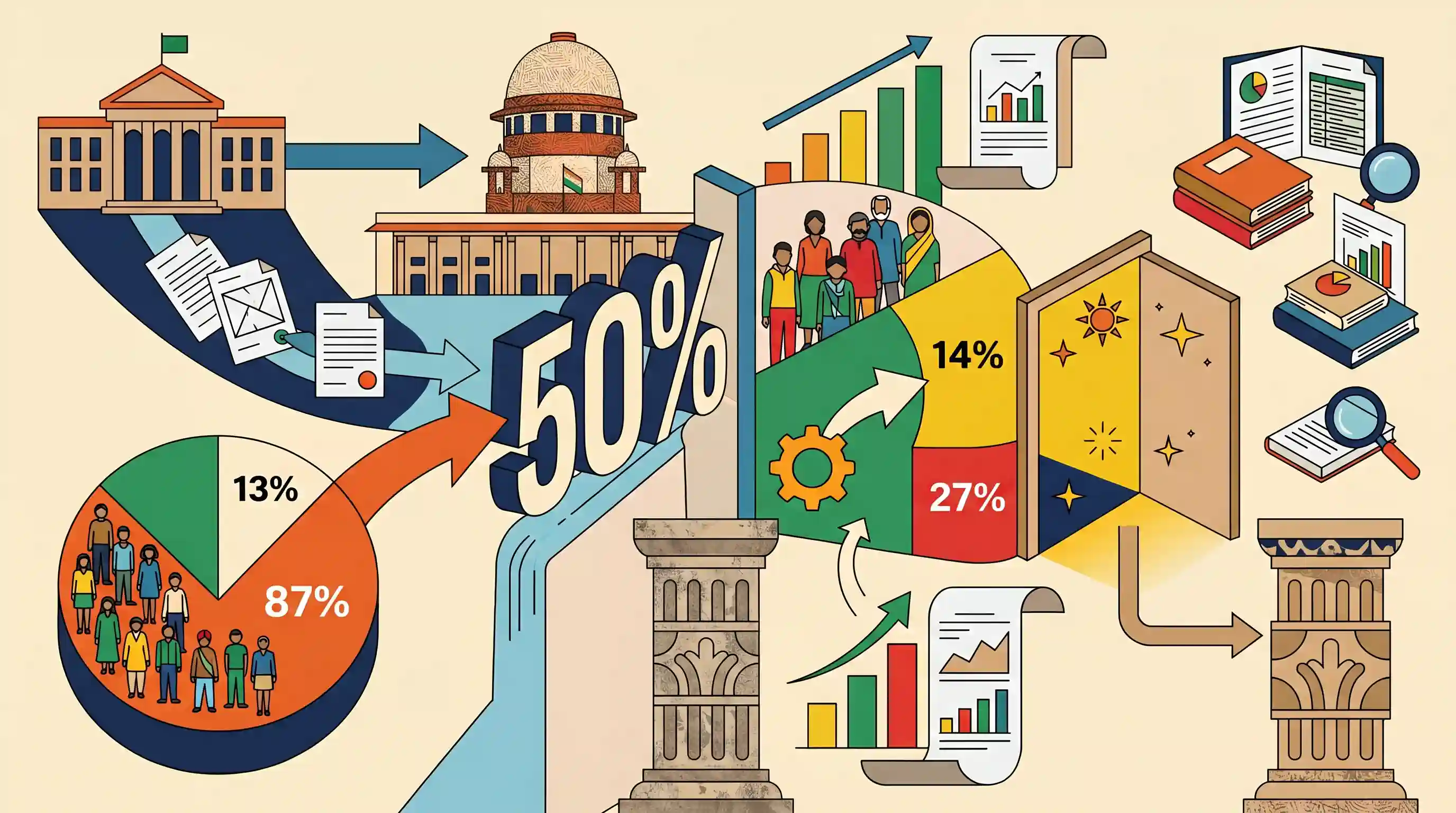
The Madhya Pradesh government has petitioned the Supreme Court to consider the 50% cap on reservations as "flexible" rather than absolute. The state is defending its 2019 amendment to the Lok Seva Act, which increased the Other Backward Classes (OBC) quota from 14% to 27%. Citing that marginalized communities form over 87% of its total population, the government argues that adhering to the strict 50% ceiling—established by the Indra Sawhney judgment—denies adequate representation to the majority. Drawing on the Jaishri Laxmanrao Patil (Maratha reservation) ruling, Madhya Pradesh contends that its demographic reality constitutes the "exceptional circumstances" required to breach the reservation threshold, supported by data from state-level backward classes commissions.
Key Points
- The Madhya Pradesh government has urged the Supreme Court to treat the 50% reservation ceiling as 'flexible' to uphold an increase in the OBC quota from 14% to 27%.
- The state argues that marginalized communities comprise 87% of its population, with OBCs alone exceeding 51%, creating 'exceptional circumstances' that justify breaching the 50% cap.
- MP invoked the Jaishri Laxmanrao Patil (Maratha reservation) judgment, which acknowledged that the 50% limit established in the Indra Sawhney case could be breached in extraordinary situations.
- The petition references findings from the Mahajan Commission and the State Backward Classes Commission as empirical evidence for the systemic backwardness of these communities.
Important Terms
Madhya Pradesh Lok Seva (Reservation for SC, ST and OBC) Amendment Act, 2019

A state law that increased Other Backward Classes (OBC) reservation from 14% to 27%, pushing total state reservations to 73% and challenging the 50% judicial ceiling.
UPSC context
GS-II: Governance and Constitution. Tests knowledge of state legislative powers vs. judicial precedents on reservation limits.
Indra Sawhney Judgment (1992)
A landmark 1992 nine-judge bench ruling that capped total reservations at 50% and introduced the 'creamy layer' concept, allowing breaches only in 'extraordinary circumstances.'
UPSC context
GS-II: Indian Constitution. Fundamental for questions on reservation policy, social justice, and judicial review.
Jaishri Laxmanrao Patil Case (2021)
A 2021 Supreme Court ruling that struck down the Maratha reservation for exceeding 50%, reaffirming that 'extraordinary circumstances' must be substantiated by rigorous quantifiable data.
UPSC context
GS-II: Social Justice. Crucial for understanding contemporary legal hurdles to state-level reservation hikes.
Ramji Mahajan Commission
The 1980 state-level Ramji Mahajan Commission that recommended 35% OBC reservation in Madhya Pradesh, providing the historical demographic data currently cited by the state government.
UPSC context
GS-II: Social Justice. Illustrates the role of state commissions in identifying backwardness for affirmative action.
Madhya Pradesh State Backward Classes Commission
A statutory body responsible for collecting empirical data on backward classes. Its reports provide the 'quantifiable data' required to justify deviations from reservation caps.
UPSC context
GS-II: Statutory Bodies. Relevant for the administrative process of determining reservation eligibility and quotas.
50% Reservation Ceiling
A judicial limit set by the Supreme Court to maintain a balance between reservation benefits (Art 16(4)) and the general principle of equality (Art 16(1)).
UPSC context
GS-II: Constitution. Key concept in balancing affirmative action with fundamental rights.
Prelims Trap
"The Constitution of India expressly mandates a strict 50% ceiling on total reservations under Article 16."
The 50% limit is a judicial innovation from the Indra Sawhney (1992) judgment, not a constitutional text. Furthermore, the judgment explicitly permitted exceptions in extraordinary circumstances.
Static Concepts Connected
What are the key constitutional amendments affecting OBC identification and reservations?
- 102nd CAA (2018): Granted constitutional status to the National Commission for Backward Classes (Article 338B) and added Article 342A regarding the central SEBC list.
- 103rd CAA (2019): Introduced a 10% reservation for Economically Weaker Sections (EWS), effectively pushing total combined reservations beyond the traditional 50% mark.
- 105th CAA (2021): Explicitly restored the power of State governments to identify and maintain their own lists of Socially and Educationally Backward Classes (SEBCs).
What were the core principles laid down in the Indra Sawhney (1992) judgment?
- 50% Ceiling: Total reservations under Article 16(4) should not exceed 50%, except in "extraordinary situations" inherent in far-flung or remote areas.
- Creamy Layer: Advanced sections among OBCs must be excluded from reservation benefits to ensure the most marginalized benefit.
- No Promotions: Reservation is confined to initial appointments and does not extend to promotions (though later modified by the 77th Amendment).
Cross-Topic Patterns
Caste Census & Empirical Data Demands
States justifying quota breaches rely heavily on local demographic data (like Bihar's caste survey). This links the 50% cap debate directly to the political demand for a national Socio-Economic Caste Census (SECC).
Federalism in Beneficiary Identification
The friction over identifying backward classes—seen in the Maratha ruling limiting state powers and the 105th CAA restoring them—highlights affirmative action as a major vector of federal tension.

Chronology of CAAs (102nd to 105th) and their impact on state reservation powers is a highly probable multi-statement 2026 Prelims MCQ.
Linked PYQs · 3
Linked PYQs · 3
- 2023PrelimsGS1
Consider the following organizations/bodies in India: 1. The National Commission for Backward Classes 2. The National Human Rights Commission 3. The National Law Commission 4. The National Consumer Disputes Redressal Commission How many of the above are constitutional bodies?
- 2023MainsGS2
“Development and welfare schemes for the vulnerable, by its nature, are discriminatory in approach.” Do you agree? Give reasons for your answer.
- 2018MainsGS2
Whether National Commission for Scheduled Castes (NCSC) can enforce the implementation of constitutional reservation for the Scheduled Castes in the religious minority institutions? Examine.
