Madhya Pradesh Uniform Civil Code Committee Report Submission
Source:new-indian-express ↗
Why It Matters
The submission of the draft MP UCC Bill is a significant milestone in state-level legislative initiatives toward Article 44 [1.1]. The recommendation to exclude Scheduled Tribes highlights the complex constitutional and social intersection between implementing a uniform code and preserving indigenous customary practices [1.1]. This is highly relevant for GS Paper 2 (Polity and Governance) and Madhya Pradesh state-specific administrative and demographic analysis [1.1] studies.
Summary
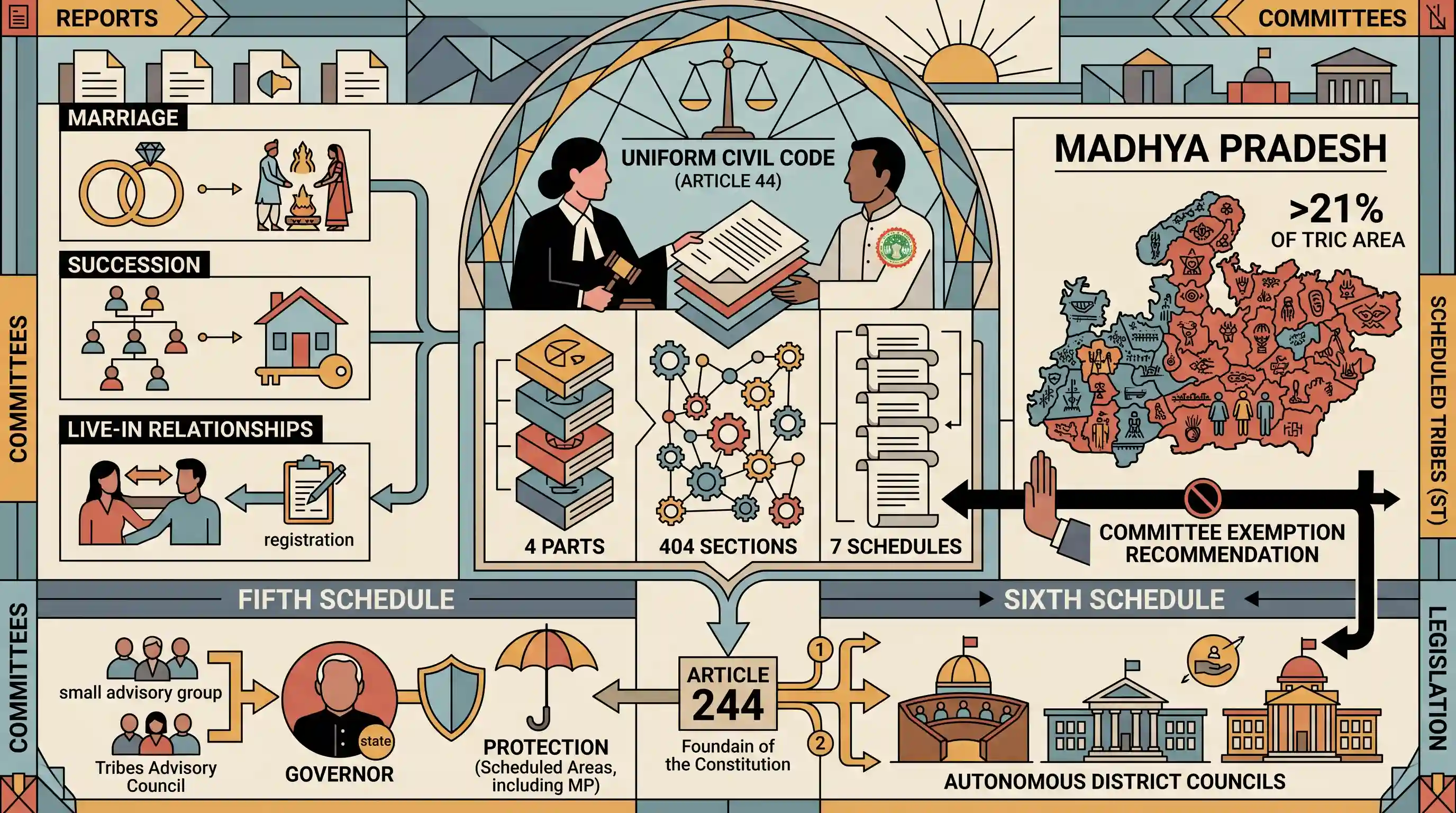
On July 13, 2026, the high-level committee chaired by retired Supreme Court Judge Justice Ranjana Prakash Desai submitted the final draft of the Uniform Civil Code (UCC) Bill to Madhya Pradesh Chief Minister Mohan Yadav [1.1]. The draft Bill, spanning 4 Parts, 404 Sections, and 7 Schedules, covers personal matters like marriage, succession, and live-in relationships, but specifically recommends exempting the state's Scheduled Tribes (who constitute over 21% of MP's population) from its purview [1.1].
Key Points
- Madhya Pradesh's high-level committee on the Uniform Civil Code (UCC) submitted its final three-volume report, including a draft UCC Bill, to Chief Minister Mohan Yadav on July 13, 2026 [1.1].
- The draft Bill (contained in Volume 2) consists of 4 Parts, 404 Sections, and 7 Schedules, covering personal laws like marriage, divorce, maintenance, succession, adoption, and live-in relationships [1.1].
- A crucial recommendation of the committee is to exempt Scheduled Tribes (STs) from the purview of the proposed UCC [1.1]. STs account for at least 21% of Madhya Pradesh's total population [1.1].
- The high-level committee was chaired by retired Supreme Court Judge Justice Ranjana Prakash Desai [1.1]. Notably, she has also headed similar UCC drafting and review panels for Uttarakhand, Maharashtra, and West Bengal [1.1].
- Other key members of the panel include senior adviser Shatrughan Singh (former chief secretary of Uttarakhand), Anoop Nair, Gopal Sharma, Budhpal Singh, Shobha Paithankar, and member-secretary Ajay Katesaria (an IAS officer) [1.1].
- The draft was developed based on extensive public feedback, analyzing more than 9.58 lakh public responses received via state consultation and a dedicated online portal [1.1].
Important Terms
Madhya Pradesh Uniform Civil Code Draft Bill

A state-level legislative proposal designed to unify personal laws (marriage, divorce, inheritance, and succession) for all residents of Madhya Pradesh, which notably proposes exempting the state's Scheduled Tribes from its purview.
UPSC context
GS Paper II (Polity); tests Article 44 (UCC) implementation, federal dynamics of personal laws, and tribal rights under the Constitution.
Supreme Court of India
The apex judicial body in India, established under Part V of the Constitution, acting as the ultimate interpreter of constitutional provisions and the final court of appeal.
UPSC context
GS Paper II (Judiciary); tests constitutional jurisdictions, federal disputes, judicial review, and the validation of state laws like UCC.
Madhya Pradesh Legislative Assembly
The unicameral legislature of Madhya Pradesh consisting of 230 members, responsible for enacting state laws, voting on budgets, and overseeing the state executive on State List and Concurrent List matters.
UPSC context
GS Paper II (State Legislature); tests state legislative processes, federalism, and the enactment of socio-religious and civil reforms.
Madhya Pradesh Law Department
The executive organ of the Madhya Pradesh government responsible for drafting legislation, offering legal advice to the state, and ensuring legal scrutiny before bills are introduced in the assembly.
UPSC context
GS Paper II (Governance); tests the role of state executive departments in lawmaking, legal drafting, and policy formulation.
Uniform Civil Code
A common set of personal laws governing marriage, divorce, inheritance, and adoption for all citizens, irrespective of their religion, as envisioned under Article 44 of the Directive Principles of State Policy.
UPSC context
GS Paper II (Polity); tests Directive Principles of State Policy, gender justice, secularism, and federal division of legislative powers.
Fifth Schedule of the Indian Constitution
A constitutional provision that designates "Scheduled Areas" and "Scheduled Tribes" in specific states, offering administrative autonomy, land protections, and legislative exemptions to preserve indigenous cultures.
UPSC context
GS Paper II (Tribal Administration); tests governance of Scheduled Areas, autonomy of indigenous groups, and constitutional limitations on uniform civil laws.
Prelims Trap
Fifth Schedule provisions automatically exempt tribal communities from state-legislated civil laws like the Uniform Civil Code.
Fifth Schedule areas do not enjoy automatic exemption; applicability of laws depends on the Governor's specific notification or explicit statutory exemptions within the state legislation itself.
Static Concepts Connected
What is the legislative competence of States to enact a Uniform Civil Code?
- Concurrent List: Entry 5 of List III empowers both Parliament and State Assemblies to legislate on marriage, succession, and civil laws.
- Presidential Assent: Under Article 254(2), a state UCC differing from existing central personal laws requires presidential assent to be legally valid.
- Article 12 State: The directive under Article 44 applies to the "State", which judicially includes provincial governments, enabling state-level UCC drafts.
How do Fifth and Sixth Schedules differ regarding tribal customary laws?
- Sixth Schedule: Grants Autonomous District Councils explicit legislative power over marriage, divorce, and social customs, offering automatic protection.
- Fifth Schedule: Lacks legislative autonomy. The Governor must issue notifications under Paragraph 5(1) to bar or modify laws, requiring explicit statutory exemptions.
Cross-Topic Patterns
Asymmetrical federalism & UCC diversity
State-level UCC enactments with varying tribal exemptions risk fragmenting Article 44's unified vision, creating regional legal variations in personal law.
Customary law vs gender justice
Tribal exemptions preserve indigenous autonomy but delay crucial gender-equal reforms in inheritance and polygamy for marginalized tribal women.

The constitutional interplay of Article 44, Entry 5 of the Concurrent List, and 5th/6th Schedules will likely feature in UPSC 2026.
Linked PYQs · 5
Linked PYQs · 5
- 2023MPPSC_PRELIMSGS1
The Directive Principles of State Policy are explained in Part IV of the Indian Constitution. This system has been taken from the Constitution of which country ?
- 2025MPPSC_PRELIMSGS1
In which Article of the Indian Constitution is there a provision of reservation of seats for Scheduled Tribes in the State Assembly?
- 2016MPPSC_PRELIMSGS1
Which district has the highest percentage of scheduled tribes population in Madhya Pradesh?
- 2025MPPSC_PRELIMSGS1
How many total major and medium Integrated Tribal Development Projects are in existence in Madhya Pradesh in 2023-24?
- 2016MPPSC_PRELIMSGS1
The population of Madhya Pradesh, according to Census 2011, is
