Madhya Pradesh Prepares Uniform Civil Code Bill with Tribal Exemptions
Source:Indian Express ↗
Why It Matters
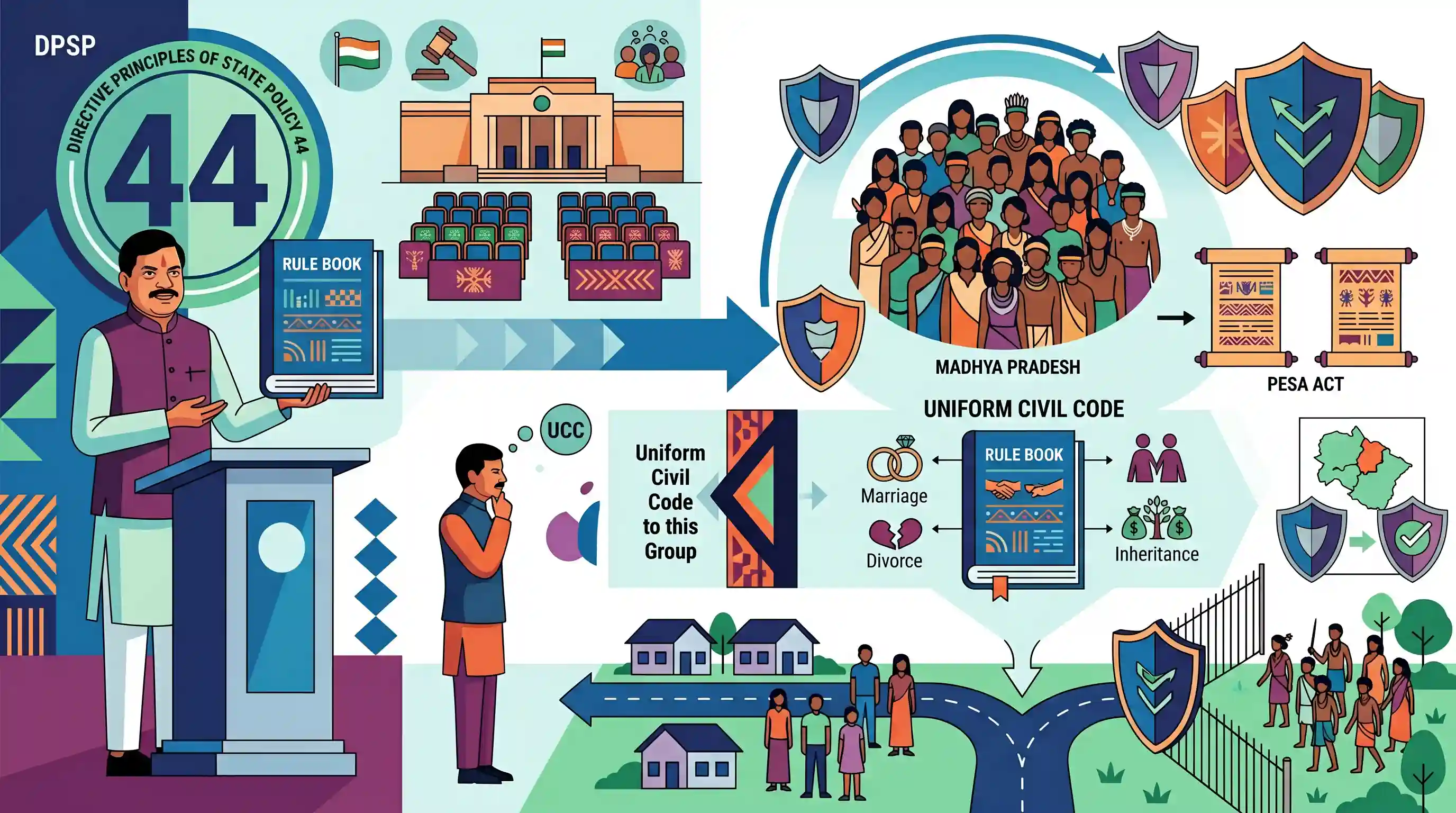
This development reflects a major policy shift and highlights the ongoing constitutional debate between establishing a uniform law for all citizens (Article 44) versus preserving the distinct customary laws and constitutional protections of tribal communities (Fifth Schedule and PESA).
Summary
Madhya Pradesh Chief Minister Mohan Yadav announced that the state will introduce a Uniform Civil Code (UCC) Bill in the July legislative assembly session. While aiming to unify personal laws regarding marriage, divorce, and inheritance, the bill faces major hurdles regarding Madhya Pradesh's substantial tribal population (over 21% of the state's total population). Since tribals are protected under the Fifth Schedule and the PESA Act 1996, the government is considering exempting them from the UCC, similar to Uttarakhand's approach, to avoid legal and political friction.
Key Points
- Madhya Pradesh Chief Minister Mohan Yadav announced plans to fast-track and introduce the Uniform Civil Code (UCC) Bill in the July Assembly session.
- The state government had previously formed a six-member committee, headed by a former Supreme Court judge, to study personal laws and submit recommendations for drafting the bill.
- The UCC aims to standardize rules for marriage, divorce, inheritance, maintenance, adoption, and live-in relationships across different religious and social communities.
- The primary challenge for MP's UCC is its large tribal population (21.1% of the state's total, with 47 of 230 Assembly seats reserved for Scheduled Tribes).
- Under the Fifth Schedule of the Constitution and the PESA Act 1996, Scheduled Areas have special protections, and tribals follow distinct customary laws for civil disputes.
- The state government is debating whether to exempt Scheduled Tribes (STs) from the UCC, following the precedent set by Uttarakhand.
Important Terms
Uniform Civil Code (UCC)

A proposed common set of civil laws governing personal matters like marriage, divorce, inheritance, and adoption for all citizens, replacing diverse religion-based personal laws.
UPSC context
GS Paper II: Polity & Constitution; tests Article 44, secularism, gender justice, and federal-state dynamics in personal laws.
Panchayats (Extension to Scheduled Areas) Act (PESA) 1996
A central law extending local self-governance provisions to Fifth Schedule areas, empowering Gram Sabhas to safeguard tribal customary laws, traditions, and natural resource rights.
UPSC context
GS Paper II: Local Governance & Tribal Rights; tests understanding of decentralization, participatory democracy, and scheduled area administration.
Fifth Schedule of the Indian Constitution
Constitutional provisions under Article 244(1) governing the administration and control of Scheduled Areas and Scheduled Tribes in states other than those in Northeast India.
UPSC context
GS Paper II: Constitutional Provisions; tests knowledge of tribal autonomy, the Governor's special powers, and Tribes Advisory Councils.
Article 44 of the Indian Constitution
A Directive Principle of State Policy advising the state to endeavor to secure a Uniform Civil Code for all citizens throughout the territory of India.
UPSC context
GS Paper II: Indian Polity; tests understanding of non-justiciable constitutional directives and their role in legislative reforms.
Prelims Trap
Uttarakhand is the first Indian state to have or implement a Uniform Civil Code.
Goa has maintained the Portuguese Civil Code of 1867 since its liberation, making Uttarakhand the first post-independence state to actively draft and pass a UCC, not the first state with one.
Static Concepts Connected
What is the constitutional status and legislative division of the Uniform Civil Code?
- Constitutional Basis: Article 44 under Part IV (DPSPs) directs the state to endeavor to secure a UCC for all citizens throughout India.
- Enforceability: As a DPSP, Article 44 is non-justiciable under Article 37, meaning it cannot be legally enforced by courts.
- Legislative Competence: Personal laws fall under Entry 5 of the Concurrent List, allowing both Parliament and State Assemblies to legislate.
How does the Constitution protect tribal customary practices in Fifth Schedule areas?
- Governor's Discretion: Paragraph 5(1) of the Fifth Schedule empowers the Governor to direct that specific laws do not apply to Scheduled Areas.
- PESA Act Mandate: The PESA Act 1996 legally safeguards and preserves tribal community customs, traditional belief systems, and social practices.
- Advisory Council Role: Tribal Advisory Councils (TAC) must be consulted on matters affecting the welfare of Scheduled Tribes within the state.
Cross-Topic Patterns
Concurrent List federalism vs. legislative uniformity
Personal laws sit on the Concurrent List, leading to asymmetric state-level UCCs that challenge the centralized, nationwide uniformity envisioned under Article 44.
Customary law insulation asymmetry
Unlike Article 371's explicit constitutional shields for Northeast customary laws, Fifth Schedule areas depend on state-level legislative exemptions and Governor discretion to bypass uniform civil laws.

The interplay between Article 44, Entry 5 of Concurrent List, and Fifth/Sixth Schedule exemptions will be framed as a complex Polity question in 2026.
Linked PYQs · 3
Linked PYQs · 3
- 2025MPPSC_PRELIMSGS1
In which Article of the Indian Constitution is there a provision of reservation of seats for Scheduled Tribes in the State Assembly?
- 2023MPPSC_PRELIMSGS1
The Directive Principles of State Policy are explained in Part IV of the Indian Constitution. This system has been taken from the Constitution of which country ?
- 2020MPPSC_PRELIMSGS1
The provision of reservation of seats for Scheduled Tribes in Municipalities in Madhya Pradesh has been made under which of the following Articles of the Constitution of India?
