Madhya Pradesh Uniform Civil Code draft and legislative plans
Source:new-indian-express ↗
Why It Matters
The development of state-level Uniform Civil Codes (following Uttarakhand's precedent) is a highly debated topic at the intersection of constitutional law (Article 44), personal laws, and federalism. For MPPSC, understanding how this impacts the state's substantial tribal demographic (21% of the population) and the legislative role of the state assembly is critical.
Summary
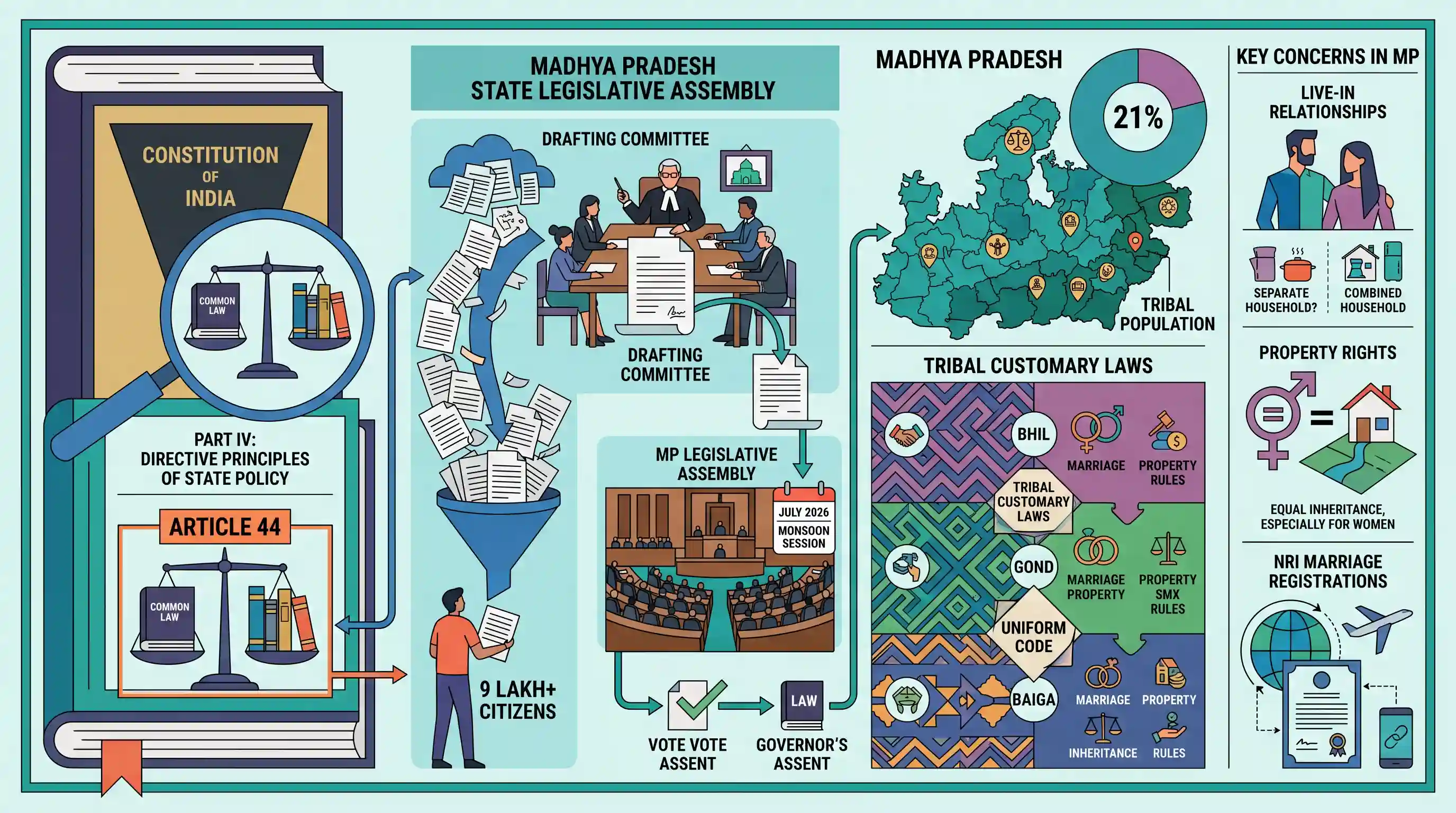
The Madhya Pradesh government is preparing to introduce its Uniform Civil Code (UCC) Bill in the monsoon Legislative Assembly session in July 2026. The state's drafting committee, led by a former Supreme Court judge, is finalizing the draft incorporating suggestions from over nine lakh citizens. Concerns remain regarding the preservation of tribal customs in a state where tribals constitute 21% of the population, as well as specific legal rules covering live-in relationships, property rights, and NRI marriage registrations.
Key Points
- The Madhya Pradesh government plans to ready its draft Uniform Civil Code (UCC) by July 5, 2026, and introduce the UCC Bill during the assembly's monsoon session beginning July 20, 2026.
- The UCC drafting committee, headed by a former Supreme Court judge, is synthesizing public feedback after a massive outreach campaign that sent over 3.5 crore text messages and received over 9 lakh suggestions.
- Key areas of focus in the proposed draft include marriage, divorce, succession, property rights, adoption, maintenance, guardianship, live-in relationships, protection for the elderly and specially-abled, and rules for NRI marriages.
- Concerns were raised by opposition leader Jitu Patwari regarding the impact of the UCC on tribal customs, highlighting that MP has over 1.60 crore tribals, constituting 21% of the state's total population.
- Religious leaders of various faiths raised apprehensions regarding the legitimization of live-in relationships under the code, while Muslim leaders questioned state-level enactment over central legislation.
Important Terms
Uniform Civil Code (UCC) Bill

A proposed state-level legislation establishing a common set of civil regulations for personal matters like marriage, divorce, and inheritance, applicable to all citizens regardless of their religion.
UPSC context
GS Paper II (Polity/Governance); tests understanding of Article 44, secularism, gender justice, and personal law reforms.
Directive Principles of State Policy (DPSP)
Non-justiciable constitutional guidelines enshrined in Part IV (Articles 36-51) that direct the State to ensure socio-economic justice and build a welfare state.
UPSC context
GS Paper II (Polity); tests the relationship between Fundamental Rights and DPSPs, and state responsibility under Article 44.
Tribal Customary Laws
Traditional, unwritten rules governing social, marital, and inheritance practices within indigenous communities, protected under special constitutional provisions like the Fifth and Sixth Schedules.
UPSC context
GS Paper II (Social Justice/Polity); tests federalism, rights of indigenous minorities, and exceptions to legal uniformity.
Madhya Pradesh Legislative Assembly
The unicameral legislature of Madhya Pradesh, empowered to frame state laws, pass the state budget, and hold the executive accountable.
UPSC context
GS Paper II (State Legislature); tests the state-level legislative process, federal distribution of powers, and legislative oversight.
Prelims Trap
A State Legislature cannot enact a Uniform Civil Code as Article 44 mandates a uniform code throughout the territory of India.
Personal laws (marriage, succession) are under Entry 5 of the Concurrent List. States can legislate UCCs, but require Presidential assent under Article 254(2) if they conflict with Central laws.
Static Concepts Connected
What is the legislative and constitutional basis for a state-level Uniform Civil Code?
- Concurrent List: Entry 5 of the Seventh Schedule places marriage, divorce, adoption, and succession under Concurrent jurisdiction, allowing both Centre and States to legislate.
- Article 44: Part of the Directive Principles of State Policy, it directs the State to secure a Uniform Civil Code for all citizens.
- Article 254(2): A State UCC conflicting with Central laws (like the Special Marriage Act) requires Presidential assent to be legally valid in that state.
How are tribal customary laws constitutionally protected from uniform civil legislations?
- Article 371: Special provisions (e.g., Article 371A for Nagaland, 371G for Mizoram) prevent Parliamentary acts on customary laws from applying without Assembly consent.
- Fifth and Sixth Schedules: Protect Scheduled Tribes' administrative and judicial autonomy, shielding their traditional customs and social practices from general civil codes.
Cross-Topic Patterns
UCC + Tribal customary protections
Reconciling Article 44 with Fifth and Sixth Schedule protections tests the balance between national integration and constitutional guarantees for indigenous practices.
Asymmetrical federalism + Personal laws
State-specific UCCs create a patchwork of civil codes, testing the limits of Article 254(2) and presidential assent on Concurrent List matters.

UCC integration vs. Fifth/Sixth Schedule protections will likely be framed as a multi-statement federalism question in Prelims 2026.
Linked PYQs · 3
Linked PYQs · 3
- 2023MPPSC_PRELIMSGS1
The Directive Principles of State Policy are explained in Part IV of the Indian Constitution. This system has been taken from the Constitution of which country ?
- 2018MPPSC_PRELIMSGS1
Which district of Madhya Pradesh has highest percentage of tribal population?
- 2025MPPSC_PRELIMSGS1
In present times, Right to Property has been accepted in the Indian Constitution in which of the following forms?
