Madhya Pradesh Year of Agriculture and Farmer Welfare Initiatives
Source:The Hindu ↗
Why It Matters
The article touches upon multiple key areas of the UPSC syllabus, including state-level agricultural and dairy policies (GS3), wildlife relocation and conservation strategies (GS3 Environment), governance reforms for ease of doing business via decriminalization (GS2/GS3), and the implementation of centrally sponsored welfare schemes at the state level (GS2).
Summary
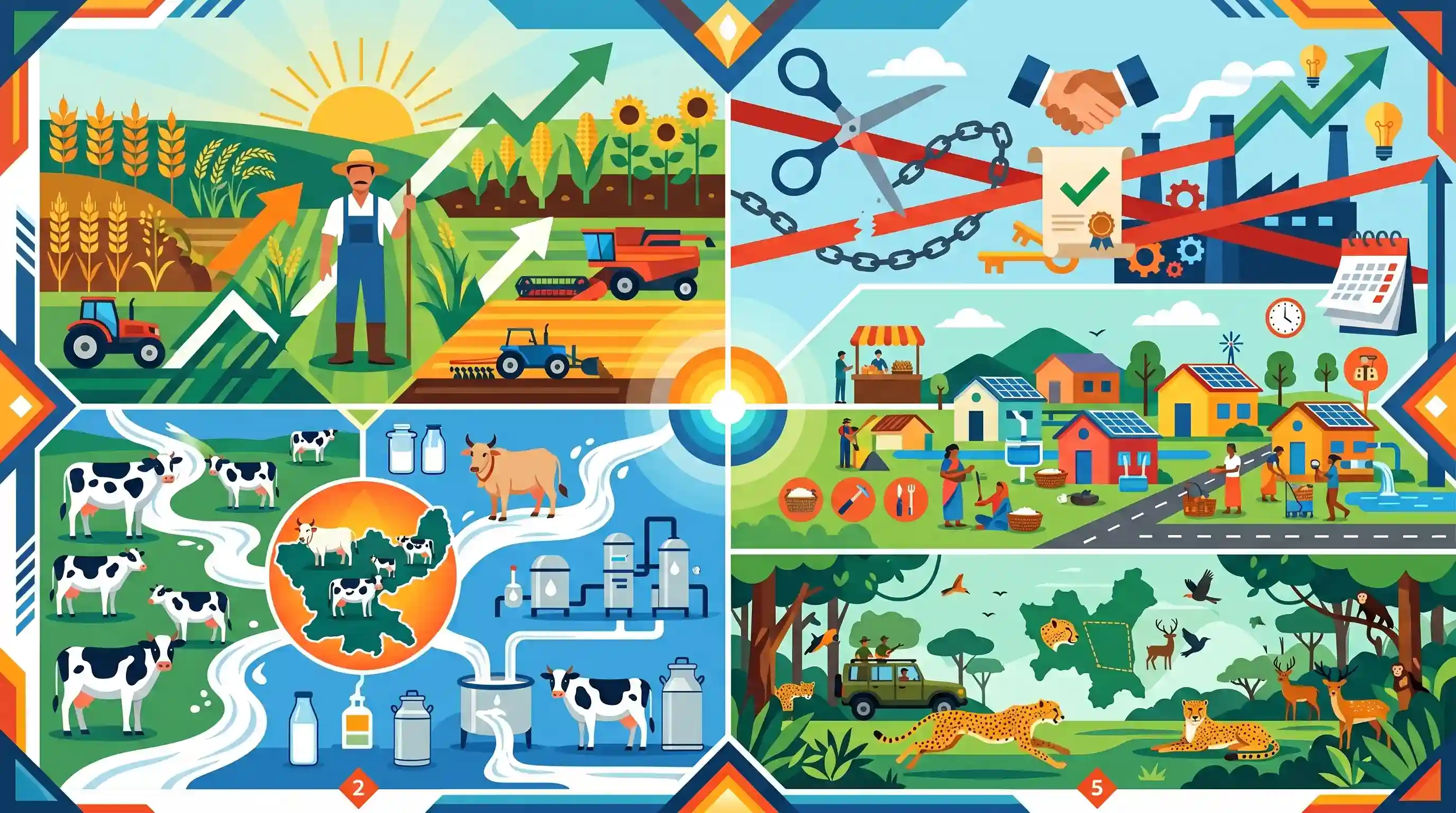
The Governor of Madhya Pradesh, Mangubhai Patel, announced that 2026 will be designated as the "Year of Agriculture" to focus on farmer welfare and doubling agricultural output. The state government plans to establish Madhya Pradesh as a "milk capital" through initiatives like the Kamdhenu Yojana. In a bid to promote the ease of doing business, the state will introduce the Madhya Pradesh Jan Vishwas Act 2025, continuing efforts to decriminalize minor offenses. Additionally, the government highlighted achievements in rural welfare schemes such as PM Awas Yojana and PM-JANMAN, and detailed wildlife conservation plans, including the introduction of cheetahs to the Nauradehi Sanctuary.
Key Points
- Madhya Pradesh will observe 2026 as the "Year of Agriculture" to emphasize farmer welfare, increase crop production, and enhance agricultural infrastructure.
- The state aims to become a "milk capital" and will launch the Kamdhenu Yojana to boost cattle rearing and dairy production.
- The upcoming Madhya Pradesh Jan Vishwas Act 2025 will decriminalize minor offenses to improve the ease of doing business, following the 2024 amendment.
- Wildlife conservation efforts include preparing Nauradehi Sanctuary for cheetahs and introducing tigers and rhinos to other state sanctuaries.
- Significant rural development milestones include housing approvals under PM Awas Yojana and PM-JANMAN, plus offering 125 days of employment under MNREGA.
Important Terms
PM-JANMAN (PM Janjati Adivasi Nyay Maha Abhiyan)

A central mission launched in 2023 to improve socio-economic conditions of 75 Particularly Vulnerable Tribal Groups (PVTGs) through 11 critical interventions including housing, water, and connectivity.
UPSC context
GS Paper 2: Welfare schemes for vulnerable sections; tests knowledge of tribal development and PVTG-specific policy interventions.
Madhya Pradesh Jan Vishwas Act 2025
State legislation (Bill 2.0) passed to decriminalize minor, technical, and procedural offences across various state laws, replacing imprisonment with financial penalties to foster Ease of Doing Business.
UPSC context
GS Paper 2: Governance/Administrative Reforms; GS Paper 3: Ease of Doing Business and decriminalization of minor defaults.
Particularly Vulnerable Tribal Groups (PVTG)
A sub-classification of Scheduled Tribes characterized by declining populations, low literacy, and pre-agricultural technology; 75 groups are identified across 18 States and one Union Territory.
UPSC context
GS Paper 2: Social Justice; frequently tested in Prelims regarding identification criteria and socio-economic vulnerability.
Kamdhenu Yojana
The Dr. Bhimrao Ambedkar Kamdhenu Yojana provides 25-33% subsidies for establishing dairy units of 25-200 milch animals, aiming to transform Madhya Pradesh into India's 'Milk Capital'.
UPSC context
GS Paper 3: Economics of animal rearing and dairy development as a means to double farmers' income.
Nauradehi Wildlife Sanctuary
The largest sanctuary in Madhya Pradesh, designated as the third home for cheetahs under Project Cheetah; it serves as a critical study site for cheetah-tiger coexistence.
UPSC context
GS Paper 3: Environment and Biodiversity; specifically regarding Project Cheetah and wildlife corridor management.
PM Awas Yojana (PMAY)
A flagship mission aimed at providing 'Housing for All' through financial assistance; the rural component (PMAY-G) targets pucca houses with basic amenities for the homeless.
UPSC context
GS Paper 2: Welfare schemes; GS Paper 3: Rural development and infrastructure.
Prelims Trap
"Kuno National Park is the exclusive site designated for India's Cheetah Reintroduction Programme."
Gandhi Sagar Sanctuary and Nauradehi Sanctuary (both in MP) have also been approved as subsequent sites for the Cheetah Reintroduction Programme.
Static Concepts Connected
What are the defining criteria for Particularly Vulnerable Tribal Groups (PVTGs)?
- Pre-agricultural tech: Reliance on hunting, gathering, or pre-agricultural methods of farming.
- Stagnant population: A declining or consistently stagnant population growth rate over time.
- Low literacy: Extremely low levels of educational attainment compared to other Scheduled Tribes.
- Economic backwardness: Subsistence level of economy with severe economic and social marginalization.
What is the core administrative philosophy behind the Jan Vishwas Acts?
- Decriminalization: Converting minor economic or procedural offences from criminal acts (carrying imprisonment) to civil infractions (carrying monetary penalties).
- Trust-based governance: Shifting the regulatory framework to trust businesses and citizens, reducing the compliance fear factor for MSMEs.
- Judicial de-clogging: Reducing the burden on the judiciary by keeping minor procedural infractions out of the criminal court system.
Cross-Topic Patterns
Expanding Project Cheetah habitats
Reintroduction is moving beyond Kuno to sites like Nauradehi and Gandhi Sagar, making central Indian grassland ecology and carrying capacity a key environment theme.
Jan Vishwas & Cooperative Federalism
States like MP adopting the Centre's decriminalization template (Jan Vishwas) reflects a growing trend of competitive federalism to improve regional Ease of Doing Business rankings.

Expect a 2026 Prelims question mapping new Project Cheetah sites (Nauradehi, Gandhi Sagar) or identifying PM-JANMAN's PVTG criteria.
Linked PYQs · 2
Linked PYQs · 2
- 2015MainsGS3
Livestock rearing has a big potential for providing non-farm employment and income in rural areas. Discuss suggesting suitable measures to promote this sector in India.
- 2020PrelimsGS1
Which one of the following protected areas is well-known for the conservation of a sub-species of the Indian swamp deer (Barasingha) that thrives well on hard ground and is exclusively graminivorous?
