MP Teachers Establish Peer-to-Peer Social Security Network
Source:etvbharat ↗
Why It Matters
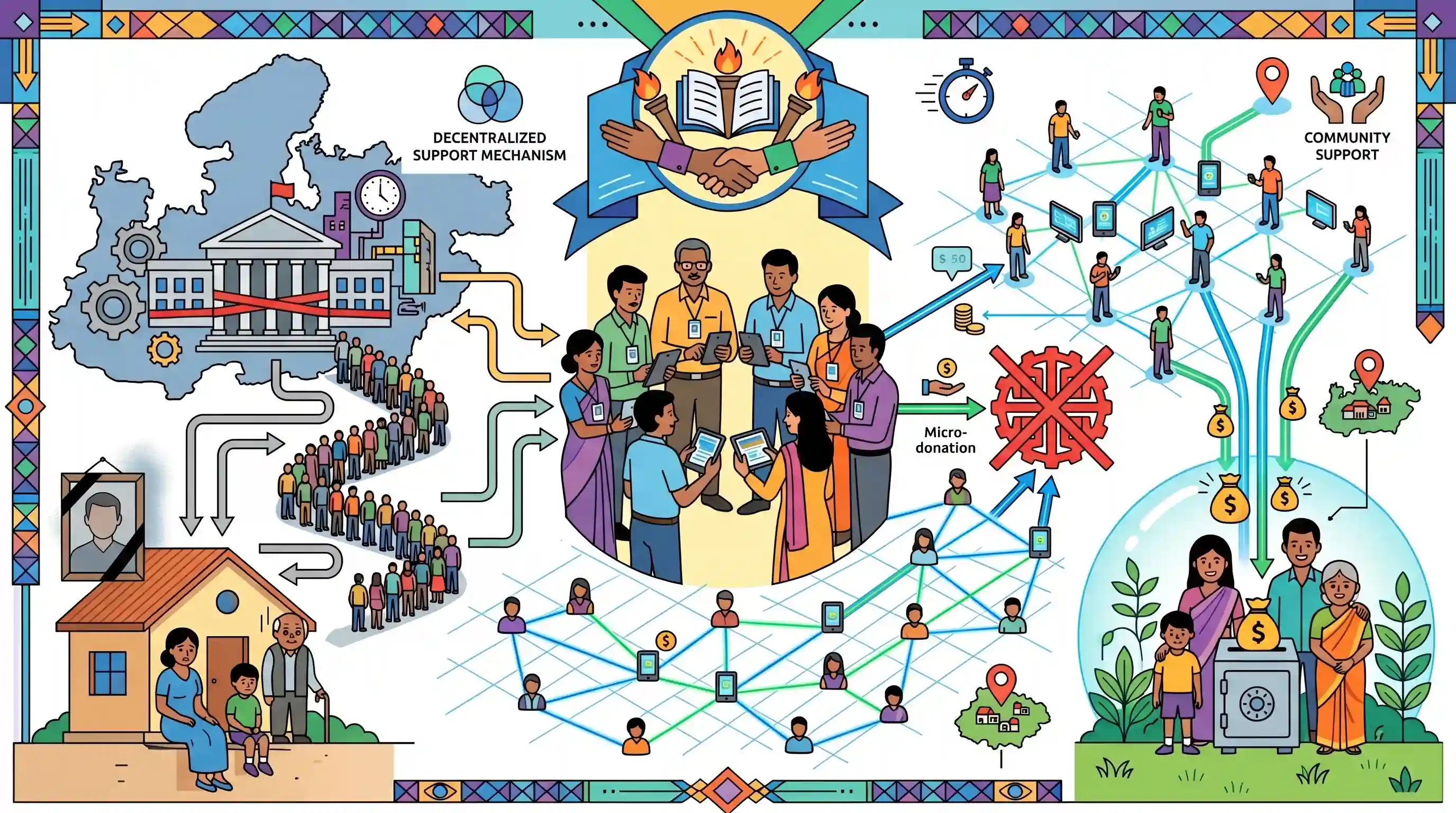
This case study demonstrates an innovative, non-governmental, peer-to-peer crowdfunding social security model. It highlights how local employee associations and civil society networks can overcome systemic administrative delays in state-sponsored welfare or ex-gratia delivery by using digital direct-benefit transfers.
Summary
Teachers and employees of the Madhya Pradesh Education Department have set up a unique peer-to-peer decentralized welfare mechanism. Under the banner of the Primary, Secondary and Higher Secondary Teachers' Association, the group facilitates immediate micro-donations directly into the bank accounts of deceased colleagues' families, bypassing governmental bureaucratic delays. Operable without a central fund to maintain transparency, the platform has supported numerous bereaved families across districts like Damoh and Datia.
Key Points
- The members of the Primary, Secondary and Higher Secondary Teachers' Association in Madhya Pradesh have created a decentralized peer-to-peer social security network to support the families of deceased colleagues.
- Under this system, when a registered member passes away, other members directly transfer a pre-determined small contribution (often as low as Rs 45) to the deceased member's bank account, bypassing administrative delays.
- The system operates without any centralized pool or fund, eliminating the risk of financial mismanagement, administrative corruption, or transactional accusations.
- Established in 2023, the model was inspired by a similar teachers' body in Uttar Pradesh and began after the sudden death of Datia-based teacher Brijesh Prajapati.
- As of mid-2026, the initiative has provided Rs 3 crore in immediate financial aid to the families of 11 deceased employees.
- The Association comprises approximately 1,12,000 members out of around 3,60,000 total teachers, clerks, and peons in the MP Education Department. Registration is free and open to all department staff.
Important Terms
Social Security

A comprehensive system of financial, healthcare, and welfare support provided to individuals and families to protect against economic contingencies such as old age, disability, illness, unemployment, or the death of a breadwinner.
UPSC context
GS Paper II (Social Justice) and GS Paper III (Indian Economy); tests knowledge of social safety nets and vulnerability mitigation.
Civil Society Organizations (CSOs)
Voluntary, non-state, and non-profit groups independent of the market and government that represent collective citizen interests, advocate for rights, and innovate community-driven models of service delivery.
UPSC context
GS Paper II (Governance); tests understanding of non-state actors, informal associations, and their role in developmental processes.
Decentralized Governance
The distribution and devolution of administrative, financial, and decision-making powers from central authorities to local self-government institutions or grassroots communities, ensuring more responsive public service delivery.
UPSC context
GS Paper II (Polity/Governance); tests understanding of democratic decentralization, local self-government, and bottom-up policy implementation.
Primary, Secondary and Higher Secondary Teachers' Association
A voluntary professional body of government educators in Madhya Pradesh that pioneered a decentralized, peer-to-peer micro-donation mechanism to provide immediate financial assistance to the families of deceased colleagues.
UPSC context
GS Paper II (Governance); tests evaluation of informal associations, civil society innovations in welfare, and employee-driven social security models.
School Education Department, Madhya Pradesh
The state administrative department responsible for implementing educational policies, managing government schools, and supervising public school teachers and administrative staff within Madhya Pradesh.
UPSC context
GS Paper II (State Administration); tests knowledge of state-level social sector machinery, employee welfare programs, and administrative accountability.
Prelims Trap
The Code on Social Security, 2020 invalidates decentralized, non-state voluntary peer-to-peer financial assistance networks.
The Code actually accommodates and validates hybrid funding frameworks, including voluntary worker contributions, alongside state-sponsored programs.
Static Concepts Connected
What are the primary constitutional directives for social security in India?
- Article 41: Directs the State to secure the right to work, education, and public assistance in cases of unemployment, old age, sickness, and disablement.
- Article 42: Mandates the State to make provision for securing just and humane conditions of work and for maternity relief.
- Article 43: Directs the State to secure a living wage, decent conditions of work, and social/cultural opportunities for workers.
How do peer-to-peer (P2P) governance models complement state welfare machinery?
- Red-Tape Mitigation: Bypasses procedural delays through agile, self-managed peer networks, eliminating treasury and administrative clearance bottlenecks.
- Zero-Corpus Design: Operates without a central fund, eliminating financial misappropriation risks and reducing regulatory overhead.
- Social Capital: Relies on mutual trust and occupational solidarity to eliminate moral hazard and administrative transaction costs.
Cross-Topic Patterns
Self-help groups & social safety nets
Non-state self-managed mutual aid models demonstrate how civil society can bridge administrative delivery gaps, a critical theme in GS-2 Governance and social justice.
Social Security Code vs. Gig Welfare
Comparing peer-to-peer micro-contribution frameworks with statutory gig worker boards under the Code on Social Security, 2020 highlights formal vs. informal welfare architectures.

GS2 mains may analyze decentralized peer-to-peer mutual aid as a vital, non-state supplement to formal social security under Article 41.
Linked PYQs · 1
Linked PYQs · 1
- 2025MPPSC_PRELIMSGS1
The objective of "Mukhyamantri Ladli Behna Yojana" implemented in entire Madhya Pradesh, in addition to economic self-reliance is:
