Madhya Pradesh revamps Take-Home Ration system through SHGs
Source:indianmasterminds ↗
Why It Matters
The decentralization of supplementary nutrition schemes via SHGs highlights an important governance mechanism that simultaneously addresses child malnutrition and rural women's livelihoods. Given MPPSC's heavy emphasis on state-specific tribal welfare schemes and PVTGs (Sahariya, Baiga, Bharia), this policy update is highly relevant for Prelims questions on social justice and health governance.
Summary
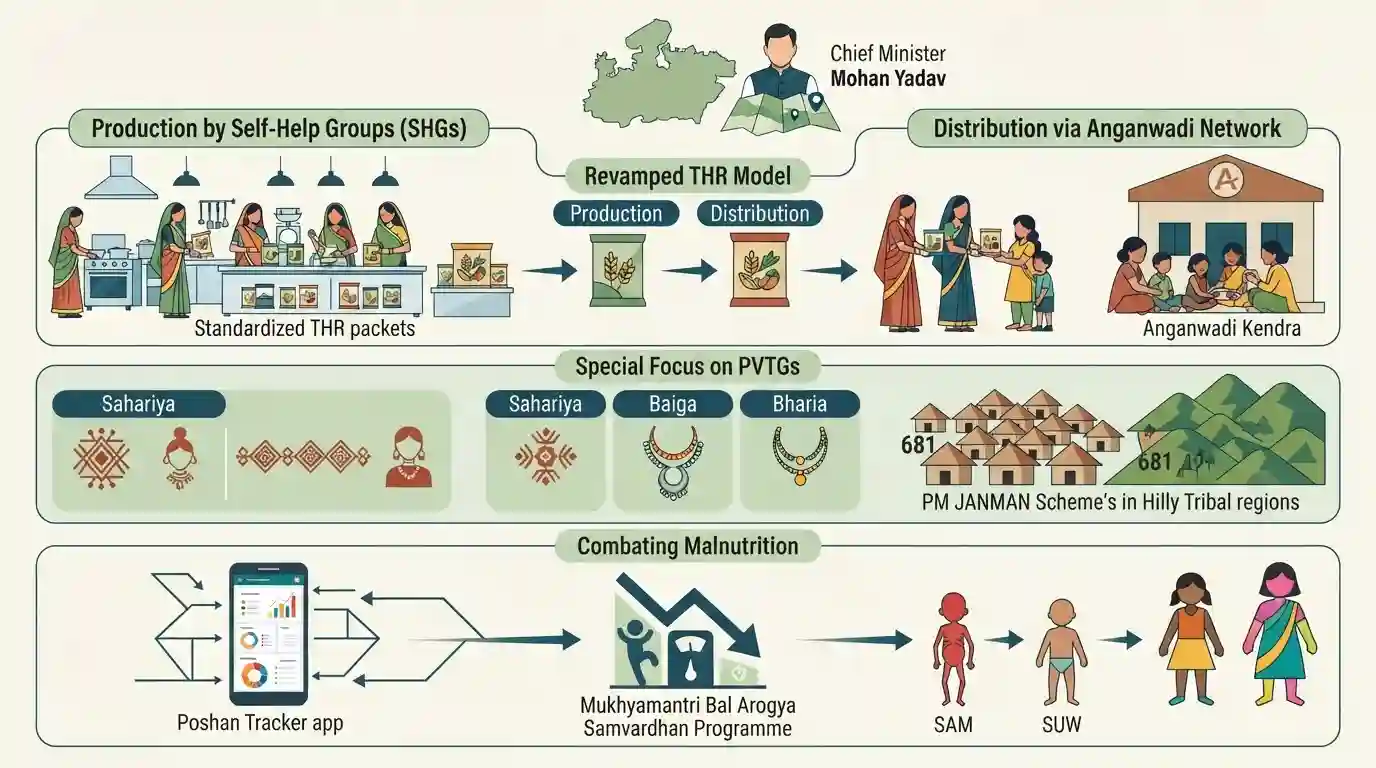
The Madhya Pradesh government, led by Chief Minister Mohan Yadav, has revamped its Take-Home Ration (THR) system to actively combat malnutrition while boosting women's economic empowerment. Under the new model, local Self-Help Groups (SHGs) are tasked with producing and distributing specialized nutrition to children and pregnant or lactating mothers via the state's Anganwadi network. Special focus is given to Particularly Vulnerable Tribal Groups (PVTGs)—the Sahariya, Baiga, and Bharia—with 681 new Anganwadi centres established under the PM JANMAN scheme. Real-time data from the Poshan Tracker app is being leveraged alongside the Mukhyamantri Bal Arogya Samvardhan Programme to reduce cases of Severe Acute Malnutrition (SAM) and Severe Underweight (SUW).
Key Points
- The Madhya Pradesh government has decentralized its Take-Home Ration (THR) system, empowering local Self-Help Groups (SHGs) to produce and distribute nutritional supplements through Anganwadi centres.
- Under PM JANMAN, 681 new Anganwadi centers have been established in tribal-dominated areas to deliver nutritious meals directly to Particularly Vulnerable Tribal Groups (PVTGs) such as the Sahariya, Baiga, and Bharia.
- The state utilizes the Poshan Tracker app for real-time monitoring of beneficiaries to effectively target children classified with Severe Acute Malnutrition (SAM) and Severe Underweight (SUW).
- The initiative achieves dual developmental goals by combating malnutrition at the grassroots level and fostering economic independence for women through SHG employment.
Important Terms
Take-Home Ration (THR) System

A supplementary nutrition program providing dry rations or locally prepared food, managed by SHGs, to pregnant women, lactating mothers, and young children via Anganwadi centres.
UPSC context
Crucial for MPPSC GS Paper 2 (Health and State Welfare Schemes), focusing on combating malnutrition and improving maternal-child health.
Pradhan Mantri Janjati Adivasi Nyaya Maha Abhiyan (PM JANMAN)
A targeted scheme providing 11 critical interventions, including housing, health, and water, to uplift the socio-economic status of Particularly Vulnerable Tribal Groups (PVTGs).
UPSC context
Highly relevant for MPPSC GS Paper 2 and Paper 1 Part B, as Madhya Pradesh has significant PVTG populations.
Mukhyamantri Bal Arogya Samvardhan Programme
A Madhya Pradesh state-specific initiative aimed at identifying, registering, and closely managing children suffering from Severe Acute Malnutrition (SAM) and Moderate Acute Malnutrition (MAM).
UPSC context
Important for MPPSC GS Paper 2 (Health & Nutrition), specifically state government interventions addressing child malnutrition in tribal and rural areas.
Poshan Tracker
A mobile-based application functioning as the primary e-governance tool for real-time tracking of Anganwadi infrastructure, daily attendance, and the growth monitoring of nutrition beneficiaries.
UPSC context
Key for MPPSC GS Paper 2 (E-governance and Public Health), illustrating technology's role in improving scheme transparency and monitoring.
Self-Help Groups (SHGs)
Informal collectives of individuals, typically women, who pool resources. Under MP's revamped model, they are economically empowered by producing and distributing the Take-Home Ration.
UPSC context
Standard topic in MPPSC GS Paper 2, highlighting women's economic empowerment, community-driven welfare delivery, and rural development.
Prelims Trap
"Gond and Bhil tribes receive special Anganwadi centers under the PM JANMAN scheme in MP."
PM JANMAN exclusively targets Particularly Vulnerable Tribal Groups (PVTGs). In MP, only Sahariya, Baiga, and Bharia are PVTGs; Gond and Bhil are not.
Static Concepts Connected
What are the geographic concentrations of Madhya Pradesh's 3 PVTGs?
- Baiga: Concentrated in the eastern districts, primarily Mandla, Dindori, and Balaghat.
- Bharia: Historically isolated in the Patalkot valley of Chhindwara district.
- Sahariya: Located in the northern Gwalior-Chambal belt, specifically in Sheopur, Shivpuri, and Guna districts.
How is Severe Acute Malnutrition (SAM) clinically defined in children?
- Severe Wasting: A weight-for-height Z-score that is below -3 standard deviations from the median.
- MUAC: Mid-Upper Arm Circumference measuring less than 11.5 cm (115 mm) in children aged 6-59 months.
- Edema: The presence of bilateral pitting edema (fluid retention) indicating severe nutritional deficiency.
Cross-Topic Patterns
Women's Empowerment + Nutritional Security
MP's THR model mirrors a growing trend where SHGs are utilized not just for microcredit, but as decentralized, last-mile supply chains for core state welfare schemes.
Digital Governance + Tribal Welfare
Integrating the Poshan Tracker with PM JANMAN highlights how mobile digital governance is being leveraged to overcome the geographical isolation of PVTG communities.

Expect a Prelims match-the-following on MP's 3 PVTGs & districts, or a Mains Q on SHGs' dual role in the rural economy and nutrition.
Linked PYQs · 4
Linked PYQs · 4
- 2025MPPSC_PRELIMSGS1
Which one of the following is not one of the Particularly Vulnerable Tribal Group (PVTG) of Madhya Pradesh?
- 2022MPPSC_PRELIMSGS1
Which of the following tribes is often addressed as "Khutia Patel" with respect?
- 2025MPPSC_PRELIMSGS1
Since the date 23.12.2017, 'Ahar Anudan Yojana' is a yojana to get rid of malnutrition of which tribal community?
- 2025MPPSC_PRELIMSGS1
The objective of "Mukhyamantri Ladli Behna Yojana" implemented in entire Madhya Pradesh, in addition to economic self-reliance is:
