Madhya Pradesh Snakebite Study: Common Krait Bites During Sleep
Source:newindianexpress ↗
Why It Matters
The study addresses a major public health hazard unique to rural environments in Madhya Pradesh, providing crucial data for medical interventions, preventive health policies, and regional disaster/morbidity management.
Summary
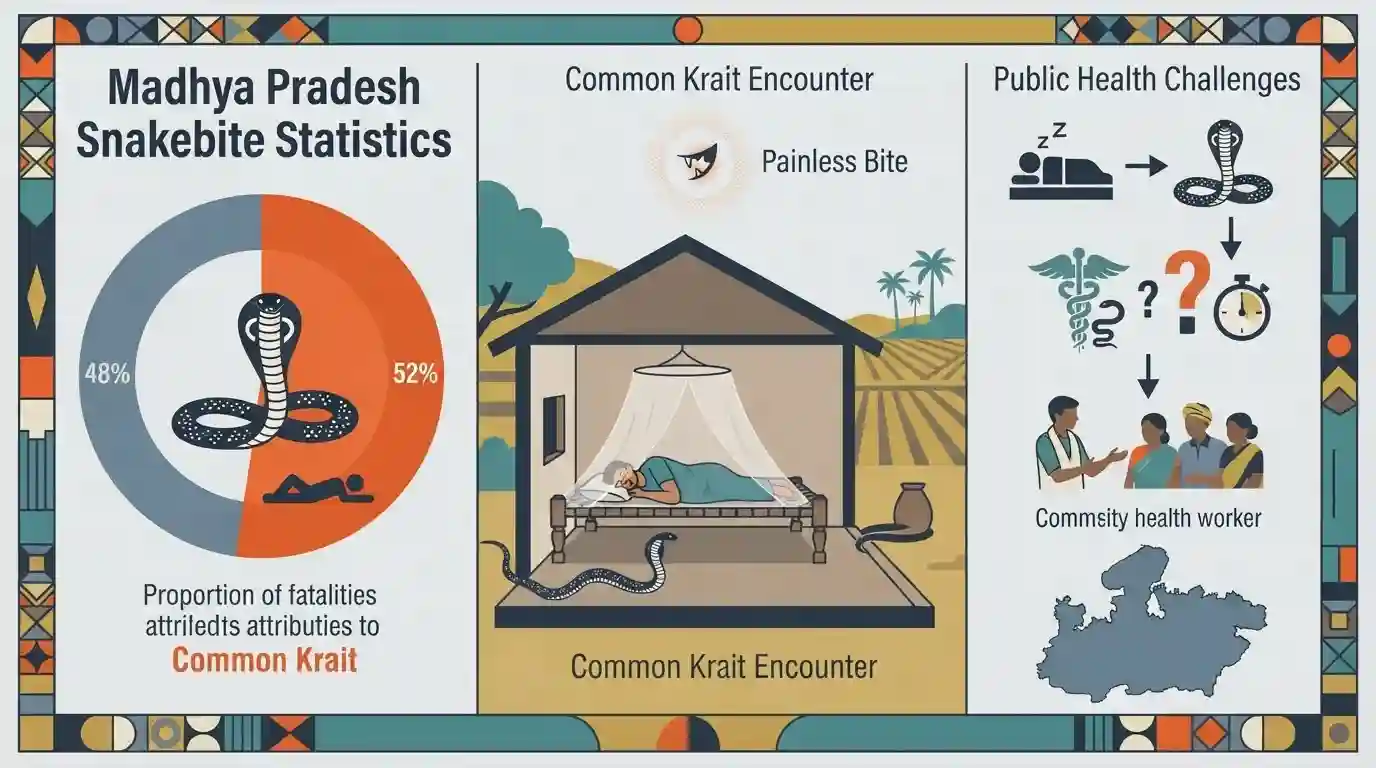
A study conducted in Madhya Pradesh highlights that nearly 52% of snakebite fatalities in the state are caused by Common Krait bites inflicted while victims are asleep, primarily due to the neurotoxic and painless nature of the bite. This finding underscores public health challenges in rural Madhya Pradesh regarding wildlife-human conflict and preventive healthcare.
Key Points
- A recent study in Madhya Pradesh revealed that Common Krait bites occurring during sleep account for nearly 52% of all snakebite deaths in the state.
- Common Krait (Bungarus caeruleus) venom is neurotoxic, causing painless bites while people are asleep, often leading to delayed medical attention and high mortality rates.
- The findings highlight the critical need for rural public health campaigns promoting bed nets, elevated sleeping habits, and immediate antivenom access.
Prelims Trap
Common Krait bites cause immediate localized pain and swelling, alerting the sleeping victim instantly.
Aspirants often assume all snakebites cause severe localized pain and swelling; however, Common Krait venom is neurotoxic and notoriously painless, delaying detection.
Static Concepts Connected
What are the key physiological characteristics and medical management challenges of Common Krait (Bungarus caeruleus) venom?
- Neurotoxic Venom: Potent neurotoxins that block neuromuscular transmission, leading to progressive paralysis without causing local tissue damage or severe pain.
- Nocturnal Risk: Bites often occur at night while victims sleep on the floor; the painless bite fails to wake the victim, causing dangerous delays in antivenom administration.
- Medical Treatment: Polyvalent antivenom remains the primary treatment, supplemented by artificial ventilation for respiratory paralysis.
Cross-Topic Patterns
Snakebite Envenoming + Neglected Tropical Diseases
Snakebite envenoming was officially recognized as a Neglected Tropical Disease by WHO, intersecting rural public health schemes and wildlife protection laws.
Wildlife-Human Conflict + Rural Health Infrastructure
Studies linking the South Panna Forest Division with human fatalities bridge wildlife management under the Wildlife Protection Act and rural healthcare delivery in MP.

Common Krait venom properties, nocturnal biting habits, and rural preventive measures (elevated sleeping/bed nets) are high-yield MPPSC Prelims facts.
Linked PYQs · 4
Linked PYQs · 4
- 2023MPPSC_PRELIMSGS1
Which type of forests are not found in Madhya Pradesh ?
- 2025MPPSC_PRELIMSGS1
According to India States of Forest Report (ISFR) 2021, which of these districts of Madhya Pradesh has forest cover less than 10 percent (% of the geographical area of the district)?
- 2025MPPSC_PRELIMSGS1
The objective of "Mukhyamantri Ladli Behna Yojana" implemented in entire Madhya Pradesh, in addition to economic self-reliance is:
- 2025MPPSC_PRELIMSGS1
What was Madhya Pradesh's composite SDG (Sustainable Development Goals) score in the SDG India Index 3.0 in 2020?
