NHRC Issues Notice Over Maternal Deaths in Madhya Pradesh Sidhi
Source:Indian Express ↗
Why It Matters
This incident serves as a vital case study for GS Paper 2 on the stark realities of India's rural healthcare infrastructure, the challenges in reducing the Maternal Mortality Ratio (MMR), and the crucial role of statutory bodies like the NHRC in holding the state accountable for the right to health and life.
Summary
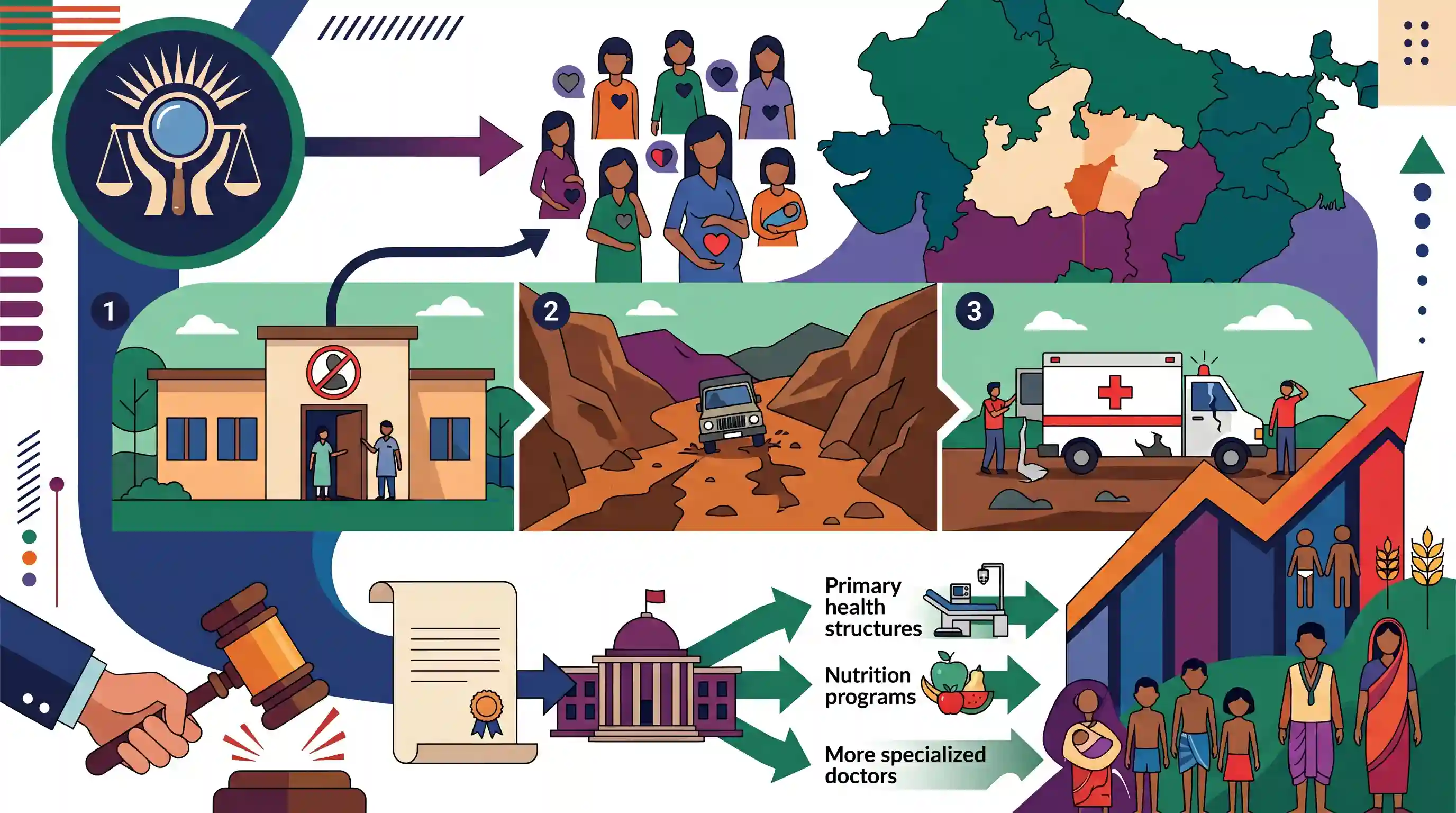
The National Human Rights Commission (NHRC) has taken suo motu cognisance of an investigation into 53 maternal deaths within a single year in Madhya Pradesh’s Sidhi district. The deaths expose glaring deficits in rural health infrastructure, including a severe shortage of specialists (gynaecologists and obstetricians) at local health centers, poor road connectivity, and a lack of reliable emergency transport. The NHRC has issued a notice to the state government seeking a detailed report, bringing to the forefront the pressing need to improve primary health structures, address underlying malnutrition, and tackle the Maternal Mortality Ratio (MMR) in India's remote and tribal regions.
Key Points
- The NHRC took suo motu cognisance of a media report detailing 53 maternal deaths in Madhya Pradesh's Sidhi district over a 12-month period.
- The deaths primarily involved women averaging 26 years of age, largely first- or second-time mothers, emphasizing the acute vulnerability of maternal health in remote regions.
- Core issues highlighted include a severe lack of doctors and technical experts at Primary Health Centres (PHCs) and Community Health Centres (CHCs), forcing patients to travel long distances.
- Poor infrastructure like bad roads and lack of reliable transport exacerbated the situation, often forcing families to carry pregnant women on cots.
- The situation underscores persistent challenges in tackling Maternal Mortality Ratio (MMR) in tribal and remote areas, compounded by underlying issues like anaemia and malnutrition.
Important Terms
National Human Rights Commission (NHRC)

An independent statutory body established in 1993 under the Protection of Human Rights Act to protect and promote rights relating to life, liberty, equality, and dignity.
UPSC context
GS II: Statutory/Quasi-judicial Bodies. Tests knowledge of institutional frameworks for human rights and governance accountability.
Maternal Mortality Ratio (MMR)
The number of maternal deaths per 100,000 live births. It is a key indicator for measuring the quality of a country's maternal healthcare and reproductive services.
UPSC context
GS II: Health/Social Sector. Used to evaluate developmental progress, gender equity, and public health efficacy.
Suo Motu Cognisance
The power of a court or statutory body to initiate legal proceedings on its own initiative, without receiving a formal complaint or petition from an affected party.
UPSC context
GS II: Judiciary/Governance. Highlights proactive institutional roles in addressing systemic failures and protecting fundamental rights.
Primary Health Care (PHC)
The first level of professional contact for individuals with the national health system, providing essential, accessible, and affordable healthcare close to where people live.
UPSC context
GS II: Issues Relating to Health. Tests understanding of rural health infrastructure and universal health coverage strategies.
Sustainable Development Goal 3 (SDG 3)
A global goal to ensure healthy lives and promote well-being for all. Target 3.1 specifically aims to reduce the global maternal mortality ratio to below 70 by 2030.
UPSC context
GS II/III: Social Sector/Economy. Relevant for discussing India’s global commitments and developmental benchmarks.
Prelims Trap
The NHRC can only investigate human rights violations upon receiving a formal petition or complaint.
Under the Protection of Human Rights Act (1993), the NHRC has explicit statutory power to take suo motu cognisance of human rights violations.
Static Concepts Connected
What are the key limitations of the NHRC's powers?
- Recommendatory Nature: Its recommendations are purely advisory and not legally binding on the government or the concerned authority.
- One-Year Time Bar: It cannot investigate an incident if more than one year has elapsed from the date of occurrence.
- Armed Forces Limitation: It has highly restricted jurisdiction and investigative powers regarding human rights violations committed by the armed forces.
What is the Three Delays Model of maternal mortality?
- Seeking Care: Delay driven by a lack of awareness, low status of women, and financial constraints in deciding to seek medical help.
- Transit Delay: Delay caused by poor road infrastructure, difficult terrain, and an absence of reliable emergency ambulances.
- Receiving Care: Delay at the facility due to absentee doctors, severe shortages of specialists (gynaecologists/anaesthetists), or inadequate blood banks.
Cross-Topic Patterns
Health as a Human Right (Art 21)
The NHRC equates systemic maternal deaths to violations of the Right to Life under Article 21, bridging constitutional fundamental rights with social sector public health infrastructure.
Tribal Geography & Health Deficits
Tribal-majority districts like Sidhi consistently underperform in NFHS health indicators, linking GS1 human geography directly with GS2 governance failures in Empowered Action Group (EAG) states.

Mains 2026 could feature a 15-marker linking NHRC's evolving role in enforcing socio-economic rights like healthcare and tribal welfare.
Linked PYQs · 4
Linked PYQs · 4
- 2021MainsGS2
“Besides being a moral imperative of a Welfare State, primary health structure is a necessary precondition for sustainable development.” Analyze.
- 2020MainsGS2
In order to enhance the prospects of social development, sound and adequate health care policies are needed particularly in the fields of geriatric and maternal health care. Discuss.
- 2024MainsGS2
In a crucial domain like the public healthcare system the Indian State should play a vital role to contain the adverse impact of marketisation of the system. Suggest some measures through which the State can enhance the reach of public healthcare at the grassroots level.
- 2014MainsGS2
National Human Rights Commission (NHRC) in India can be most effective when its tasks are adequately supported by other mechanisms that ensure the accountability of a government. In light of the above observation assess the role of NHRC as an effective complement to the judiciary and other institutions in promoting and protecting human rights standards.
