Panna SDM Under Scrutiny For Jailing Delivery Executive Over Parcel
Source:The Hindu ↗
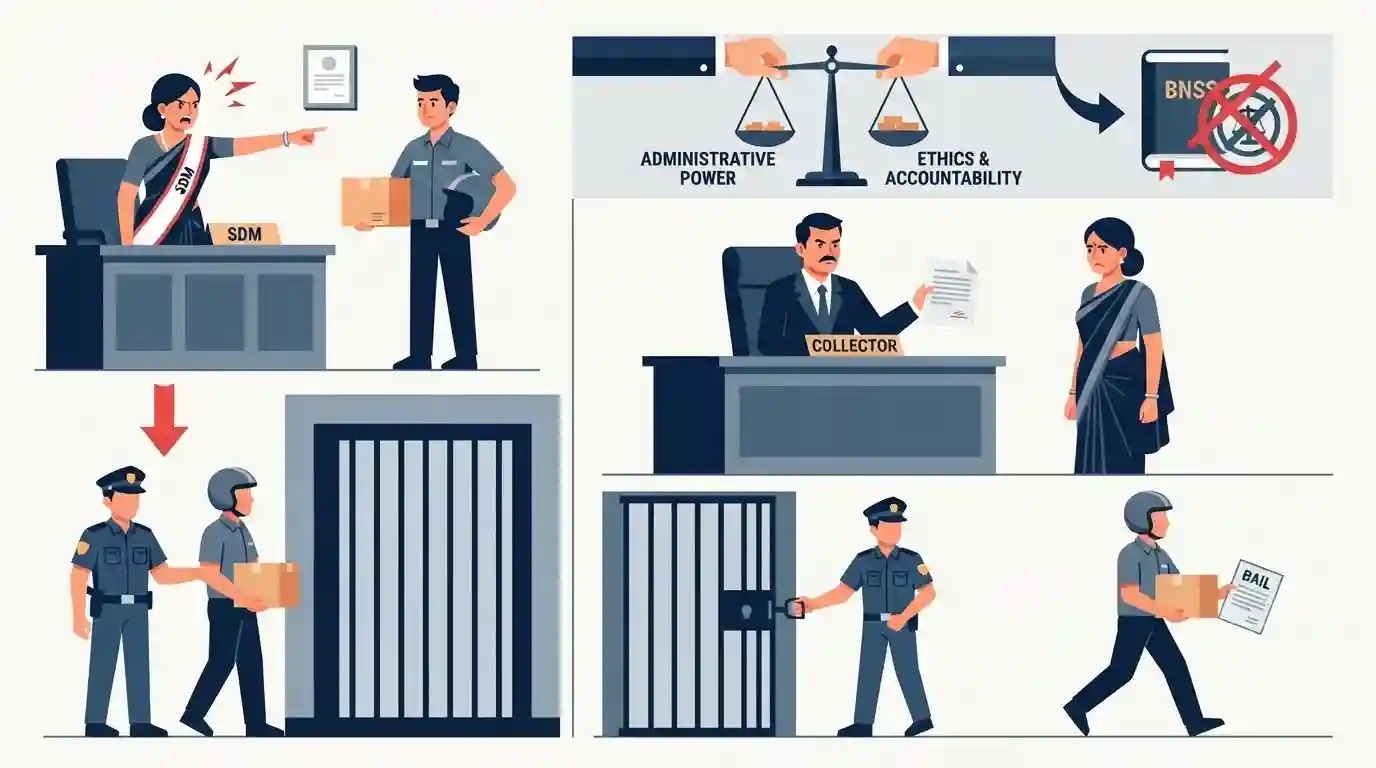
Why It Matters
The incident is a textbook case of administrative overreach and misuse of procedural laws (BNSS). It directly ties into MPPSC and UPSC syllabus themes regarding the ethical conduct of public servants, the mechanisms of accountability in governance, and the functioning of the district administration.
Summary
A Sub-Divisional Magistrate (SDM) in Madhya Pradesh's Panna district faced severe criticism and disciplinary action after she ordered the jailing of a delivery executive over an incomplete parcel. The executive was sent to jail under Section 170 of the Bharatiya Nagarik Suraksha Sanhita (BNSS) following an altercation. The incident highlights the abuse of administrative power and lack of ethical conduct by civil servants, prompting the district Collector to issue a show-cause notice and the police to release the executive on bail.
Key Points
- An SDM in Panna district (Madhya Pradesh) allegedly misused her authority by sending a delivery executive to jail over a minor dispute regarding an incomplete parcel.
- The SDM instructed the Tehsildar to prepare a jail warrant under Section 170 of the Bharatiya Nagarik Suraksha Sanhita (BNSS) after the executive suggested initiating a return for the missing item.
- Following public backlash and media attention, the delivery executive was granted bail, and the Panna Collector initiated disciplinary action by issuing a show-cause notice to the SDM.
- The incident has sparked a debate on the arbitrary exercise of power by civil servants and the need for strict ethical guidelines and accountability in district administration.
Important Terms
Bharatiya Nagarik Suraksha Sanhita (BNSS)

The procedural law replacing the Code of Criminal Procedure (CrPC), 1973, effective July 2024. It governs arrests, investigations, and trials in India, introducing digital processes and mandatory forensics to modernize the criminal justice framework.
UPSC context
GS Paper 2 (Polity). Tests knowledge of criminal justice reforms, legal frameworks, and balancing state power with citizen rights.
Section 170 BNSS
A provision enabling police to make preventive arrests without a warrant or Magistrate's order to stop an imminent cognizable offence. Replacing Section 151 CrPC, its misuse raises serious concerns about arbitrary detention and human rights.
UPSC context
GS Paper 2 & 4. Crucial for topics on police powers, fundamental rights (Article 21), and the abuse of administrative authority.
District Administration
The core unit of state field governance in India, headed by a District Collector/Magistrate. It oversees revenue, law and order, and development, ensuring accountability of subordinate executive magistrates like SDMs and Tehsildars.
UPSC context
GS Paper 2 & 4. Tests understanding of the role of civil services in a democracy, administrative hierarchy, and ethical public conduct.
Prelims Trap
Executive Magistrates can award punitive imprisonment for petty offenses to maintain local public order.
Executive Magistrates (like DMs/SDMs) only possess preventive jurisdiction (e.g., maintaining peace). Punitive imprisonment strictly belongs to Judicial Magistrates under Article 50.
Static Concepts Connected
What distinguishes Executive Magistrates from Judicial Magistrates?
- Appointment: Executive Magistrates are appointed by the State Government, while Judicial Magistrates function under the purview of the respective High Court.
- Functions: Executive Magistrates handle administrative and preventive functions (law & order). Judicial Magistrates handle criminal trials and pronounce punitive actions.
- Constitutional Basis: This functional division gives practical effect to Article 50 of the DPSP, which mandates separating the judiciary from the executive.
What is the scope of preventive arrest under Section 170 of the BNSS?
- Preventive Purpose: It authorizes arrest without a warrant strictly to prevent the commission of a cognizable offense, not to punish for a private altercation.
- CrPC Equivalent: This provision corresponds directly to Section 151 of the erstwhile Code of Criminal Procedure (CrPC), 1973.
- Time Constraint: Detention under this section cannot exceed 24 hours unless further detention is required or authorized under other provisions of the law.
Cross-Topic Patterns
Discretionary power vs. Administrative Ethics
The misuse of BNSS provisions for personal disputes perfectly illustrates the 2nd ARC's concerns over unchecked discretionary powers overriding the Nolan Principles of Objectivity and Integrity.
BNSS implementation and Executive overreach
As the BNSS replaces the CrPC, arbitrary application of preventive arrest sections highlights the ongoing tension between executive law-and-order mandates and fundamental constitutional rights (Article 21).

Prelims 2026 may test the constitutional boundaries (Article 50) of Executive vs Judicial Magistrates under the new BNSS framework.
Linked PYQs · 3
Linked PYQs · 3
- 2023MPPSC_PRELIMSGS1
The Union Public Service Commission constituted a committee in July 2000 to review the civil services examination under the chairmanship of:
- 2021MPPSC_PRELIMSGS1
Chairperson and Member of the State Public Service Commission are appointed
- 2021MPPSC_PRELIMSGS1
The Development Monitoring and Evaluation Office (DMEO) was constituted on
