Accountability gaps in mid-day meal implementation at grassroots
Source:The Hindu ↗
Why It Matters
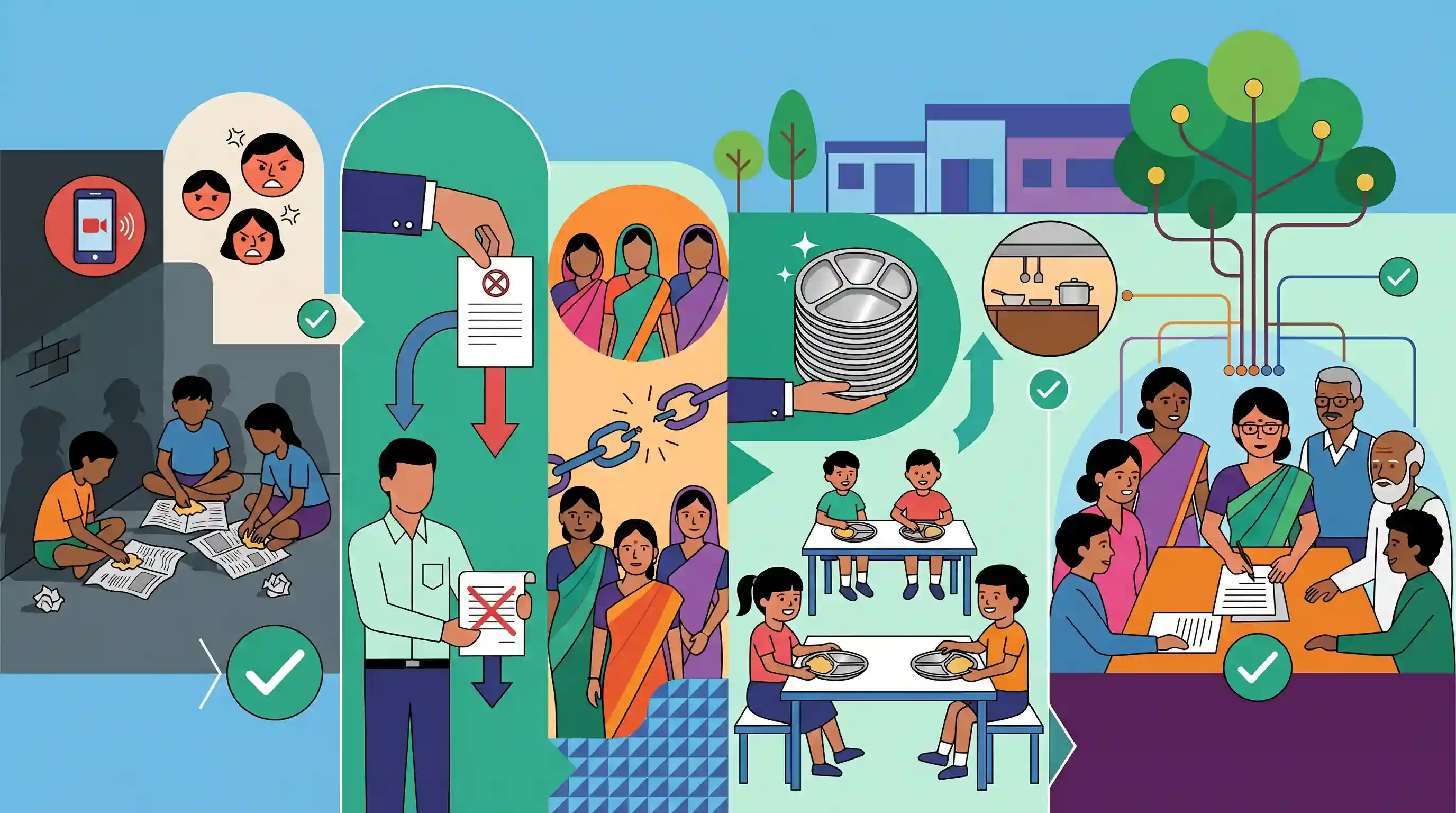
This incident highlights critical gaps in the implementation, monitoring, and accountability of flagship welfare schemes like PM POSHAN at the grassroots level. It underscores the role of SHGs and local committees in delivering basic services, and demonstrates how public scrutiny can enforce immediate corrective administrative actions and uphold the dignity of beneficiaries.
Summary
Following widespread outrage over a viral video showing primary school students eating mid-day meals on newspapers in Madhya Pradesh's Sheopur district, the state administration intervened by providing stainless steel plates. Authorities took strict disciplinary action, suspending the school in-charge and cancelling the contract of the Self-Help Group (SHG) responsible for the meals. The responsibility for meal preparation was subsequently handed over to the local School Management Committee, highlighting issues of accountability and service delivery in grassroots welfare schemes.
Key Points
- A viral video showed primary school students in Madhya Pradesh's Sheopur district eating mid-day meals served on newspapers.
- The incident sparked political outrage over the dignity and welfare of children from marginalized communities.
- In response, the local administration provided stainless steel plates to the school and officials ate with the children to restore confidence.
- The contract of the Self-Help Group (SHG) responsible for meal preparation was cancelled due to negligence, and duties were transferred to the School Management Committee.
- Administrative action was taken, including the suspension of the school in-charge and the issuance of show-cause notices to other staff.
Important Terms
PM POSHAN

A centrally sponsored scheme (formerly Mid-day Meal) providing one hot cooked meal daily to children in classes 1–8 in government and government-aided schools to improve nutrition and attendance.
UPSC context
GS Paper 2: Issues relating to poverty and hunger; government policies and interventions for development.
Self-Help Group (SHG)
Informal, voluntary associations of 10–20 individuals (primarily women) who pool savings to provide micro-loans to members and manage community services like meal preparation.
UPSC context
GS Paper 2: Development processes and the role of SHGs; GS Paper 3: Financial inclusion.
School Management Committee (SMC)
A local body mandated by the RTE Act (2009) comprising parents, teachers, and local authorities to monitor school functioning, development plans, and mid-day meal implementation.
UPSC context
GS Paper 2: Issues relating to development and management of Education; local governance and decentralization.
Accountability in Public Service Delivery
The obligation of public officials and service providers to be answerable for their performance, ensuring transparent, ethical, and efficient implementation of welfare schemes.
UPSC context
GS Paper 2: Important aspects of governance, transparency, and accountability; GS Paper 4: Ethics in public administration.
Social Audit
A community-led monitoring process where citizens scrutinize government records and evaluate service quality (like meal hygiene) to ensure transparency and proper fund utilization.
UPSC context
GS Paper 2: Transparency & accountability; institutional and other measures (Governance).
Prelims Trap
"School Management Committees (SMCs) are constituted under the National Food Security Act to monitor PM POSHAN."
Aspirants confuse the statutory backing of the meal (NFSA) with the body monitoring the school (SMCs). SMCs are actually mandated by the Right to Education (RTE) Act 2009.
Static Concepts Connected
What is the statutory mandate of School Management Committees (SMCs)?
- RTE Act 2009: Section 21 of the Act mandates the formation of SMCs in all government, government-aided, and special category schools.
- Composition: Minimum 75% of members must be parents or guardians. It requires proportionate representation for disadvantaged groups, and 50% must be women.
- Key Functions: Prepare school development plans, monitor school operations, and oversee the utilization of government grants, including the PM POSHAN scheme.
How does the NFSA provide statutory backing to PM POSHAN?
- Legal Guarantee: The NFSA 2013 legally guarantees one hot cooked meal per school day to children in classes I to VIII (aged 6 to 14) to combat malnutrition.
- Nutritional Norms: The Act dictates specific minimums, such as 450 calories and 12g of protein for primary children, and 700 calories/20g protein for upper primary.
- Food Security Allowance: It mandates the state to pay a monetary allowance to beneficiaries if meals cannot be provided on any school day due to unforeseen circumstances.
Cross-Topic Patterns
SHGs + Local Governance accountability
Transferring duties from an erring SHG to the SMC highlights the GS2 theme of SHG accountability, community-led oversight, and social audits in decentralized welfare delivery.
NFSA + Social Equity in Education
Dignity and non-discrimination in Mid-Day Meals frequently links GS-2 vulnerability topics (welfare of marginalized communities) with GS-4 administrative ethics and public service delivery.

Expect a Prelims question testing the statutory backing of PM POSHAN (NFSA) and the mandate of SMCs under the RTE Act.
Linked PYQs · 4
Linked PYQs · 4
- 2024MainsGS2
Poverty and malnutrition create a vicious cycle, adversely affecting human capital formation. What steps can be taken to break the cycle ?
- 2017MainsGS2
The emergence of the Self-Help Groups (SHGs) in contemporary times points to the slow but steady withdrawal of the State from developmental activities." Examine the role of the SHGs in developmental activities and the measures taken by the Government of India to promote the SHGs.
- 2023PrelimsGS1
Consider the following statements: 1. The Self-Help Group (SHG) programme was originally initiated by the State Bank of India by providing microcredit to the financially deprived. 2. In an SHG, all members of a group take responsibility for a loan that an individual member takes. 3. The Regional Rural Banks and Scheduled Commercial Banks support SHGs. How many of the above statements are correct?
- 2016MainsGS2
Examine the main provisions of the National Child Policy and throw light on the status of its implementation.
