Madhya Pradesh Resumes Regular Fertilizer Distribution for Farmers
Source:thecliffnews ↗
Why It Matters
Fertilizer availability is critical for agricultural productivity in Madhya Pradesh, a heavily agrarian state. Understanding the dynamics of agricultural inputs, crop seasons (Kharif), and state interventions is essential for MPPSC aspirants studying the state's economy and geography.
Summary
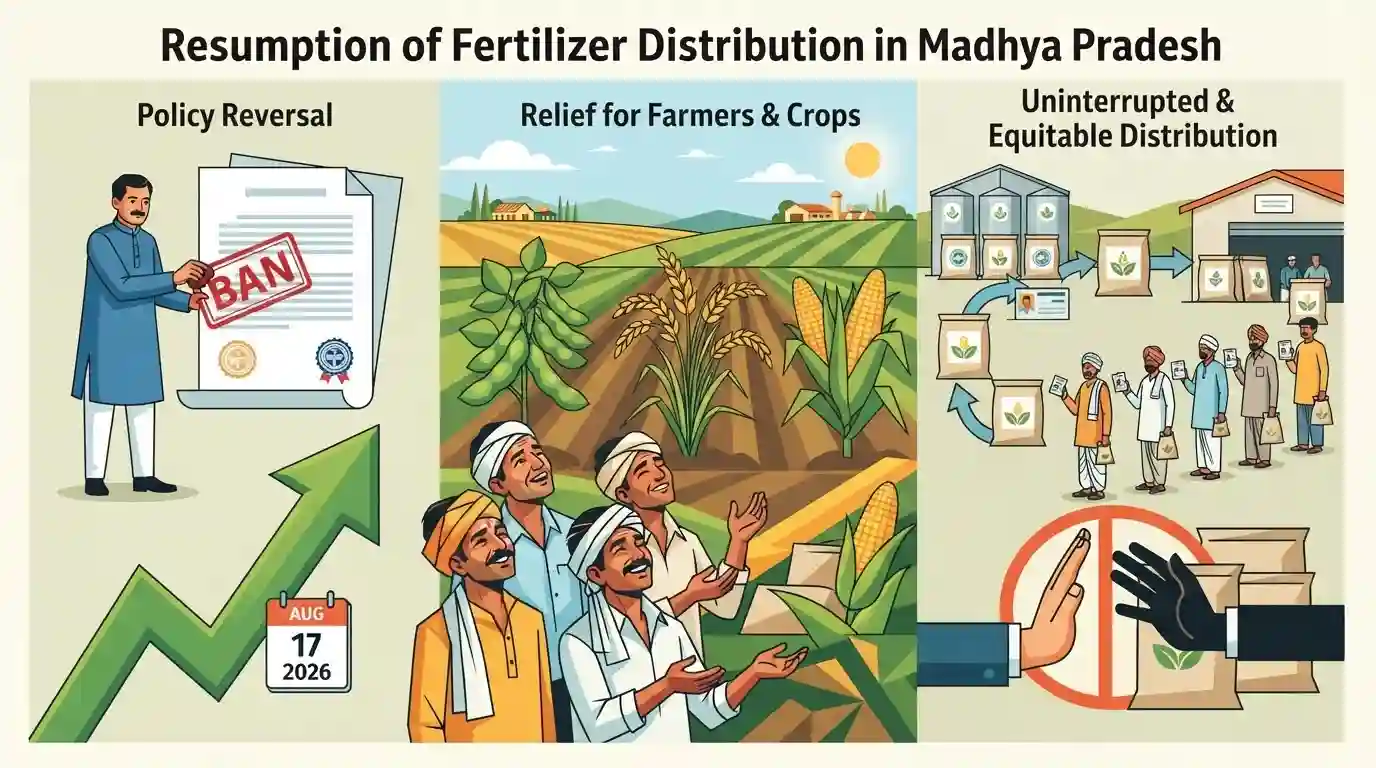
The Madhya Pradesh government has resumed regular fertilizer distribution starting August 17, 2026, revoking an abrupt ban imposed just days prior. The reversal brings significant relief to over 82 lakh farmers dependent on fertilizers for crucial Kharif crops like soybean, paddy, and maize. The state administration has been directed to maintain uninterrupted supply, ensure equitable access, and strictly curb black marketing and hoarding practices.
Key Points
- The Madhya Pradesh government has reversed its August 14 order banning the sale of fertilizers, resuming regular distribution from August 17, 2026.
- The decision provides major relief to over 82 lakh farmers in the state who are in urgent need of fertilizers for their Kharif crops.
- Timely availability of fertilizers is critical for major Kharif crops cultivated in the state, such as soybean, paddy, and maize.
- The administration is tasked with ensuring a smooth supply chain, preventing black marketing and hoarding, and maintaining transparency in distribution.
Important Terms
MARKFED (MP State Cooperative Marketing Federation)

The apex cooperative institution in Madhya Pradesh responsible for procuring agricultural produce and distributing subsidized fertilizers to farmers through primary agricultural cooperative societies (PACS).
UPSC context
Important for MPPSC Paper 2 (Economy), testing knowledge of agricultural marketing, cooperatives, and the state's fertilizer supply chain.
Kharif Crops
Monsoon-sown crops planted in June-July and harvested in September-October. Crucial Kharif crops in Madhya Pradesh include soybean, paddy, and maize, which heavily depend on timely fertilizer application.
UPSC context
Crucial for MPPSC Paper 1 (Geography) and Paper 2 (Economy) when discussing state cropping patterns, monsoon dependency, and major crops.
Farmers Welfare and Agriculture Development Department
The nodal state department in Madhya Pradesh tasked with agricultural policy-making, crop management, overseeing input distribution like fertilizers, and driving initiatives for farmer welfare.
UPSC context
Highly relevant for Paper 2 (Governance and Economy) regarding the administrative bodies regulating state agriculture and implementing rural policies.
Fertilizer Black Marketing
The illegal stockpiling and unauthorized high-priced sale of subsidized fertilizers. The state government actively polices this to ensure equitable distribution for farmers during critical sowing periods.
UPSC context
Tests knowledge on agricultural governance, supply chain challenges, and regulatory frameworks (like the Essential Commodities Act) in MPPSC Paper 2.
Soybean (Golden Bean)
A major Kharif oilseed crop that makes Madhya Pradesh the "Soya State" of India, as the state produces over half of the country's total soybean output.
UPSC context
Frequently tested in MPPSC Prelims and Mains (Paper 1 & 2) regarding state-specific agricultural dominance and major cash crops.
Prelims Trap
Paddy and soybean are both primarily cultivated in the Malwa plateau region.
While soybean is the dominant crop of the Malwa plateau, paddy requires high rainfall and is concentrated in eastern/south-eastern MP (Baghelkhand and Wainganga basin).
Static Concepts Connected
What is the geographic distribution of major Kharif crops in Madhya Pradesh?
- Soybean: Dominates the Malwa Plateau and Narmada Valley regions, earning MP the title of "Soya State."
- Paddy (Rice): Concentrated in eastern and south-eastern regions (Baghelkhand Plateau, Wainganga basin) where monsoon rainfall is significantly higher.
- Maize: Largely cultivated in the southern and western tribal belts, prominently in Chhindwara, Jhabua, and Alirajpur districts.
Where is the prominent fertilizer manufacturing facility located in Madhya Pradesh?
- Vijaipur (Vijaipur): Located in Guna district, it houses a major National Fertilizers Limited (NFL) plant.
- HVJ Pipeline Link: The Vijaipur plant is gas-based and receives its feedstock from the Hazira-Vijaipur-Jagdishpur (HVJ) pipeline.
- Rock Phosphate Reserves: Jhabua and Chhatarpur are known for rock phosphate deposits, a crucial raw material for phosphatic fertilizers.
Cross-Topic Patterns
Agro-Climatic Zones + Kharif Demand
Fertilizer demand maps directly onto MP's 11 agro-climatic zones. Soybean drives input demand in the Malwa Plateau, while paddy dictates supply needs in the eastern Baghelkhand region.
Fertilizer Industry + Energy Infrastructure
MP's fertilizer supply chain is intimately linked to national energy infrastructure, specifically the HVJ gas pipeline which feeds the critical National Fertilizers Limited (NFL) plant in Vijaipur, Guna.

Match-the-following questions pairing MP's Kharif crops with agro-climatic zones or fertilizer plants (like Vijaipur) are highly probable.
Linked PYQs · 4
Linked PYQs · 4
- 2024MPPSC_PRELIMSGS1
In which district of Madhya Pradesh was the production of soybean initially started?
- 2024MPPSC_PRELIMSGS1
UNNATI (Agri-GISl project of Madhya Pradesh Government is for :
- 2024MPPSC_PRELIMSGS1
According to 2021 - 22, the area and production of wheat occupies which place among cereals, in Madhya Pradesh?
- 2020MPPSC_PRELIMSGS1
Main crop of Madhya Pradesh is
