Madhya Pradesh School Education Department Teacher Recruitment
Source:careerindia ↗
Why It Matters
Teacher availability and public expenditure on education (with MP allocating 12.22% of its 2023-24 budget to education) are critical indicators of human development in Madhya Pradesh. This recruitment supports the structural realization of the Right to Education (RTE) under Article 21A, a frequent area of examination in MPPSC.
Summary
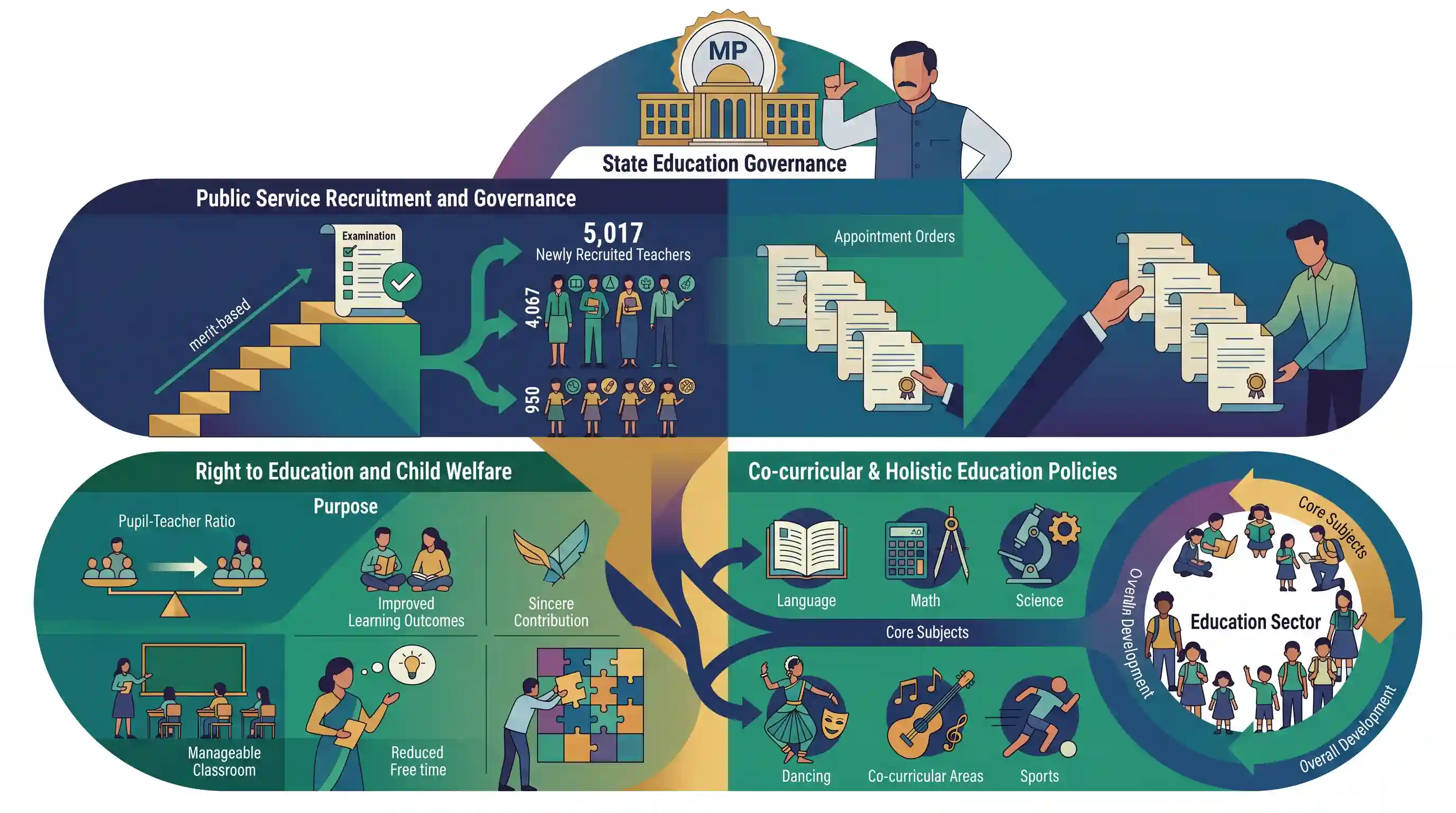
The Madhya Pradesh School Education Department has issued appointment orders to 5,017 newly recruited teachers, consisting of 4,067 Secondary Teachers and 950 Primary Teachers. Aimed at improving learning outcomes, reducing teacher workloads, and lowering pupil-teacher ratios, this recruitment emphasizes both core academic subjects and co-curricular areas such as sports, dance, and music. Madhya Pradesh School Education and Transport Minister Uday Pratap Singh highlighted the merit-based nature of these recruitments and urged the teachers to sincerely contribute to the overall development of the state's education sector.
Key Points
- The Madhya Pradesh Department of School Education issued appointment letters to 5,017 newly recruited teachers to address the vacancy backlog in state government schools.
- Of the total recruits, 4,067 are selected as Secondary Teachers in core subjects (Hindi, Mathematics, English, Sanskrit, Social Science) as well as sports and singing.
- A cohort of 950 Primary Teachers has been appointed specifically for co-curricular disciplines, including sports, dance, and singing, prioritizing a holistic educational approach.
- The State's Minister for School Education and Transport, Uday Pratap Singh, congratulated the selected candidates, stressing their vital role in enhancing subject-wise learning outcomes and rural-urban educational parity.
- This major hiring step directly aligns with structural efforts to maintain ideal pupil-teacher ratios and deliver on the fundamental mandate of free and compulsory education.
Important Terms
Right to Education Act, 2009

A landmark Indian legislation that operationalizes the fundamental right to free and compulsory elementary education for children aged 6 to 14, establishing norms for school infrastructure and teacher-pupil ratios.
UPSC context
GS Paper II: Social Justice; tests knowledge of educational rights, statutory provisions, and government schemes promoting elementary education.
Eighty-sixth Constitutional Amendment Act, 2002
A constitutional amendment that inserted Article 21A, making free and compulsory elementary education a fundamental right for children aged 6 to 14, while also revising Article 45 and adding Article 51A(k).
UPSC context
GS Paper II: Polity; tests understanding of fundamental rights, DPSPs, fundamental duties, and social welfare constitutional amendments.
Pupil-Teacher Ratio (PTR)
The proportion of enrolled students to the number of teachers in an educational institution, used to assess teacher workloads and classroom learning quality.
UPSC context
GS Paper II: Education; tests awareness of RTE standards, school infrastructure norms, and governance of teacher recruitment.
Article 21A of the Indian Constitution
A fundamental right added to the Indian Constitution guaranteeing free and compulsory elementary education to all children aged six to fourteen years, in a manner determined by state law.
UPSC context
GS Paper II: Polity; tests core fundamental rights, judicial precedents, and legislative implementation of educational access in India.
Prelims Trap
The RTE Act, 2009 mandates a uniform Pupil-Teacher Ratio (PTR) of 30:1 across all levels of school education.
The RTE Act mandates a 30:1 ratio specifically for primary levels (Classes 1-5), and relaxes it to 35:1 for upper primary schools (Classes 6-8).
Static Concepts Connected
What are the Pupil-Teacher Ratio (PTR) standards mandated under the RTE Act, 2009?
- Primary school level: Mandates a strict PTR of 30:1 for classes 1 to 5 to facilitate individualized learning.
- Upper Primary level: Prescribes a slightly relaxed PTR of 35:1 for classes 6 to 8.
- Deployment restrictions: Prohibits deploying teachers for non-academic work, except for disaster relief, election duties, and the decennial census.
How did key judicial rulings shape the Right to Education as a Fundamental Right?
- Mohini Jain Case (1992): The Supreme Court declared the right to education as a fundamental right at all levels, linking it directly to human dignity under Article 21.
- Unni Krishnan Case (1993): The Court limited the absolute Mohini Jain ruling, holding that the right to free education exists progressively up to the age of 14 years.
Cross-Topic Patterns
Concurrent List and fiscal federalism
Education policy execution depends on joint funding schemes (Samagra Shiksha), yet real-world delivery relies heavily on state-level civil service recruitment capabilities and fiscal capacity.
NEP 2020 and co-curricular parity
Recruiting specialized sports, dance, and music teachers addresses NEP 2020's goal to eliminate the rigid hierarchy between academic and co-curricular subjects.

Analysis of judicial precedents leading to Article 21A and RTE structural gaps like PTR compliance remains a high-probability UPSC area.
Linked PYQs · 3
Linked PYQs · 3
- 2025MPPSC_PRELIMSGS1
What percentage of the Madhya Pradesh government's total expenditure budget was allocated to education in 2023-24?
- 2023MPPSC_PRELIMSGS1
Through Which Amendment of the Constitution has the Right to Education became a Fundamental Right?
- 2025MPPSC_PRELIMSGS1
Which Constitutional Amendment has added Fundamental Right to Free and Compulsory Education of Children between the age of 6 to 14 years?
