MP expands Project Cheetah to third habitat for metapopulation
Source:deccanchronicle ↗
Why It Matters
Understanding wildlife conservation initiatives like Project Cheetah and the concept of 'metapopulation' is crucial for environmental geography and ecology sections in prelims, focusing on the management of relocated species and their new habitats.
Summary
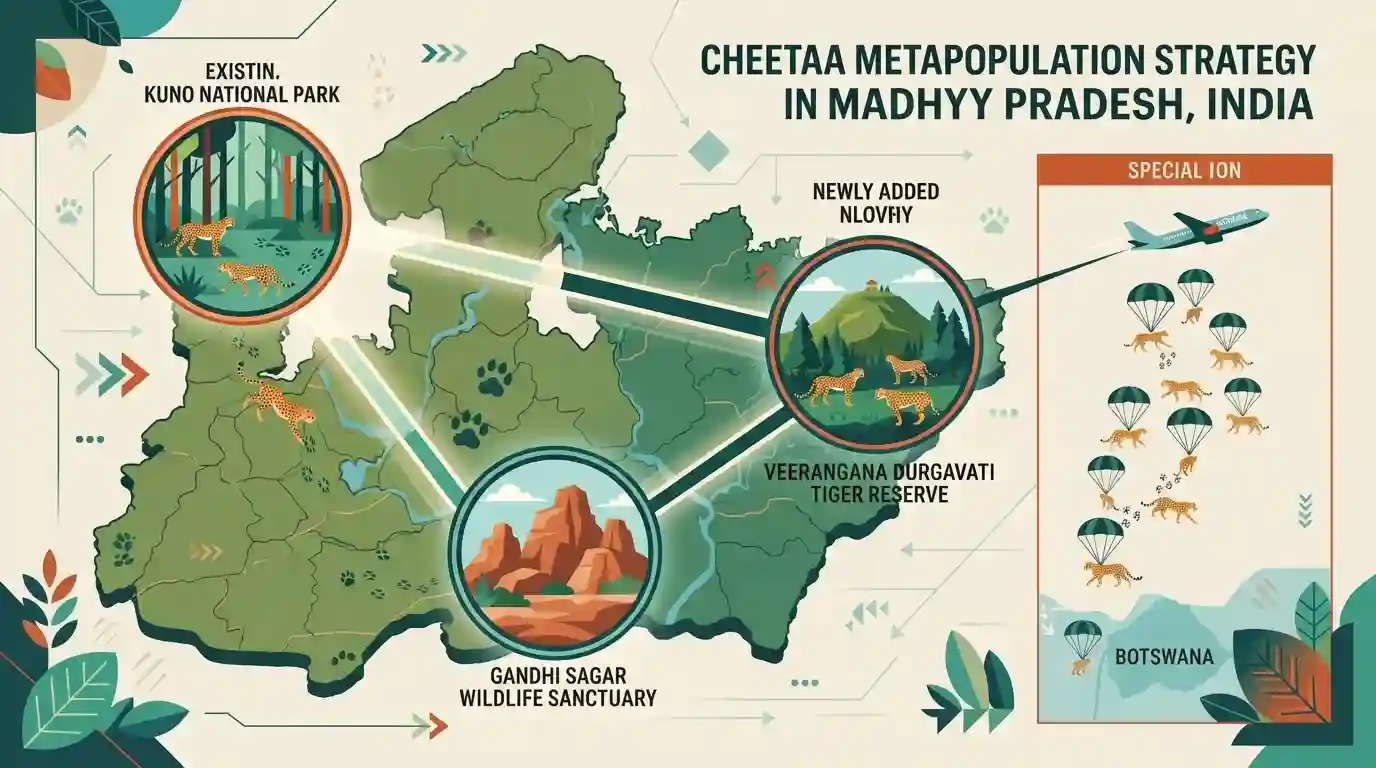
Madhya Pradesh plans to introduce cheetahs into a third habitat, the Veerangana Durgavati Tiger Reserve, as part of Project Cheetah. By establishing interconnected populations in Kuno National Park, Gandhi Sagar Wildlife Sanctuary, and the proposed new reserve, the state aims to create a sustainable cheetah 'metapopulation'. This multi-site strategy ensures genetic diversity and builds resilience for the relocated African cheetahs. Additionally, 12 new cheetahs from Botswana are scheduled to arrive soon at the Gandhi Sagar Wildlife Sanctuary.
Key Points
- Madhya Pradesh is expanding Project Cheetah to a third habitat at Veerangana Durgavati Tiger Reserve in Narasinghpur district.
- The initiative aims to build a metapopulation of cheetahs, promoting genetic diversity and long-term survival by interconnecting populations across multiple sites.
- Currently, cheetahs exist in Kuno National Park and Gandhi Sagar Wildlife Sanctuary.
- Twelve more cheetahs will soon be brought from Botswana and released into Gandhi Sagar Wildlife Sanctuary.
Important Terms
Project Cheetah

Launched in 2022, it is India's intercontinental wildlife program to reintroduce the African cheetah, which went locally extinct in 1952. It aims to establish a self-sustaining cheetah population while restoring the country's open forest and grassland ecosystems.
UPSC context
GS Paper 3 (Environment). Tests awareness of major government wildlife reintroduction initiatives, flagship species, and ecological restoration objectives.
Veerangana Durgavati Tiger Reserve
Madhya Pradesh's largest tiger reserve, spanning Sagar, Damoh, and Narsinghpur districts. Notified in 2023, it connects Panna and Satpura reserves and is being developed as the third habitat for Project Cheetah to support metapopulation goals.
UPSC context
MPPSC Prelims & GS 3 (Environment). Tests knowledge of MP’s protected areas, new tiger reserves, and current wildlife conservation updates.
Metapopulation
In ecology, a metapopulation is a group of spatially separated populations of the same species that interact. Managing cheetahs this way involves moving individuals between reserves to maintain genetic diversity and prevent local extinctions.
UPSC context
GS Paper 3 (Ecology). Tests conceptual understanding of scientific wildlife management, genetic diversity conservation, and habitat fragmentation solutions.
Gandhi Sagar Wildlife Sanctuary
A wildlife sanctuary located in Madhya Pradesh's Mandsaur and Neemuch districts. It features dry deciduous forests and serves as India's second cheetah habitat, receiving translocated cheetahs from Kuno to expand their geographical spread.
UPSC context
MPPSC Prelims & GS 3 (Environment). Tests knowledge of MP sanctuaries and secondary sites developed for Project Cheetah's expansion.
Kuno National Park
A protected area in the Sheopur district of Madhya Pradesh. Characterized by dry deciduous forests and grasslands, it was established as the primary site for Project Cheetah in 2022 and hosts India's main free-ranging cheetah population.
UPSC context
MPPSC Prelims & GS 3 (Environment). Highly tested regarding MP's national parks, geography, and its status as the inaugural site for Project Cheetah.
Prelims Trap
"Veerangana Durgavati is a newly established Wildlife Sanctuary created exclusively for cheetahs."
It is not a newly created cheetah-only sanctuary. It was notified as Madhya Pradesh's 7th Tiger Reserve in 2023 by merging Nauradehi and Veerangana Durgavati sanctuaries.
Static Concepts Connected
How do major rivers intersect Madhya Pradesh's three cheetah habitats?
- Kuno River: Flows south-to-north straight through Kuno National Park, acting as its central lifeline before joining the Chambal.
- Chambal River: Bisects the Gandhi Sagar Wildlife Sanctuary in Mandsaur and Neemuch, creating the deep gorges that characterize the landscape.
- Narmada & Yamuna Basins: Veerangana Durgavati TR spans Sagar, Damoh, and Narsinghpur, sitting on the transitional watershed between the Narmada and Yamuna basins.
What defines a 'metapopulation' in conservation ecology?
- Separated but Interacting: A regional group of spatially separated populations of the same species that interact and interbreed at some level.
- Genetic Exchange: Interaction relies on physical wildlife corridors or, as with Project Cheetah, human-assisted translocations to prevent inbreeding.
- Ecological Resilience: It ensures that a localized disaster (like a disease outbreak or fire) at one site does not wipe out the entire species.
Cross-Topic Patterns
Ken-Betwa Link & Habitat Compensation
Nauradehi WLS (now part of Veerangana Durgavati TR) was previously earmarked to receive compensatory afforestation and tiger relocations for the Ken-Betwa river interlinking project's submergence zones.
Multi-Apex Predator Landscapes
MP's strategy reflects a shift towards multi-apex predator reserves (tigers, leopards, and now cheetahs) sharing macro-landscapes, testing inter-species coexistence models in India.

Expect a match-the-following question pairing Kuno, Gandhi Sagar, and Veerangana Durgavati with their respective districts or rivers.
Linked PYQs · 3
Linked PYQs · 3
- 2023MPPSC_PRELIMSGS1
Which type of forests are not found in Madhya Pradesh ?
- 2016MPPSC_PRELIMSGS1
In which year was the wildlife protection act enforced in India?
- 2025MPPSC_PRELIMSGS1
The Government of India passed the Environment (Protection) Act to protect and improve the quality of environment in:
