Rajya Sabha Elections Cross-Voting Fears Prompt Congress MLA Shift
Source:The Hindu ↗
Why It Matters
The article illustrates the political dynamics of Rajya Sabha elections, highlighting issues of cross-voting, 'resort politics', and the role of the Leader of Opposition. Understanding Rajya Sabha election mechanics, the open ballot system, anti-defection provisions, and state representation is highly relevant for constitutional and state-level polity in MPPSC.
Summary
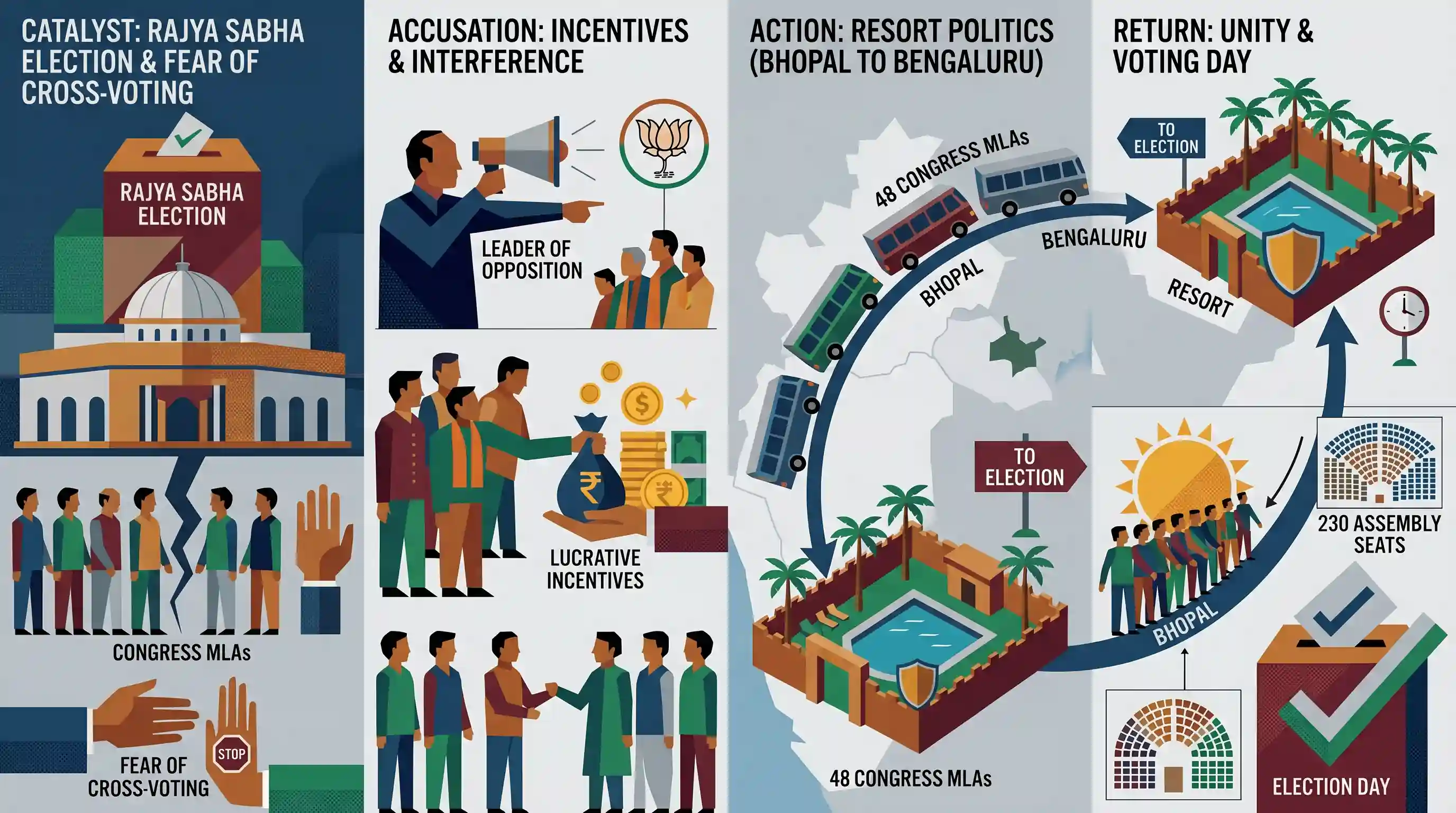
Fearing cross-voting in the upcoming Rajya Sabha elections, around 48 Congress MLAs from Madhya Pradesh left Bhopal for a resort near Bengaluru, Karnataka. Leader of Opposition Umang Singhar accused the BJP of offering lucrative incentives to Congress legislators, asserting that the party's MLAs remain united. The MLAs are scheduled to return to Bhopal on the day of the election.
Key Points
- In response to fears of cross-voting in the Rajya Sabha elections, 48 Madhya Pradesh Congress MLAs flew to Bengaluru to stay at a resort until polling day.
- Leader of the Opposition (LoP) in the MP Assembly, Umang Singhar, accused the BJP of trying to bribe Congress legislators and asserted that all 62 Congress MLAs remain united.
- Rajya Sabha members are elected by the elected MLAs of state legislative assemblies using proportional representation by means of a single transferable vote. Madhya Pradesh is allocated 11 seats in the Rajya Sabha.
- The Supreme Court of India, in Kuldip Nayar v. Union of India (2006), upheld the 'open ballot' system for Rajya Sabha elections to prevent cross-voting and political corruption, though cross-voting does not trigger automatic disqualification under the Tenth Schedule (Anti-Defection Law).
- The post of Leader of the Opposition in the state legislative assembly holds statutory status and carries key political significance in Madhya Pradesh's legislative history.
Important Terms
Tenth Schedule of the Constitution of India (Anti-Defection Law)

Added by the 52nd Amendment in 1985, it outlines provisions for the disqualification of legislators on grounds of defection, though it does not automatically apply to Rajya Sabha cross-voting.
UPSC context
GS Paper II: Parliament & State Legislatures. Evaluates knowledge on political defection, party whips, and judicial interpretations.
Representation of the People Act, 1951
A parliamentary act governing the actual conduct of elections, qualifications/disqualifications of members, and electoral offences. A 2003 amendment introduced the open ballot system for Rajya Sabha elections.
UPSC context
GS Paper II: Salient features of RPA. Core to electoral reforms, voting procedures, and legislative transparency.
Madhya Pradesh Legislative Assembly
The unicameral state legislature of Madhya Pradesh, consisting of elected members (MLAs) who indirectly elect state representatives to the Rajya Sabha using proportional representation.
UPSC context
GS Paper II: State Legislatures. Tests understanding of state legislative processes, indirect voting, and federal representation.
Indian National Congress
One of India's oldest national political parties, acting as a major ruling or opposition party at both Union and state levels in India's multiparty democracy.
UPSC context
GS Paper II: Political Parties. Relevant for understanding the party system, opposition dynamics, and federal politics.
Prelims Trap
An MLA cross-voting in Rajya Sabha elections faces automatic disqualification under the Tenth Schedule of the Constitution.
Rajya Sabha elections are not considered 'proceedings of the House'. Thus, political party whips are not binding, and cross-voting does not trigger automatic Tenth Schedule disqualification.
Static Concepts Connected
What are the unique constitutional and statutory rules governing Rajya Sabha elections?
- Voting Mechanism: Elections are held through proportional representation by means of a single transferable vote (STV) by elected state MLAs.
- Open Ballot System: Under Rule 39AA of the Conduct of Election Rules, 1961, voters must show their marked ballot to their party representative. Independent MLAs do not show their ballot.
- Whip and Tenth Schedule: Voting against the party's choice does not trigger disqualification under the Tenth Schedule, and parties cannot issue a legally binding whip.
What is the status and significance of the Leader of the Opposition (LoP) in State Assemblies?
- Statutory Position: The post is a statutory position, governed by specific state enactments (e.g., MP Vidhan Mandal Virodhi Dal Ka Neta Act, 1980) rather than the Constitution.
- Numerical Strength: The opposition party must secure at least 10% of the total seats in the state assembly to claim the official LoP designation.
- Selection Committees: The LoP is a key member of high-level statutory selection committees, such as those for the Lokayukta and the State Information Commissioner.
Cross-Topic Patterns
Federal Representation vs Party Discipline
The 'open ballot' system prioritizes party integrity over individual legislative conscience, altering the federal representative character of the Rajya Sabha.
Judicial Review of Electoral Rules
The Kuldip Nayar case demonstrates how the judiciary balances Article 19(1)(a) freedom of expression with legislative purity and prevention of political bribery.

Rajya Sabha open ballot rules, Tenth Schedule exemption, and Kuldip Nayar case likely to feature as a multi-statement Prelims question.
Linked PYQs · 3
Linked PYQs · 3
- 2018MPPSC_PRELIMSGS1
Who among the following women won the by-edition in 2017 for the one Rajya Sabha seat from Madhya Pradesh?
- 2020MPPSC_PRELIMSGS1
Which of the following Chief Minister of Madhya Pradesh have not held the office of the leader of the opposition in Madhya Pradesh Legislative Assembly? 1. Digvijay Singh 2. Motilal Vora 3. Virendra Kumar Sakhlecha 4. Shyamcharan Shukla
- 2009MPPSC_PRELIMSGS1
Who is the leader of opposition in Vidhan Sabha of Madhya Pradesh?
