Madhya Pradesh Proposes Subsidized Cows for Ladli Behna Beneficiaries
Source:indiatvnews ↗
Why It Matters
This topic is highly relevant for the MPPSC State Service Prelims as the exam frequently tests factual and conceptual details of major state-level welfare schemes like the Ladli Behna Yojana (e.g., objectives, payout amounts, and implementation metrics), along with the geographic and economic ranks of MP in agriculture and dairy production.
Summary
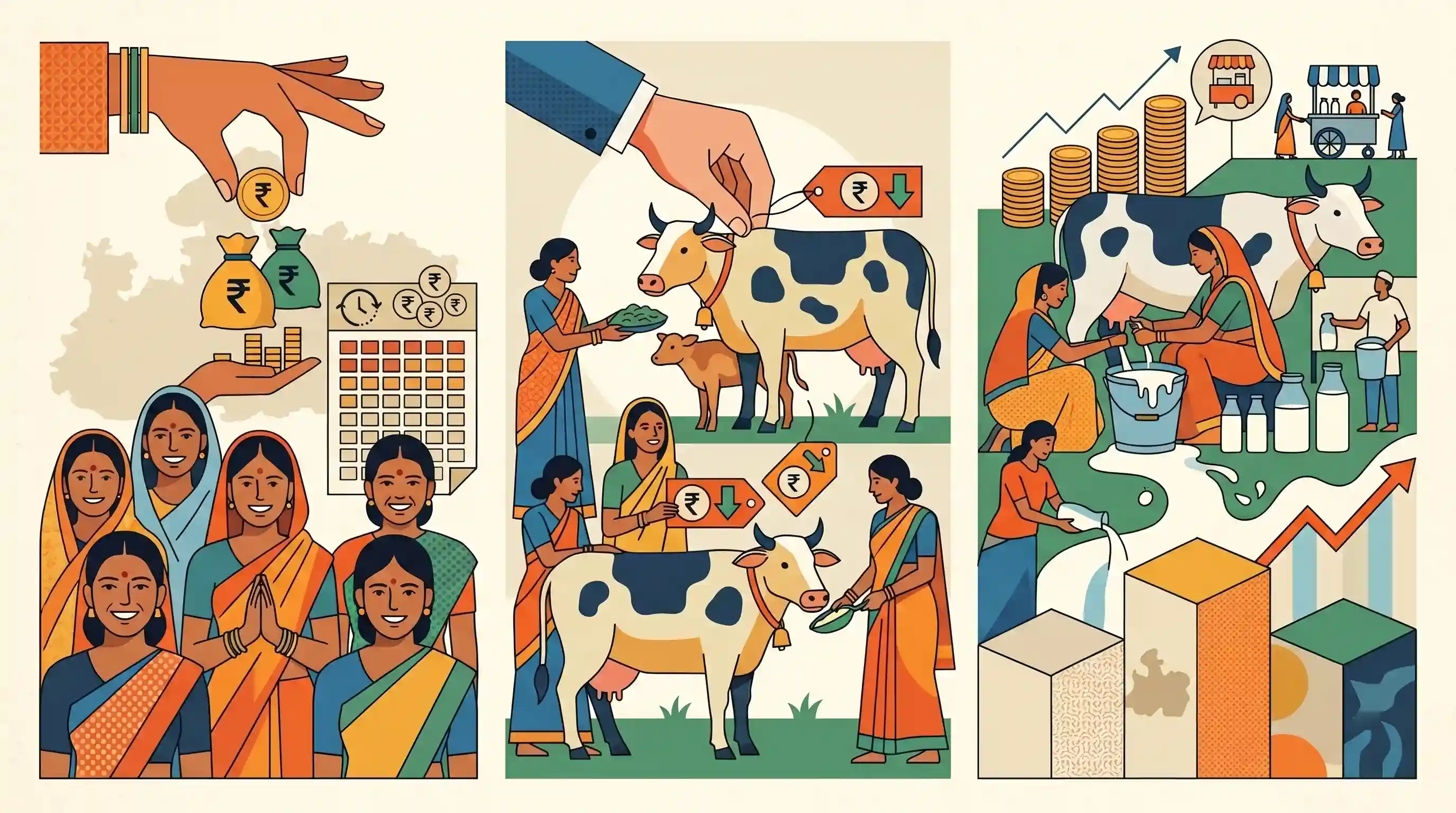
The Madhya Pradesh government, under Chief Minister Mohan Yadav, is planning a new welfare initiative to provide cows at subsidised rates to the beneficiaries of its flagship Mukhyamantri Ladli Behna Yojana. Proposed by Minister of State (Independent Charge) for Animal Husbandry and Dairying Lakhan Patel, the scheme seeks to elevate women's economic self-reliance while boosting the state's dairy sector. Madhya Pradesh currently stands as the third-largest milk producer in India, behind Uttar Pradesh and Rajasthan. Since its launch in June 2023, the Ladli Behna Yojana has successfully transferred Rs 55,926.51 crore to 1.22 crore women beneficiaries across 35 monthly installments of Rs 1,500 (as of 2026).
Key Points
- Subsidised Cow Proposal: The Madhya Pradesh government plans to provide cows at subsidised rates to the beneficiaries of the 'Mukhyamantri Ladli Behna Yojana' to boost milk production and promote women's financial independence.
- State's Milk Production Rank: According to Union Government data released in November 2025, Madhya Pradesh is the third-largest milk-producing state in India, behind Uttar Pradesh and Rajasthan.
- Ladli Behna Yojana Financials: Launched in June 2023, the flagship scheme has disbursed Rs 55,926.51 crore across 35 monthly installments to 1.22 crore women beneficiaries up to April 2026. The monthly assistance currently stands at Rs 1,500.
- Socio-Economic Objectives: In addition to direct cash transfers, integrating animal husbandry aims to double down on women's empowerment, healthcare, household nutrition, and dairy entrepreneurship.
Important Terms
Mukhyamantri Ladli Behna Yojana

A flagship welfare scheme of the Madhya Pradesh government launched in 2023, providing monthly cash transfers directly to eligible women to enhance their health, nutrition, and financial autonomy.
UPSC context
GS Paper II: Welfare schemes for vulnerable sections. Tests understanding of gender-based direct income support and state-level social security.
Economics of Animal Rearing
The study and practice of raising domesticated livestock for food, fiber, and secondary outputs, analyzing agricultural diversification, capital investment, and rural livelihood enhancement.
UPSC context
GS Paper III: Economics of animal rearing. Tests livestock farming policies, dairy infrastructure, and doubling farmers' income.
Department of Animal Husbandry and Dairying
A department under India's Ministry of Fisheries, Animal Husbandry and Dairying, responsible for improving livestock health, breed conservation, feed availability, and upgrading dairy infrastructure.
UPSC context
GS Paper II: Government policies and interventions. Tests understanding of administrative bodies and infrastructure funds boosting allied sectors.
Direct Benefit Transfer
A governance mechanism designed to transfer subsidies, pensions, and welfare benefits directly into validated bank accounts using digital networks to eliminate leakages.
UPSC context
GS Paper II/III: E-governance and public finance. Tests knowledge of JAM trinity, leakage reduction, and digital inclusion.
Prelims Trap
The Mukhyamantri Ladli Behna Yojana is open to all resident women in Madhya Pradesh aged 21-60, regardless of marital status.
While the scheme targets women aged 21-60, the standard criteria strictly require applicants to be married (including widowed, divorced, or separated women), excluding unmarried women.
Static Concepts Connected
What is the economic significance of India's dairy sector and its primary challenges?
- Livelihood security: Employs over 80 million rural households, offering a critical safety net against crop failure for landless and marginal farmers.
- GDP contribution: Accounts for nearly 5% of the national GDP and has consistently outpaced the crop sector's growth rate.
- Structural bottlenecks: Struggles with low average milk yield per animal, seasonal green fodder deficits, and fragmented cold-chain infrastructure.
Why is livestock rearing critical for the economic empowerment of rural women?
- Asset ownership: Provides women with direct control over physical assets, bypassing patriarchal land ownership barriers in rural India.
- Daily cash flow: Ensures regular daily or weekly income, unlike seasonal crop cycles, enhancing household nutritional and educational spending.
Cross-Topic Patterns
Direct cash vs. asset-based welfare
Shifting from direct cash transfers to subsidised livestock distribution shows a policy transition from safety-net consumption support to productive, asset-based rural entrepreneurship.
Dairy expansion vs. climate goals
Scaling up cattle populations to boost milk production directly impacts India's methane emission mitigation targets and green fodder management strategies under climate action.

Mains questions may analyze how states transition from cash transfers to asset distribution like cattle to build sustainable rural livelihoods.
Linked PYQs · 2
Linked PYQs · 2
- 2025MPPSC_PRELIMSGS1
The objective of "Mukhyamantri Ladli Behna Yojana" implemented in entire Madhya Pradesh, in addition to economic self-reliance is:
- 2022MPPSC_PRELIMSGS1
What amount will be given to eligible women under "Ladli Bahna Yojana" of the Madhya Pradesh Government?
