Madhya Pradesh Reduces Medical College Fees for NEET Students
Source:indianmasterminds ↗
Why It Matters
The integration of merit-based fee structures and state-led counselling for private college management quotas represents a significant step in democratizing access to professional education, directly addressing the financial barriers in the medical field. It aligns with governance themes of equity and resource allocation in human development.
Summary
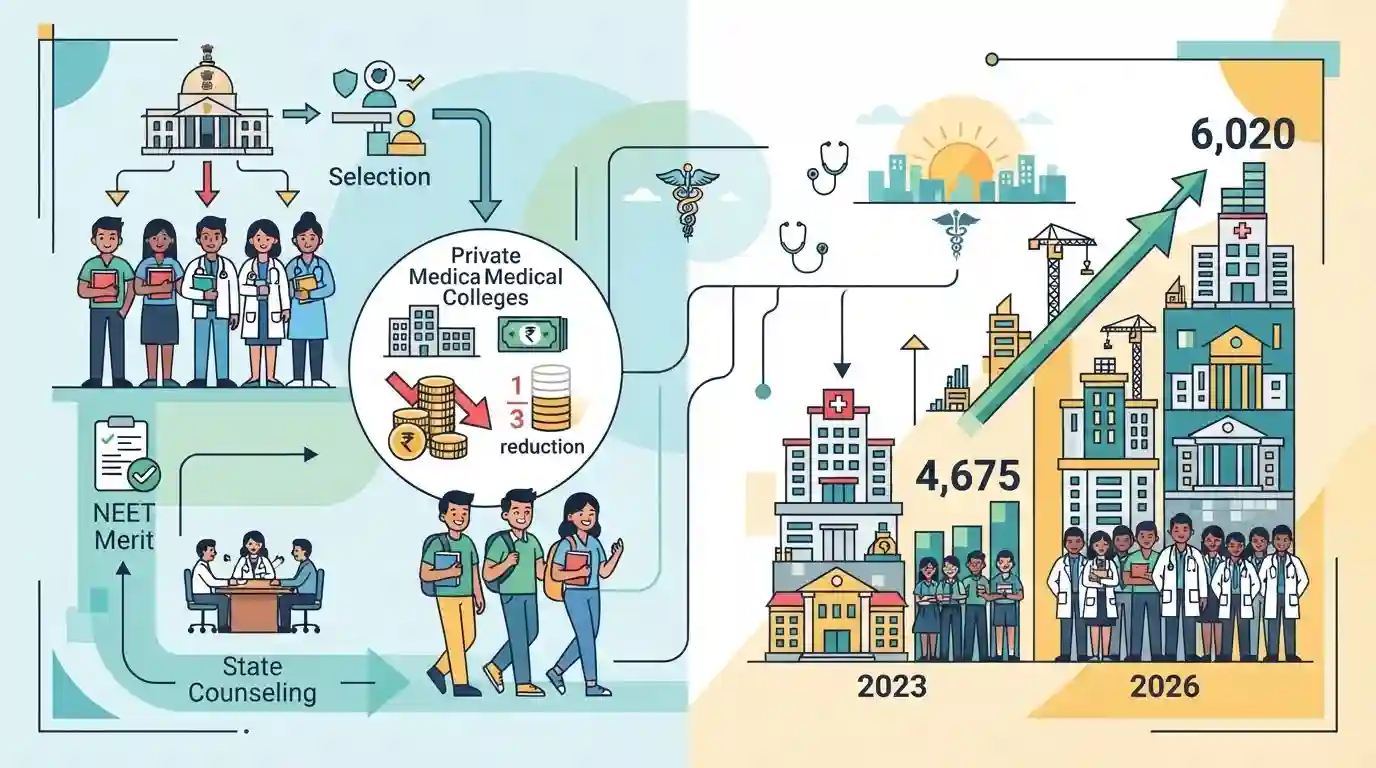
The Madhya Pradesh government has introduced reforms to make medical education more affordable for meritorious students. By mandating that private medical college management quota seats be filled through state counselling based on NEET merit, the government will reduce the fees for these students by one-third. Additionally, the state is expanding its healthcare education infrastructure, increasing total MBBS seats from 4,675 in 2023 to a projected 6,020 in 2026, thereby improving accessibility to professional medical training.
Key Points
- The Madhya Pradesh government has announced a policy to make medical education more affordable by reducing fees by one-third for meritorious NEET students.
- Admissions to private medical colleges under the management quota will now be conducted through state government counselling based strictly on NEET merit, rather than by the institutions directly.
- The state is significantly increasing its medical capacity, with MBBS seats projected to rise from 4,675 in 2023 to 6,020 by the 2026 academic session.
- This policy shift aims to ensure talented youths can pursue professional medical education without facing prohibitive financial burdens in private institutions.
Important Terms
Madhya Pradesh Government

The executive authority of the Indian state of Madhya Pradesh, responsible for state-level administration, policy-making, and implementing welfare schemes.
UPSC context
Relevant for GS Paper 2 (State Government policies, Health & Education interventions) and cooperative federalism discussions.
Management Quota
A highly sought-after portion of seats in private medical colleges where admissions were traditionally less strictly bound by state merit lists and usually carry significantly higher fees than government-subsidized quotas.
UPSC context
Important for GS Paper 2 (Issues relating to Education, Health, and Social Justice) and ethics in education commercialization.
National Eligibility cum Entrance Test (NEET)
The sole, mandatory national entrance examination in India for admission to undergraduate medical (MBBS), dental (BDS), and AYUSH courses in both government and private institutions, conducted by the National Testing Agency.
UPSC context
Core to GS Paper 2 (Human Resources, Education) and discussions on equitable access, national standards, and centralization vs state rights.
State Counselling (Medical Education)
The process of centralized seat allocation in state medical colleges. In MP, the Directorate of Medical Education handles this process for state quota seats in government and private institutions based on NEET ranks.
UPSC context
Relates to GS Paper 2 (Issues related to Education, State policies) concerning transparency, meritocracy, and affirmative action in seat allocation.
Prelims Trap
The NMC Act empowers the regulatory body to cap fees for all seats in private medical colleges.
The NMC Act 2019 only allows the Commission to frame fee-regulation guidelines for 50% of seats in private medical colleges and deemed universities, not all seats.
Static Concepts Connected
What is the fee regulation mandate of the National Medical Commission?
- 50% Seat Cap: The NMC Act 2019 empowers the Commission to frame fee guidelines for exactly 50% of seats in private medical colleges and deemed universities.
- Replacing MCI: It replaced the Medical Council of India to introduce functional autonomy, separate rating from assessment, and curb the commercialization of medical education.
What is the judicial stance on private medical college autonomy?
- P.A. Inamdar (2005): Upheld the institutional autonomy of private, self-financing professional colleges to have management quotas but strictly barred capitation fees or profiteering.
- T.M.A. Pai (2002): Affirmed that private unaided institutions have the fundamental right to establish and administer educational institutions under Article 19(1)(g).
Cross-Topic Patterns
Affordable education vs. Institutional viability
State measures enforcing state counselling for management quotas touch upon the fundamental right to carry on an occupation (Article 19(1)(g)), balancing student welfare against self-financing college autonomy.
WHO doctor-population ratio & AYUSH
India's medical seat expansion achieved a 1:811 ratio (including AYUSH), crossing the WHO 1:1,000 threshold, but severe rural-urban maldistribution remains a primary GS-2 governance challenge.

NMC's 50% fee regulation limit + WHO doctor-population ratio (including AYUSH) is ripe for a multi-statement governance question in 2026.
Linked PYQs · 1
Linked PYQs · 1
- 2025MPPSC_PRELIMSGS1
The objective of conferring the Shankar Shah and Rani Durgavati award to tribal students is:
