Madhya Pradesh Initiates Ujjain Jaora Greenfield Highway Project
Source:constructionworld ↗
Why It Matters
Infrastructure and road networks are explicitly mentioned in the MPPSC syllabus under the Geography and Economy of Madhya Pradesh. Major state projects, especially greenfield highways connecting culturally significant cities like Ujjain, are highly probable subjects for current affairs and geography-based questions.
Summary
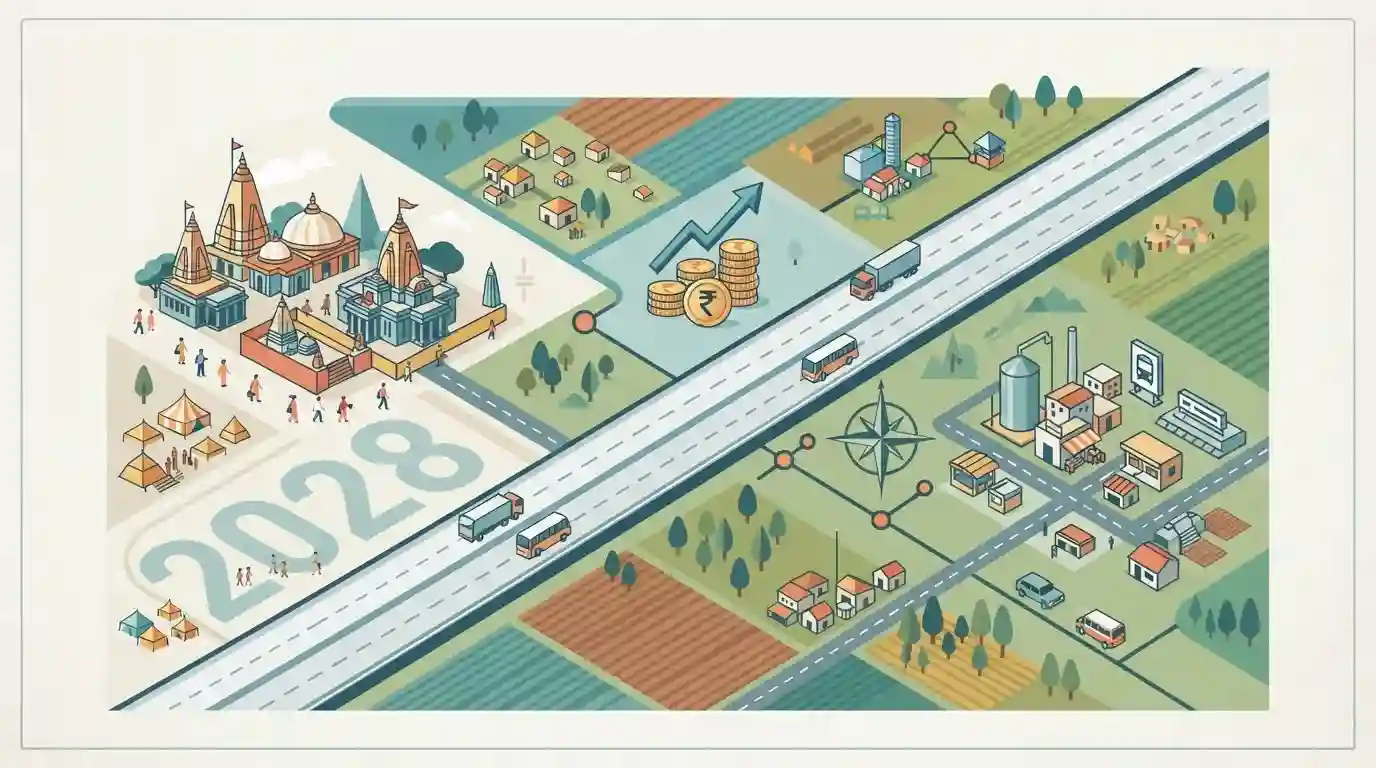
Madhya Pradesh has announced the development of the ₹50.17 billion Ujjain-Jaora Greenfield Highway. This new infrastructural project aims to establish a direct, high-speed road link between the spiritual hub of Ujjain and Jaora, thereby boosting connectivity in western MP. The greenfield alignment will facilitate smoother transit for trade and tourism, which is especially important ahead of the 2028 Simhastha Kumbh Mela in Ujjain. The project highlights the state's ongoing push to improve its road density and transport infrastructure to support long-term economic growth.
Key Points
- Madhya Pradesh has launched the Ujjain-Jaora Greenfield Highway project, valued at ₹50.17 billion (approx. ₹5,017 crore).
- As a greenfield project, the highway will be built on a new alignment to provide a shorter, more efficient route between the two cities.
- The highway will significantly improve connectivity for Ujjain, a major religious and cultural center, ahead of the upcoming 2028 Simhastha Kumbh Mela.
- The project aims to boost regional trade, tourism, and overall economic development in western Madhya Pradesh by integrating the area more deeply with national transport networks.
Prelims Trap
The Kshipra River, hosting the Simhastha Kumbh, is a direct right-bank tributary of the Yamuna River.
Aspirants often confuse tributary hierarchies; Kshipra is a tributary of the Chambal, which joins the Yamuna, which finally merges with the Ganga. It does not flow directly into the Yamuna or Ganga.
Static Concepts Connected
What defines the difference between Greenfield and Brownfield infrastructure models?
- Greenfield Projects: Greenfield projects are constructed from scratch on completely undeveloped land, requiring fresh land acquisition, clearances, and structural planning.
- Brownfield Projects: Brownfield projects involve modifying, expanding, or upgrading pre-existing infrastructure, bypassing early-stage land-use issues but inheriting structural constraints.
- Risk Comparison: Greenfield carries higher initial regulatory and land acquisition risk, whereas Brownfield carries operational disruption and integration risks.
What are the geographical features of the Kshipra and Chambal river systems?
- Kshipra Origin: The Kshipra River originates in the Kakri Bardi hills of the Vindhya Range in Madhya Pradesh and flows north across the Malwa Plateau.
- Tributary Hierarchy: The Chambal River is a major tributary of the Yamuna River, and its major right-bank tributaries include the Kshipra, Kali Sindh, and Parbati.
- Geomorphology: The Chambal basin is globally renowned for its badland topography, characterized by deep ravines formed due to severe gully erosion.
Cross-Topic Patterns
Infrastructure + Cultural Tourism Policy
Greenfield connectivity projects integrated with spiritual hubs reflect India's shifting tourism policy, leveraging mega-cultural events like the Kumbh Mela for regional economic transformation.
State Feeder Networks + National Corridors
Feeder links like Ujjain-Jaora connecting to the Delhi-Mumbai Expressway demonstrate how state-led assets multiply the logistics efficacy of national-level economic corridors.

UPSC may combine greenfield investment concepts with Chambal-Kshipra river geography in a multi-statement physical/economic geography question.
Linked PYQs · 1
Linked PYQs · 1
- 2023MPPSC_PRELIMSGS1
Which of the following statements is not correct regarding the roadways of Madhya Pradesh according to Basic Road Statistics 2018-19?
