Pre-Monsoon Activity Intensifies Across Districts of Madhya Pradesh
Source:freepressjournal ↗
Why It Matters
The Southwest Monsoon and localized climate patterns are core syllabus topics for the MPPSC Prelims. Understanding the standard monsoon timeline (June 15 arrival, 15 days after Kerala), regional climate variations, and temperature anomalies between high-altitude stations like Pachmarhi and northern plain districts like Sheopur is highly tested in Madhya Pradesh geography.
Summary
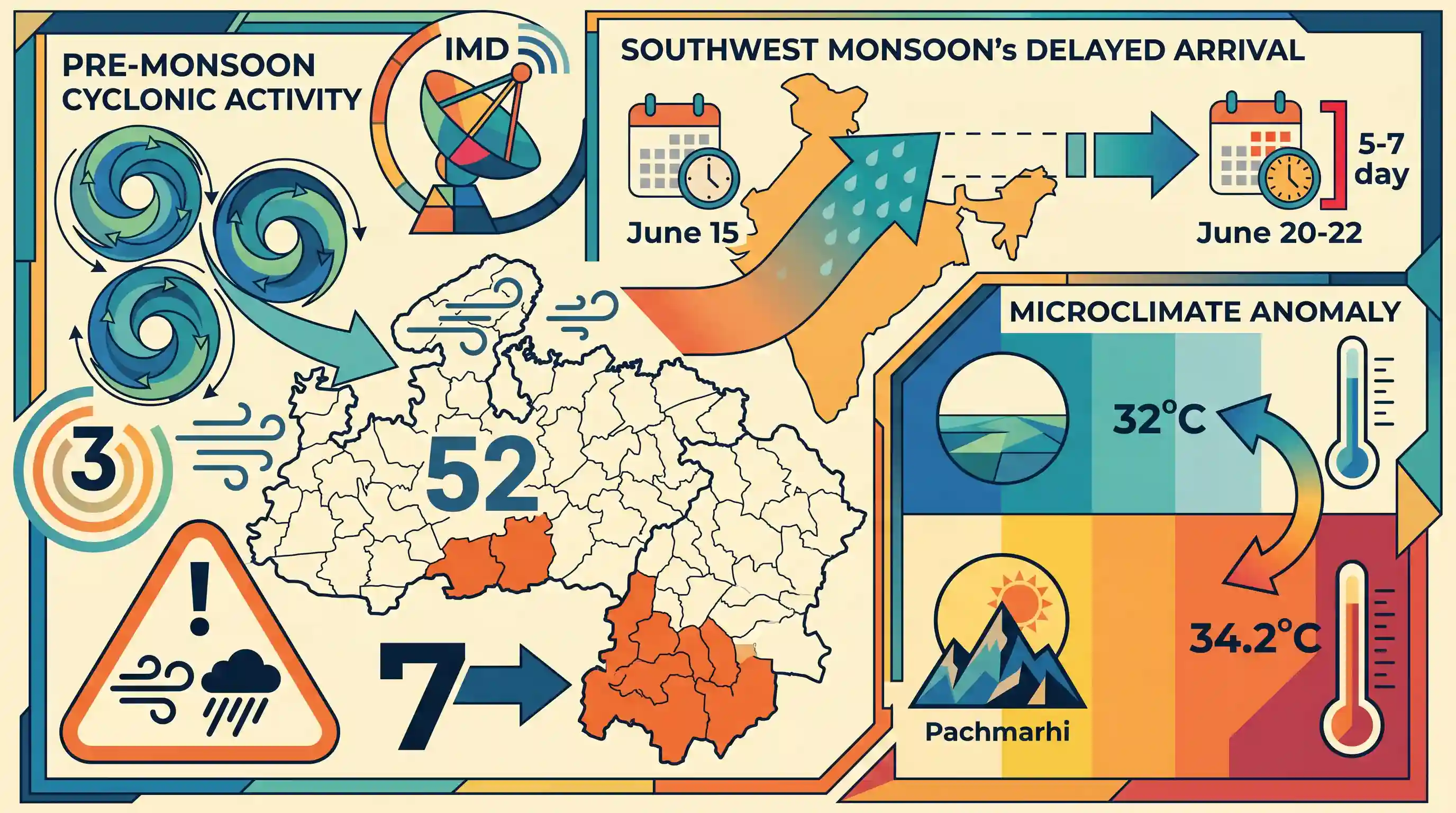
In June 2026, Madhya Pradesh experienced intense pre-monsoon weather driven by three active cyclonic circulations, bringing high-speed winds and rain across 52 districts. The IMD issued an orange alert for seven districts and projected the Southwest Monsoon's entry into the state between June 20 and June 22, representing a 5-to-7-day delay from the typical June 15 arrival date. The weather activity also caused a localized temperature anomaly, making the northern plains district of Sheopur (32°C) cooler than the hill station of Pachmarhi (34.2°C).
Key Points
- Intense pre-monsoon activity in Madhya Pradesh in early June 2026 brought heavy rain and strong winds (40-60 kmph) across 52 districts, driven by three active cyclonic circulations.
- An Orange Alert was issued by the IMD for seven districts: Guna, Ashoknagar, Vidisha, Sehore, Dewas, Harda, and Betul.
- The normal arrival date of the southwest monsoon in Madhya Pradesh is June 15, typically about 15 days after it reaches Kerala. In 2026, since the monsoon reached Kerala on June 4, its entry into MP is delayed and expected between June 20 and June 22.
- A notable climate anomaly was observed where Sheopur (located in the typically hot northern region of MP) recorded a maximum temperature of 32°C due to pre-monsoon rain, making it cooler than Pachmarhi, MP's only hill station, which recorded 34.2°C.
Important Terms
India Meteorological Department (IMD)

The principal government agency under the Ministry of Earth Sciences responsible for meteorological observations, weather forecasting, seismology, and early warnings of natural disasters in India.
UPSC context
GS Paper I (Geography) and Paper III (Disaster Management); tests institutional frameworks for weather monitoring and climate hazards.
Southwest Monsoon
The major rain-bearing wind system blowing from sea to land in India from June to September, driven by differential heating of the subcontinent and the Indian Ocean.
UPSC context
GS Paper I (Physical Geography of India); crucial for understanding atmospheric dynamics, agricultural cycles, and water resource management.
Orange Alert
A weather warning status issued by the IMD signaling expected severe weather that can disrupt transport and utilities, advising authorities and citizens to be prepared.
UPSC context
GS Paper III (Disaster Management); tests early warning systems, risk mitigation, and color-coded hazard communication.
Cyclonic Circulation
A system of winds rotating inward to a low-pressure center, moving anticlockwise in the Northern Hemisphere, which often acts as a precursor to heavier storms.
UPSC context
GS Paper I (Physical Geography); tests understanding of pressure systems, Coriolis force, and local weather patterns.
Microclimate
A localized set of atmospheric conditions within a small geographic area that differs from the surrounding regional climate due to factors like topography and vegetation.
UPSC context
GS Paper I (Climatology) and Paper III (Environment); tests localized climate variations, shifting microclimatic zones, and urban effects.
Temperature Anomaly
The deviation of an observed temperature at a specific location and time from its long-term average temperature or the expected latitudinal mean.
UPSC context
GS Paper I (Physical Geography); tests atmospheric thermodynamics, temperature distribution controls, and climate change tracking.
Prelims Trap
An IMD Orange Alert mandates local administrations to order immediate evacuations and shut down all transport networks.
Orange Alert only means 'Be Prepared' for severe weather. Evacuations and active disaster response mandates are typically associated with Red Alerts ('Take Action').
Static Concepts Connected
What are the four color-coded weather alerts used by the IMD and their meanings?
- Green (No warning): No adverse weather is expected; no advisory action is required by the public.
- Yellow (Be aware): Indicates potentially hazardous weather; the public should stay updated on changing conditions.
- Orange (Be prepared): Signifies high risk of severe weather; residents must prepare for potential disruptions and emergencies.
- Red (Take action): Represents extremely severe weather conditions; immediate protective action and coordination with disaster management are required.
How do the Arabian Sea and Bay of Bengal branches interact over Central India?
- Arabian Sea branch: Enters through the Narmada and Tapti river valleys, supplying rain to western and central regions.
- Bay of Bengal branch: Moves over the Gangetic plains to rain heavily on wetter eastern and southeastern districts.
- Central convergence: The two branches meet over central-northern India, creating prolonged wet spells and intense localized precipitation.
Cross-Topic Patterns
Monsoon delays and Kharif crop yields
A delayed monsoon onset in central India disrupts the sowing cycles of key oilseeds like soybean, requiring contingency planning under climate-resilient agriculture initiatives.
Microclimates and disaster vulnerability mapping
Extreme temperature anomalies and localized cyclonic circulations emphasize the need for block-level microclimatic monitoring under India’s National Action Plan on Climate Change.

The thermodynamic factors driving pre-monsoon cyclonic circulations and IMD warning systems are highly likely to be tested in GS-1.
Linked PYQs · 3
Linked PYQs · 3
- 2025MPPSC_PRELIMSGS1
Read the following statements regarding the climate of Madhya Pradesh and select the correct answer from the codes given below: 1. Most of the rainfall in the state is received from the monsoon. 2. Wind speed during winters is faster than in summer and rainy seasons. 3. Distance from sea also affects the distribution of monsoon rains in the state. 4. Summer temperature in Pachmarhi is related to the altitude above sea level. Codes:
- 2023MPPSC_PRELIMSGS1
Which of the following statements is not correct regarding the climate of Madhya Pradesh?
- 2022MPPSC_PRELIMSGS1
Which of the following statements regarding the climate of Madhya Pradesh is not correct?
