IMD Predicts Late June Onset for Southwest Monsoon in Madhya Pradesh
Source:freepressjournal ↗
Why It Matters
The physical geography and climate of Madhya Pradesh, including temperature variations (Pachmarhi and Khajuraho), monsoon arrival dates, and pre-monsoon weather anomalies, are frequent and high-yielding areas of testing in the MPPSC State Service Prelims GS Paper 1.
Summary
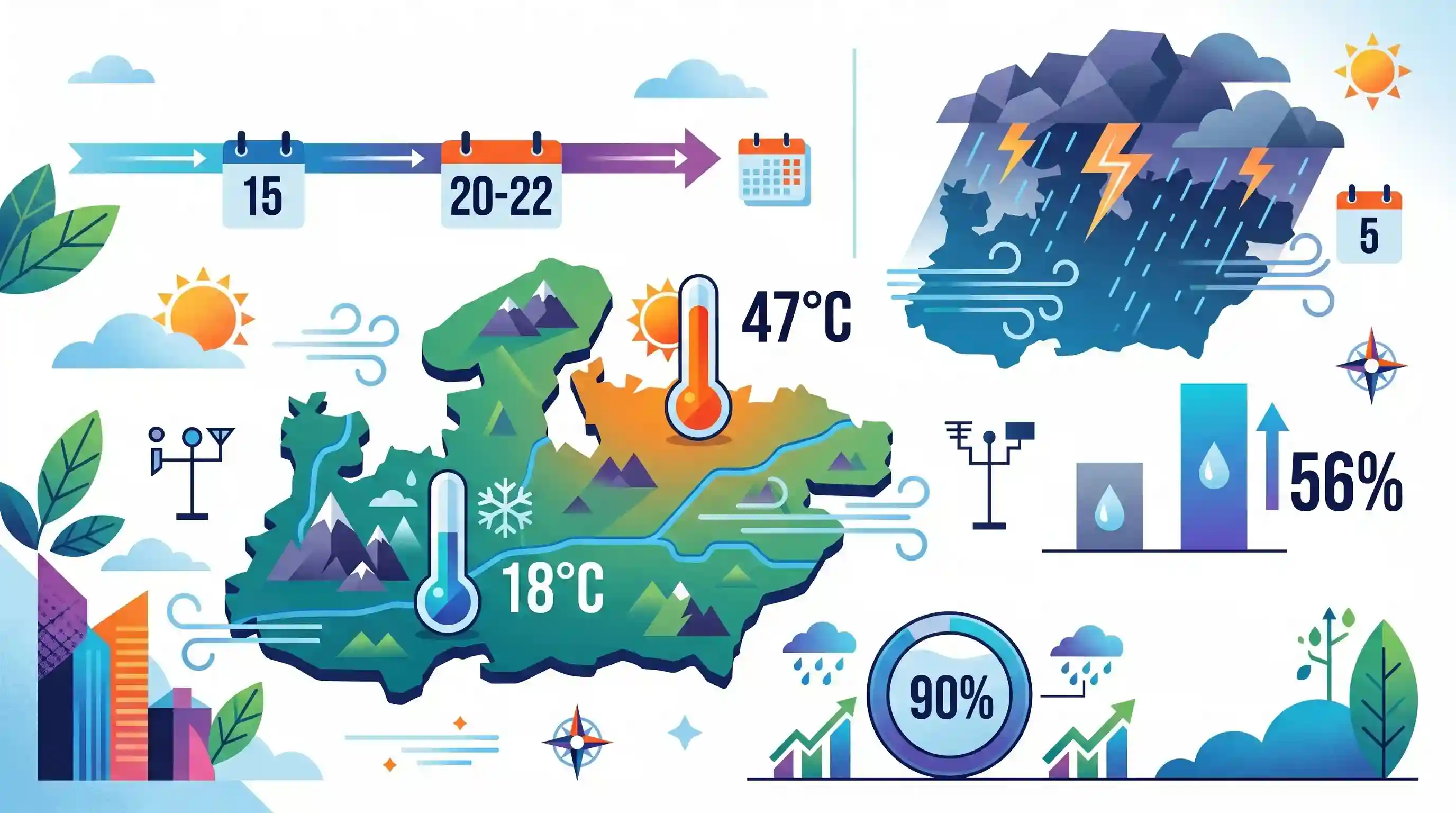
Madhya Pradesh experienced extensive pre-monsoon showers and storm activity on June 5, 2026. The India Meteorological Department (IMD) updated that the southwest monsoon is delayed and expected to arrive in the state around June 20–22, 2026, compared to the normal onset date of June 15. Despite a projected 90% normal monsoon season, MP experienced 56% above-average rainfall in May 2026, coupled with extreme heat in Khajuraho (47°C) and cooler temperatures in the hill station of Pachmarhi (18°C).
Key Points
- Monsoon Arrival Delay: The southwest monsoon is expected to arrive in Madhya Pradesh between June 20 and 22, 2026, which is 5 to 7 days later than the normal onset date of June 15.
- Seasonal Rainfall Projection: The IMD has forecast the seasonal monsoon rainfall for MP in 2026 to be around 90 percent of the long-term average.
- Pre-Monsoon Anomalies: May 2026 saw extreme weather, with rainfall 56 percent above the normal level alongside intense heat waves where Khajuraho recorded temperatures above 47°C.
- Altitude and Temperature: Pachmarhi remained the coolest location in the state, recording a minimum temperature of 18°C, which demonstrates the altitude-based temperature variation characteristic of the region.
- Pre-monsoon Storms: Active pre-monsoon weather brought heavy winds (up to 70 kmph in Bhopal) and showers to more than 20 districts, with Ratlam receiving the highest pre-monsoon precipitation of 1.5 inches in a 24-hour window.
Important Terms
India Meteorological Department (IMD)

The principal government agency under the Ministry of Earth Sciences responsible for meteorological observations, weather forecasting, and monitoring seismology in India.
UPSC context
GS Paper I (Physical Geography) and GS III (Disaster Management); tests key national climate and forecasting institutions.
Southwest Monsoon
The moisture-laden seasonal wind system that blows from the southwest direction, delivering roughly 75% to 80% of India's annual rainfall between June and September.
UPSC context
GS Paper I (Indian Physical Geography); tests the mechanics, onset, distribution, and drivers of India's principal monsoon system.
Pre-Monsoon Showers
Convective, local thunderstorms occurring between March and May before the monsoon onset, known regionally by names like Mango Showers, Kaal Baisakhi, or Cherry Blossoms.
UPSC context
GS Paper I (Indian Climate); tests localized wind and rainfall systems, their geographic distribution, and agrarian significance.
Pachmarhi Biosphere Reserve
A key protected area in Madhya Pradesh's Satpura Range, designated as a UNESCO Biosphere Reserve to conserve Central Indian biodiversity and indigenous tribal culture.
UPSC context
GS Paper III (Environment & Ecology); tests protected area networks, biosphere reserves under UNESCO's MAB, and regional physical geography.
Prelims Trap
Madhya Pradesh receives its monsoon rainfall exclusively from the Arabian Sea branch due to its western-central landlocked position.
While western MP receives significant moisture from the Arabian Sea branch, the southeastern districts (like Balaghat and Mandla) get their maximum rainfall from the Bay of Bengal branch.
Static Concepts Connected
How do the two branches of the Southwest Monsoon interact over Central India?
- Arabian Sea Branch: Enters via the western coast, moving over the Western Ghats and Deccan Plateau to reach western and central Madhya Pradesh.
- Bay of Bengal Branch: Moves up the Bay of Bengal, deflects along the Himalayas, and enters central India from the east, watering eastern and southeastern MP.
- Monsoon Convergence Zone: The two branches merge over northern and central India, creating a zone of intense convective precipitation.
What geographic factors govern the microclimate of Pachmarhi in the Satpura Range?
- Altitude Effect: Situated at ~1,067 meters, it experiences a drop in temperature governed by the normal environmental lapse rate.
- Vegetative Cover: Thick moist deciduous forests act as a local temperature buffer, reducing extreme diurnal variations.
- Local Topography: The surrounding Satpura troughs channel cool mountain breezes during summer nights.
Cross-Topic Patterns
Climate anomalies + Agricultural crop cycles
Delayed monsoon onset shifts the Kharif sowing window, forcing farmers to adopt short-duration varieties to avoid crop damage during late-stage harvesting.
Urban heat islands + Heatwave forecasting
Extreme temperatures like 47°C in tourist hubs underscore the urgency of micro-level heat action plans and urban cooling infrastructure in landlocked states.

Spatio-temporal variations in SW monsoon branches and altitude-based temperature variations in Central India are likely 2026 targets.
Linked PYQs · 4
Linked PYQs · 4
- 2025MPPSC_PRELIMSGS1
Read the following statements regarding the climate of Madhya Pradesh and select the correct answer from the codes given below: 1. Most of the rainfall in the state is received from the monsoon. 2. Wind speed during winters is faster than in summer and rainy seasons. 3. Distance from sea also affects the distribution of monsoon rains in the state. 4. Summer temperature in Pachmarhi is related to the altitude above sea level. Codes:
- 2018MPPSC_PRELIMSGS1
The climate of Madhya Pradesh is
- 2024MPPSC_PRELIMSGS1
The south-eastern part of Madhya Pradesh receives maximum rainfall from :
- 2023MPPSC_PRELIMSGS1
Which of the following statements is not correct regarding the climate of Madhya Pradesh?
