Pre-Monsoon Showers Bring Relief from Heatwaves Across Madhya Pradesh
Source:freepressjournal ↗
Why It Matters
Climate and rainfall patterns of Madhya Pradesh are core areas of the MPPSC Prelims Geography syllabus. This article provides critical factual data regarding the state's average monsoon arrival date (June 15), regional temperature variations (e.g., Khajuraho's extreme summer temperatures), and the meteorological systems (troughs, western disturbances, pre-monsoon activities) that influence local climate anomalies.
Summary
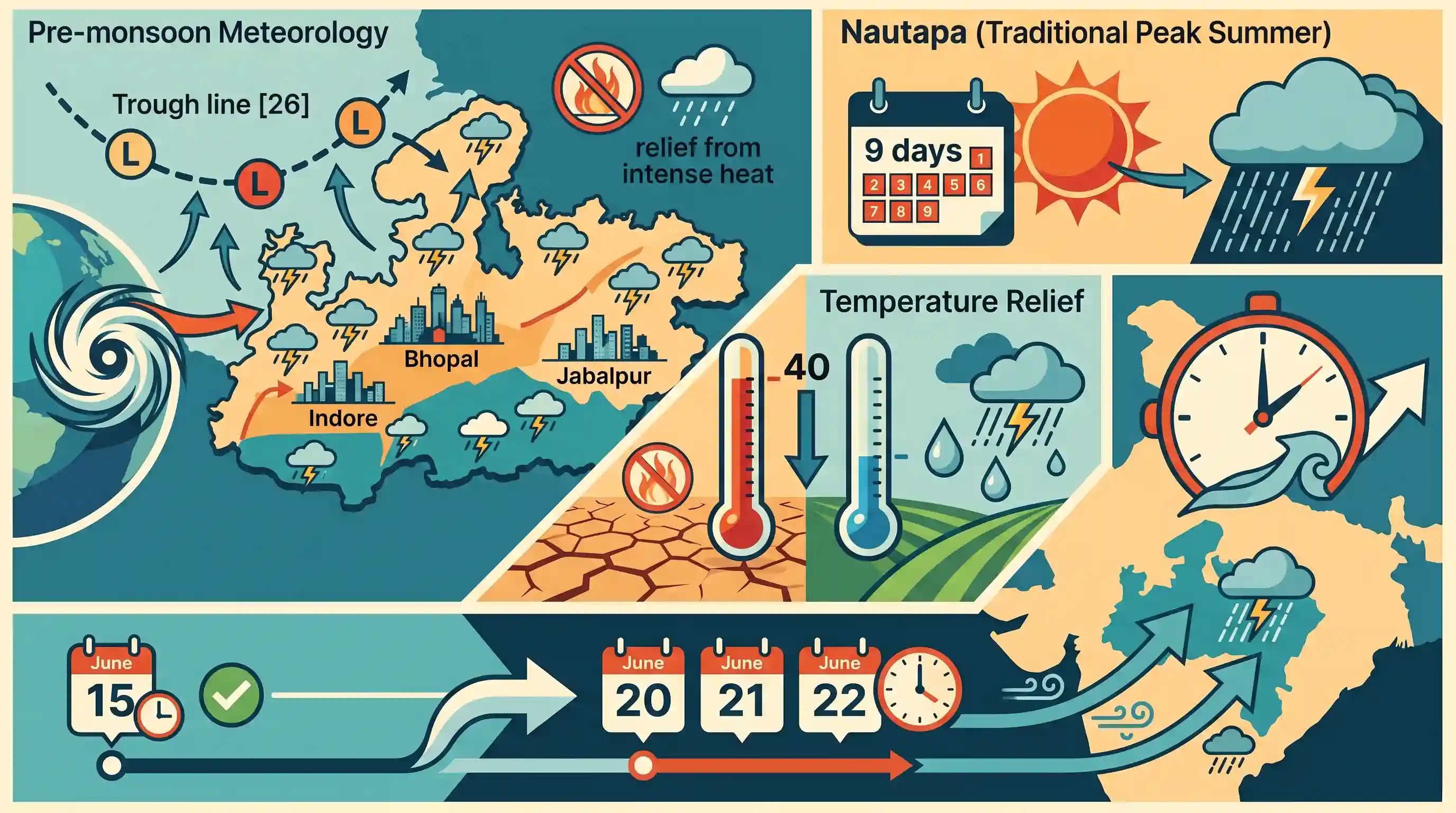
Widespread pre-monsoon rains, a trough system, and a western disturbance have brought significant relief from intense heatwaves across Madhya Pradesh in June 2026, bringing temperatures well below 40°C. Uniquely, the traditional nine-day peak summer period of 'Nautapa' recorded rain and thunderstorms across the state. The Southwest Monsoon is projected to arrive between June 20 and June 22, 2026, slightly delayed from its normal onset date of June 15.
Key Points
- Relief from Heatwaves: Pre-monsoon weather triggers, including a trough system and a western disturbance, ended the severe heatwave in Madhya Pradesh by bringing temperatures down below 40°C across most districts.
- Delayed Monsoon: The Southwest Monsoon is expected to enter Madhya Pradesh between June 20 and June 22, 2026, representing a 5 to 7-day delay from its normal arrival date of June 15.
- Nautapa Rainfall: All nine days of 'Nautapa' (the traditional nine-day period of peak summer heat) witnessed rain or thunderstorms, drastically reducing temperatures by up to 10°C.
- Regional Temperature Relief: Khajuraho, which recorded peak temperatures above 47°C in May, dropped to 40°C, while other major cities like Bhopal, Indore, Ujjain, Gwalior, and Jabalpur registered temperatures between 37°C and 38.7°C.
Important Terms
India Meteorological Department

India's principal government agency under the Ministry of Earth Sciences, established in 1875. It is responsible for meteorological observations, weather forecasting, seismology, and issuing early warnings for hazardous weather events like monsoons and cyclones.
UPSC context
GS Paper I (Geography) & GS Paper III (Disaster Management); tests knowledge of key national scientific bodies and their forecasting mandates.
IMD
The abbreviation for the India Meteorological Department, the nodal agency of the Government of India for weather forecasting, climate services, seismology, and issuing alerts for extreme events like heatwaves, coldwaves, and tropical cyclones.
UPSC context
GS Paper I (Geography) & GS Paper III (Disaster Management); tests awareness of abbreviation, institutional framework, and disaster preparedness in India.
Southwest Monsoon
A seasonal wind system occurring from June to September, driven by differential heating between the Indian landmass and the ocean. It delivers roughly 75% of India’s annual rainfall, crucial for its agrarian economy.
UPSC context
GS Paper I (Climatology/Geography); tests understanding of the seasonal wind reversal mechanism and its massive economic and ecological impacts.
Western Disturbance
An extra-tropical cyclonic storm originating in the Mediterranean region that travels eastward. Guided by westerly jet streams, it brings crucial winter and pre-monsoon precipitation to northwest and central India, benefiting Rabi crops.
UPSC context
GS Paper I (Physical Geography); tests atmospheric circulation patterns, jet stream interactions, and their agricultural relevance in northern India.
Nautapa
A traditional nine-day period of peak summer in India, beginning when the Sun enters the Rohini constellation. Historically associated with extreme heat, its temperatures are traditionally linked to subsequent monsoon strength.
UPSC context
GS Paper I (Geography/Cultural Meteorology); tests indigenous weather concepts, seasonal peak summer indicators, and local climate folklore.
Monsoon Trough
A low-pressure area and portion of the Inter-Tropical Convergence Zone (ITCZ) that shifts over the Indo-Gangetic plains during the summer. Its movement and positioning fundamentally dictate the distribution of rainfall across India.
UPSC context
GS Paper I (Geography - Climatology); tests understanding of the ITCZ, low-pressure troughs, and active-break cycles in the monsoon.
Prelims Trap
Western Disturbances are strictly winter phenomena restricted to northwestern India and do not affect Central India's summer temperatures.
While Western Disturbances are primary drivers of Northwest India's winter rain, they regularly penetrate Central India during pre-monsoon months, triggering thunderstorms and cooling heatwaves.
Static Concepts Connected
What is the mechanism of the Southwest Monsoon onset in India?
- Thermal Low: The heating of the Tibetan Plateau and North-Central Indian landmass creates a strong thermal low-pressure cell.
- ITCZ Movement: The Inter-Tropical Convergence Zone (ITCZ) shifts northward to the Indo-Gangetic plains, acting as a massive trough that pulls southern hemisphere winds.
- Jet Stream Shift: The subtropical westerly jet stream must withdraw completely from south of the Himalayas, allowing the tropical easterly jet stream to establish over the peninsula.
How do Western Disturbances influence Indian weather outside of winter?
- Origin: These are non-monsoonal precipitation patterns driven by the westerlies, originating over the Mediterranean Sea.
- Transitional Role: While peak activity is in winter, they occasionally interact with local convection/troughs in late spring, leading to unseasonal pre-monsoon rainfall and sudden drops in heatwave temperatures.
Cross-Topic Patterns
Indigenous Weather Wisdom vs Meteorology
The cultural concept of 'Nautapa' directly correlates with scientific solar insolation models, where intense land heating creates the crucial low-pressure zone that pulls the Southwest Monsoon inland.
Monsoon Shifts and Agricultural Security
Delayed monsoons coupled with unseasonal pre-monsoon rainfall disrupt the critical heat accumulation phase, forcing a shift in Kharif sowing schedules and cropping patterns in Central India.

UPSC may test the interaction between transitional Western Disturbances and the thermal low-pressure systems critical for monsoon onset.
Linked PYQs · 5
Linked PYQs · 5
- 2018MPPSC_PRELIMSGS1
The climate of Madhya Pradesh is
- 2025MPPSC_PRELIMSGS1
Read the following statements regarding the climate of Madhya Pradesh and select the correct answer from the codes given below: 1. Most of the rainfall in the state is received from the monsoon. 2. Wind speed during winters is faster than in summer and rainy seasons. 3. Distance from sea also affects the distribution of monsoon rains in the state. 4. Summer temperature in Pachmarhi is related to the altitude above sea level. Codes:
- 2022MPPSC_PRELIMSGS1
Which of the following statements regarding the climate of Madhya Pradesh is not correct?
- 2023MPPSC_PRELIMSGS1
Which of the following statements is not correct regarding the climate of Madhya Pradesh?
- 2024MPPSC_PRELIMSGS1
The south-eastern part of Madhya Pradesh receives maximum rainfall from :
