Southwest Monsoon Expected to Cover Remaining Madhya Pradesh Districts
Source:free-press-journal ↗
Why It Matters
The climate and rainfall patterns of Madhya Pradesh are core topics under the MPPSC Prelims GS Paper 1 syllabus. Understanding the division of rainfall (Arabian Sea and Bay of Bengal branches), regional temperature variations (like the sub-tropical climate of Gwalior), and the state's monsoon patterns is critical as these topics are regularly tested in previous exams.
Summary
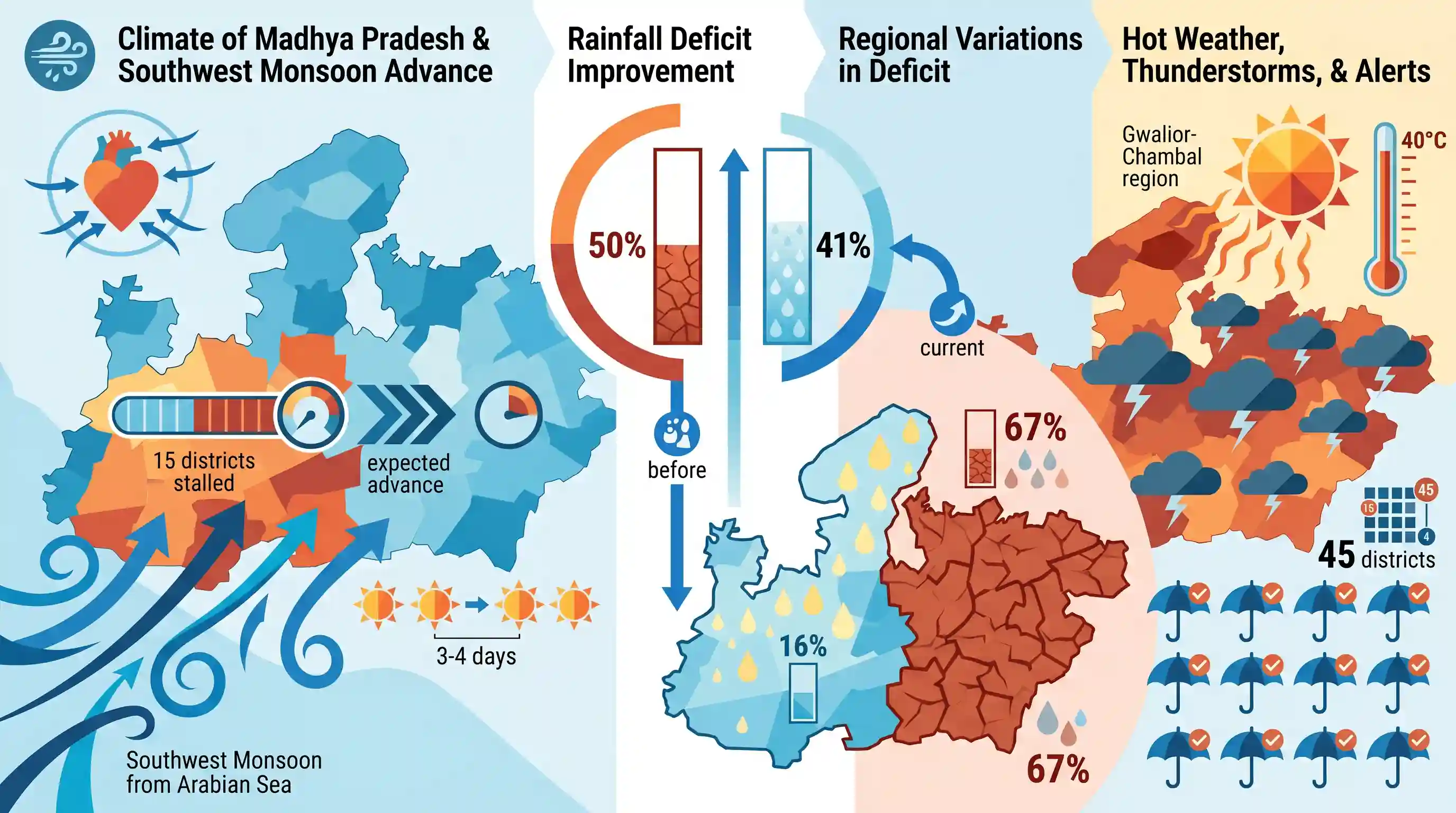
The article outlines weather updates for Madhya Pradesh as of June 28, 2026. After stalling in 15 districts, the Southwest Monsoon is expected to advance across the rest of the state in 3-4 days. Despite recent rainfall improving the deficit from 50% to 41%, there is a stark regional disparity: Eastern MP is suffering a severe 67% rainfall deficit, while Western MP is at a 16% deficit. Hot weather conditions continue in the Gwalior-Chambal region with temperatures over 40°C, while widespread thunderstorms and rain alerts have been issued for 45 districts.
Key Points
- The Southwest Monsoon is projected to advance further into Madhya Pradesh within 3 to 4 days after stalling in 15 districts.
- The state faces an overall rainfall deficit of 41% from June 1 to June 28, 2026, receiving 63.5 mm against the historical normal of 107.3 mm.
- The deficit is highly uneven: Eastern Madhya Pradesh has a severe 67% deficit below normal, while Western Madhya Pradesh is 16% below normal.
- High temperatures exceeding 40°C persist in the Gwalior-Chambal region as the monsoon has not yet reached the northern parts of the state.
- The IMD has issued rain, thunderstorm, and lightning alerts for 45 districts across Madhya Pradesh, including Bhopal, Indore, Jabalpur, and Ujjain.
Important Terms
India Meteorological Department (IMD)

India's principal agency for meteorological observations, weather forecasting, and seismology under the Ministry of Earth Sciences, providing crucial warnings for natural disasters.
UPSC context
GS Paper I (Geography) and GS Paper III (Disaster Management); tests institutional framework and disaster preparedness.
Southwest Monsoon
A seasonal wind system blowing from the southwest across the Indian Ocean (June–September), bringing major rainfall and serving as the lifeline of India's agricultural economy.
UPSC context
GS Paper I (Geography - Climatology); tests understanding of monsoon mechanisms, its branches, and impacts.
Long Period Average (LPA)
The multi-decade mean rainfall (presently based on the 1971–2020 average of 86.8 cm) used by the IMD as a benchmark to gauge monsoon performance.
UPSC context
GS Paper I (Geography) and GS Paper III (Agriculture); tests understanding of forecasting parameters and monsoon variability.
Monsoon Trough
An elongated low-pressure zone extending from northwest India to the Bay of Bengal, whose north-south oscillation significantly determines rainfall distribution across the country.
UPSC context
GS Paper I (Geography - Indian Physical Geography); tests knowledge of pressure systems and rainfall distribution.
Rainfall Deficit
A meteorological scenario where actual rainfall is significantly below the historical average (LPA), classified as "deficient" by the IMD when the deficit exceeds 10%.
UPSC context
GS Paper I (Geography) and GS Paper III (Agriculture); tests knowledge of agricultural droughts and food security.
Prelims Trap
Madhya Pradesh receives its monsoon rainfall exclusively from the Arabian Sea branch due to its geographical proximity to the western coast.
Madhya Pradesh is a classic transition zone receiving precipitation from both the Arabian Sea and Bay of Bengal branches, with the eastern region relying heavily on the latter.
Static Concepts Connected
How do the two branches of the Southwest Monsoon interact over Central India?
- Arabian Sea Branch: Sweeps over the west coast, channeling moisture through the Narmada and Tapti troughs to rain over Western MP.
- Bay of Bengal Branch: Moves through the Bengal and Odisha plains, supplying heavy rainfall to Eastern and South-eastern MP.
- Merging Zone: The two branches converge over the northern plains of MP and adjoining Uttar Pradesh, causing highly variable rainfall.
Cross-Topic Patterns
Monsoon variability + Kharif sowing
Severe early-season deficits (like 67% in Eastern MP) delay sowing of water-intensive crops like paddy and soybean, forcing farmers toward low-yield contingency crops.
River basins + Regional deficits
Disparities in monsoon distribution accelerate the demand for inter-basin river linking projects, like Ken-Betwa, to mitigate localized drought conditions.

UPSC may target the precise merging zones of the Arabian Sea and Bay of Bengal monsoon branches over the Central Indian highlands.
Linked PYQs · 4
Linked PYQs · 4
- 2018MPPSC_PRELIMSGS1
The climate of Madhya Pradesh is
- 2025MPPSC_PRELIMSGS1
Read the following statements regarding the climate of Madhya Pradesh and select the correct answer from the codes given below: 1. Most of the rainfall in the state is received from the monsoon. 2. Wind speed during winters is faster than in summer and rainy seasons. 3. Distance from sea also affects the distribution of monsoon rains in the state. 4. Summer temperature in Pachmarhi is related to the altitude above sea level. Codes:
- 2024MPPSC_PRELIMSGS1
The south-eastern part of Madhya Pradesh receives maximum rainfall from :
- 2021MPPSC_PRELIMSGS1
Which one of the following statements is not correct regarding the climate of Madhya Pradesh?
