Monsoon Delayed in Madhya Pradesh with Significant Rainfall Deficit
Source:freepressjournal ↗
Why It Matters
Monsoon delays and rainfall disparities heavily influence agricultural activities, crop sowing (Kharif crops), and water supply planning in Madhya Pradesh, which is a key area of study for MP Geography and Economics in the MPPSC State Service Prelims.
Summary
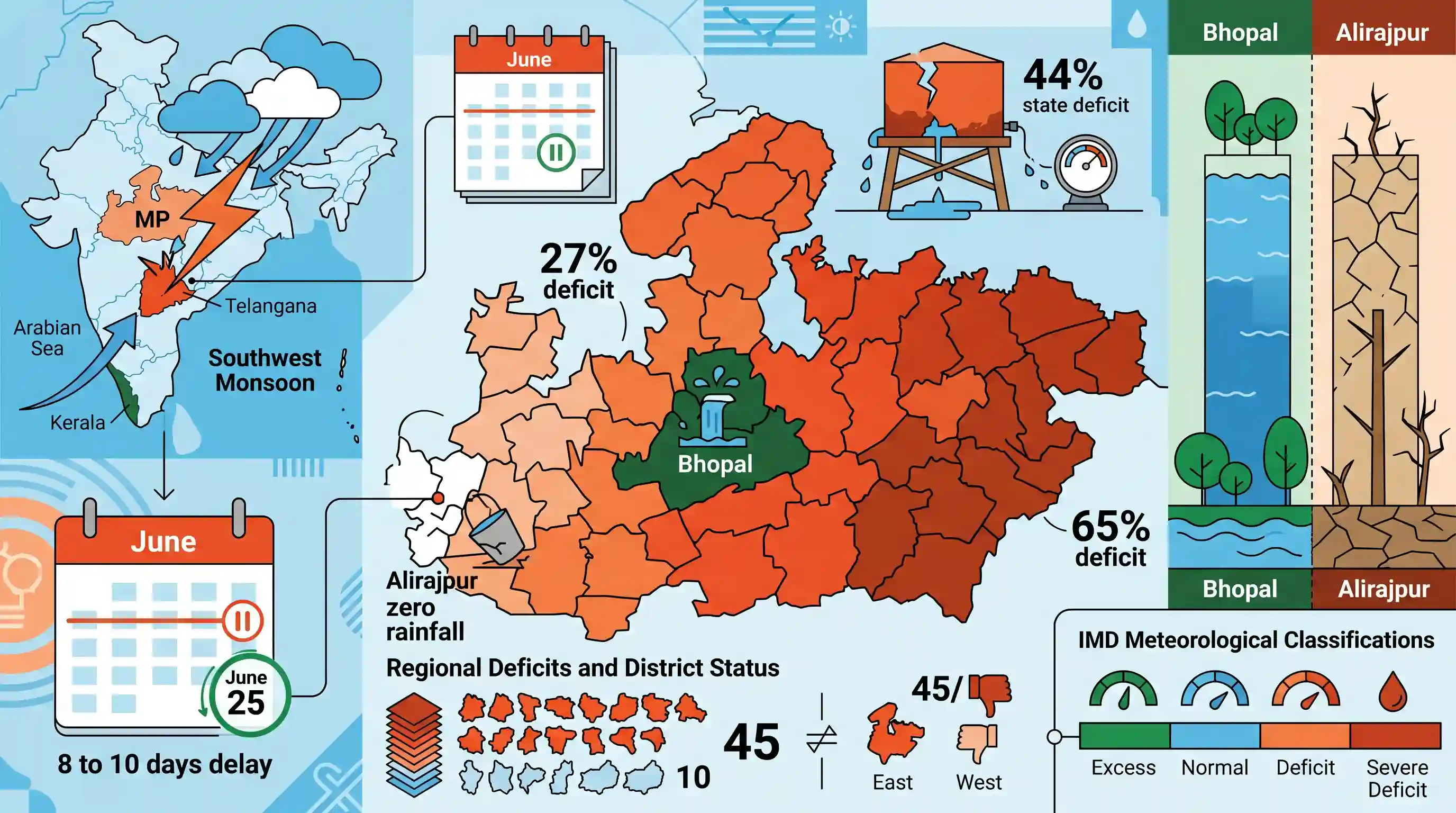
The Southwest Monsoon's arrival in Madhya Pradesh has been delayed by 8 to 10 days in 2026, with arrival expected around June 25 due to a stall over Telangana. This has resulted in a 44% rainfall deficit across the state, with the eastern region suffering a 65% shortfall and the western region facing a 27% deficit. Out of the state's 55 districts, 45 have below-normal rainfall. Bhopal is an outlier with 62% excess rainfall, whereas Alirajpur has recorded zero rainfall.
Key Points
- The Southwest Monsoon's entry into Madhya Pradesh is delayed by 8–10 days, with the onset expected around June 25, 2026, instead of the normal June 15.
- The delay is caused by the monsoon stalling over Telangana since June 8, leading to a 44% overall rainfall deficit in Madhya Pradesh during June so far.
- Out of 55 districts in Madhya Pradesh, 45 have reported below-normal rainfall.
- The eastern region (comprising Jabalpur, Rewa, Shahdol, and Sagar divisions) faces a severe 65% deficit, whereas the western region (Bhopal, Indore, Ujjain, Gwalior, Chambal, and Narmadapuram divisions) has recorded a 27% deficit.
- Bhopal has registered a 62% excess rainfall (4 inches compared to the average of 2.5 inches), making it the best-performing district.
- Alirajpur is the only district in the state that has recorded zero rainfall so far this season.
Important Terms
India Meteorological Department (IMD)

The principal government agency under the Ministry of Earth Sciences responsible for meteorological observations, weather forecasting, seismology, and early warnings of hazardous weather events in India.
UPSC context
GS Paper I (Geography) and GS Paper III (Disaster Management). Tests institutional frameworks for weather monitoring and climate preparedness.
Southwest Monsoon
A seasonal wind system blowing from the southwest, active from June to September, bringing nearly 70–75% of India's annual rainfall, vital for agriculture and the economy.
UPSC context
GS Paper I (Physical Geography). Tests understanding of atmospheric dynamics, wind reversals, and socio-economic impacts on Indian agriculture.
Long Period Average (LPA)
The benchmark long-term average rainfall recorded over a specific region for a given interval (like 30 or 50 years) used by IMD to smooth out annual variations and predict monsoon behavior.
UPSC context
GS Paper I (Physical Geography). Tests understanding of climatological metrics used to classify rainfall deviations and predict droughts.
Rainfall Deficit
A condition where actual seasonal rainfall falls below the Long Period Average (LPA). It is classified as "deficient" by the IMD when the shortfall is between 19% and 59% of the LPA.
UPSC context
GS Paper III (Agriculture and Disaster Management). Tests knowledge of crop failure risks, water resource scarcity, and drought mitigation policies.
Monsoon Onset
The official declaration of the start of the Southwest Monsoon, determined by IMD using specific parameters after May 10, including rainfall at 14 designated stations, wind field depth, and outgoing longwave radiation.
UPSC context
GS Paper I (Climatology). Tests technical parameters of atmospheric transitions, westerly winds, and seasonal onset criteria.
Prelims Trap
Madhya Pradesh receives its monsoon precipitation exclusively from the Arabian Sea branch due to its geographic proximity to India's west coast.
Madhya Pradesh receives rainfall from both the Arabian Sea and Bay of Bengal branches. The eastern part is heavily fed by the Bay of Bengal branch, not just the Arabian Sea.
Static Concepts Connected
Why does Madhya Pradesh receive rainfall from two distinct branches of the Southwest Monsoon?
- Arabian Sea branch: The Arabian Sea branch enters Central India via the Narmada-Tapti rift valleys, bringing rain primarily to the western Malwa plateau region.
- Bay of Bengal branch: The Bay of Bengal branch moves up the Indo-Gangetic plains and deflects southwestward, supplying significant precipitation to eastern and southeastern districts.
- Zone of convergence: These two air masses frequently merge over the Central Highlands, causing prolonged convective rainfall during normal monsoon years.
What is the difference between a monsoonal 'stall' and a monsoonal 'break'?
- Monsoonal Stall: A temporary halt in the forward march of the Northern Limit of Monsoon (NLM) during its advancement phase, often caused by weak pressure gradients.
- Monsoonal Break: A prolonged dry spell after the monsoon is fully established, occurring when the monsoon trough shifts northwards toward the Himalayan foothills.
Cross-Topic Patterns
Rainfed agriculture and crop-sowing delays
Delayed monsoons in Central India shift the sowing window for vital kharif crops like soybean, elevating seed failure risks and disrupting rural agricultural credit cycles.
Micro-irrigation and groundwater recharge limits
Regional monsoon stalls highlight the vulnerability of decentralized water harvesting structures like farm ponds, which rely on early June showers to prevent severe groundwater depletion.

GS-I 2026 will likely test the physical mechanisms of monsoonal stalling versus active-break cycles and their impact on Central India.
Linked PYQs · 3
Linked PYQs · 3
- 2018MPPSC_PRELIMSGS1
The climate of Madhya Pradesh is
- 2025MPPSC_PRELIMSGS1
Read the following statements regarding the climate of Madhya Pradesh and select the correct answer from the codes given below: 1. Most of the rainfall in the state is received from the monsoon. 2. Wind speed during winters is faster than in summer and rainy seasons. 3. Distance from sea also affects the distribution of monsoon rains in the state. 4. Summer temperature in Pachmarhi is related to the altitude above sea level. Codes:
- 2024MPPSC_PRELIMSGS1
The south-eastern part of Madhya Pradesh receives maximum rainfall from :
