Madhya Pradesh Faces Severe Rain Deficit Ahead of Monsoon Arrival
Source:free-press-journal ↗
Why It Matters
Monsoon arrival and regional rainfall variations are critical for agriculture-dependent economies like Madhya Pradesh. MPPSC frequently asks questions on regional rainfall distribution, climate classification, and monsoon branches affecting the state.
Summary
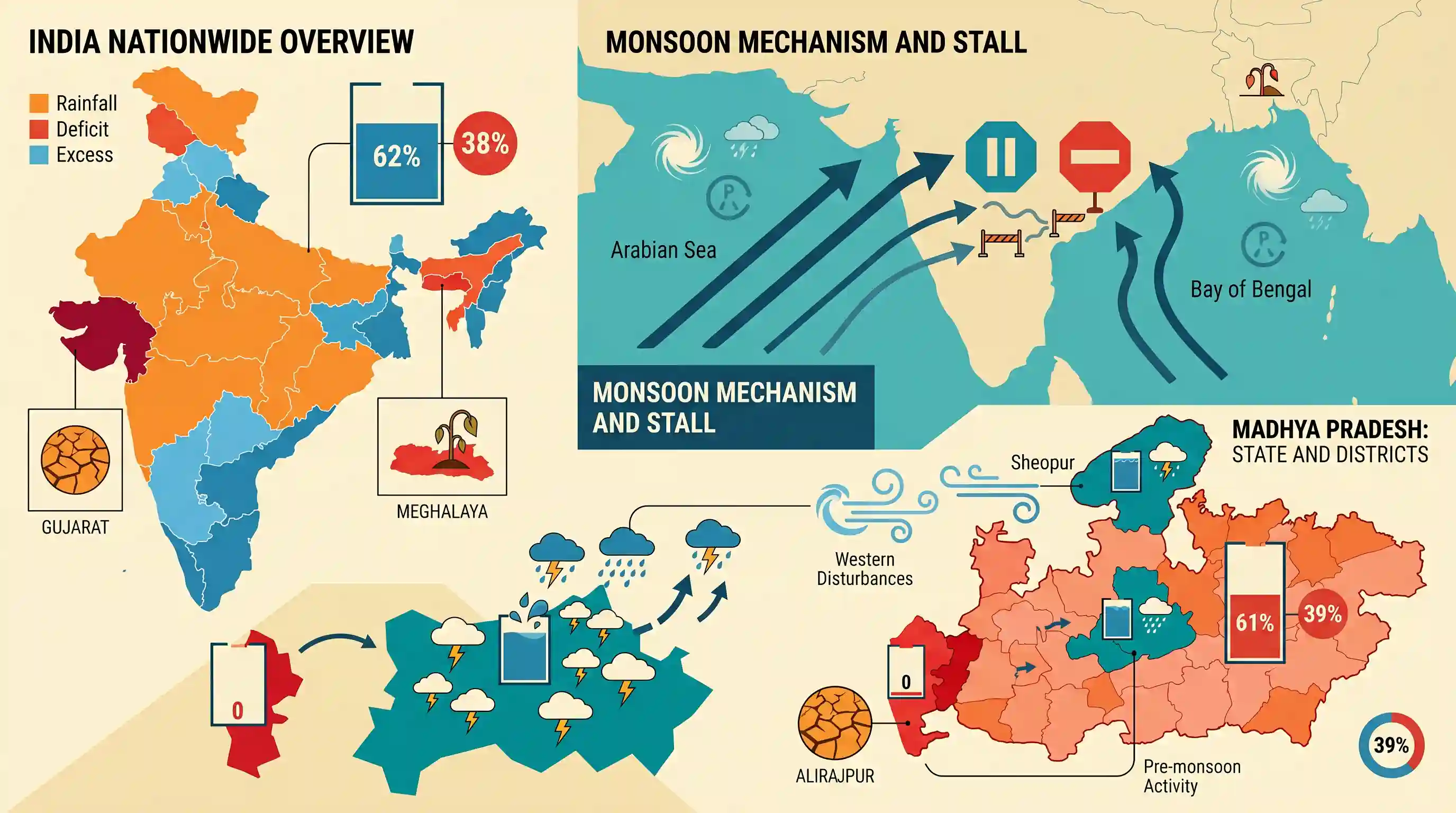
By mid-June 2026, Madhya Pradesh recorded a 39% rainfall deficit due to a stalled southwest monsoon caused by weak weather systems in the Bay of Bengal and Arabian Sea. While Alirajpur recorded zero rainfall, some districts like Bhopal and Sheopur received excess rainfall from pre-monsoon activities and western disturbances. Nationwide, India registered a 38% deficit, with Meghalaya and Gujarat seeing the sharpest shortfalls.
Key Points
- Madhya Pradesh faced a 39% rainfall deficit between June 1 and June 18, 2026, receiving only 28.4 mm of average rainfall compared to the normal average of 46.8 mm.
- Out of 52 districts in MP, 22 recorded rainfall deficits of 50% or more, with Alirajpur district registering zero rainfall during this period.
- Pockets of excess rainfall were observed due to pre-monsoon activity and western disturbances: Sheopur (+128%), Bhopal (+94%), Neemuch (+87%), and Guna (+62%).
- On a national scale, India faced a 38% rainfall deficit up to June 18, 2026. Meghalaya recorded the highest state-level deficit at 86%, followed by Gujarat at 79%.
- Meteorologists attribute the delayed monsoon advance to weak seasonal weather systems over the Bay of Bengal and the Arabian Sea.
Important Terms
India Meteorological Department (IMD)

The principal government agency under the Ministry of Earth Sciences responsible for meteorological observations, weather forecasting, seismology, and early warnings for natural disasters.
UPSC context
GS Paper I (Climatology) and GS III (Disaster Management); tests knowledge of key scientific institutions and warning systems.
Southwest Monsoon
A seasonal wind system blowing from the southwest, bringing nearly 70-75% of India's annual rainfall between June and September, driven by differential heating of land and sea.
UPSC context
GS Paper I (Climatology, Indian Geography); tests mechanism, onset, and spatial-temporal variation of India’s lifeline weather pattern.
Western Disturbance
An extra-tropical storm originating in the Mediterranean region that travels eastward, bringing essential winter and pre-monsoon precipitation, wind, and snow to northwest India.
UPSC context
GS Paper I (Climatology); tests non-monsoonal rain systems and their agricultural importance for northern India's Rabi crops.
Long Period Average (LPA)
The long-term benchmark average of rainfall recorded over a historical period, against which the IMD measures and categorizes current seasonal monsoon performance.
UPSC context
GS Paper I (Physical Geography - Climatology); tests understanding of statistical benchmarks used in measuring climatic variations.
Rainfall Deficit
A shortfall in precipitation below the expected long-term average, officially categorized as deficient by the IMD when actual rainfall is 19% to 59% lower than the LPA.
UPSC context
GS Paper III (Agriculture and Disaster Management); tests understanding of agricultural drought, water stress, and food security.
Prelims Trap
Western Disturbances are strictly winter phenomena restricted to North India and cannot cause pre-monsoon precipitation in Central India.
Intense Western Disturbances can penetrate south up to 15°N, triggering unseasonal convective rain and pre-monsoon activity in Madhya Pradesh.
Static Concepts Connected
What factors cause a stall or delay in the Southwest Monsoon's progress?
- Weak oceanic systems: Absence of strong low-pressure depressions in the Bay of Bengal and Arabian Sea fails to pull the monsoon trough northward.
- Delayed jet transition: Slow northward migration of the subtropical westerly jet stream delays the establishment of the easterly jet over the peninsula.
- Madden-Julian Oscillation: An unfavorable phase of the MJO in the Indian Ocean suppresses local convective activity, weakening the monsoon winds.
How is Madhya Pradesh's climate categorized under the Köppen system?
- Aw and Cwa zones: The state is predominantly Tropical Savanna (Aw) and Humid Subtropical (Cwa), featuring distinct dry winter seasons.
- BSh dry pockets: The northwestern fringes of the state exhibit Hot Semi-Arid (BSh) characteristics due to lower precipitation.
Cross-Topic Patterns
Monsoon delays and kharif cropping
A delayed monsoon alters the sowing window for critical cash crops like soybean, increasing agricultural vulnerability and impacting rural inflation.
Western Disturbances and climate anomalies
Deep-penetrating western disturbances in late spring disrupt regional thermal gradients, directly delaying the seasonal development of the Indian thermal low.

UPSC may couple Western Disturbance latitude limits with Köppen climate zones of Central India to test physical geography depth.
Linked PYQs · 4
Linked PYQs · 4
- 2024MPPSC_PRELIMSGS1
The south-eastern part of Madhya Pradesh receives maximum rainfall from :
- 2025MPPSC_PRELIMSGS1
Read the following statements regarding the climate of Madhya Pradesh and select the correct answer from the codes given below: 1. Most of the rainfall in the state is received from the monsoon. 2. Wind speed during winters is faster than in summer and rainy seasons. 3. Distance from sea also affects the distribution of monsoon rains in the state. 4. Summer temperature in Pachmarhi is related to the altitude above sea level. Codes:
- 2018MPPSC_PRELIMSGS1
The climate of Madhya Pradesh is
- 2020MPPSC_PRELIMSGS1
In which part of Madhya Pradesh annual variation in temperature is maximum?
